Meepo NLS Pro Review – Goodbye Hobbywing.

Following the recent announcement on NLS Pro switching over to LingYi ESC, I figured that an updated review of the board would probably be helpful.
(Just to clarify things up, I did my NLS Pro review by upgrading the internal of NLS to NLS Pro, so I didn’t have the new shock-absorbing griptapes.)

Introduction to NLS Pro

As many already know, NLS Pro is the upgraded version of the original NLS which was priced at $599. It is a hundred bucks more expensive than the now-discontinued NLS, but it has a few important upgrades. The new NLS Pro has a much bigger battery and a new ESC. That means higher speed and smoother control.

It also gets a few upgrades on the parts among which includes upgrading the bushings used to macaroon bushing, change and rechange of ESC and use of a shock-absorbing layer of griptape which would help to make the ride even more comfortable. (I don’t have it)

So it’s ESC was changed twice
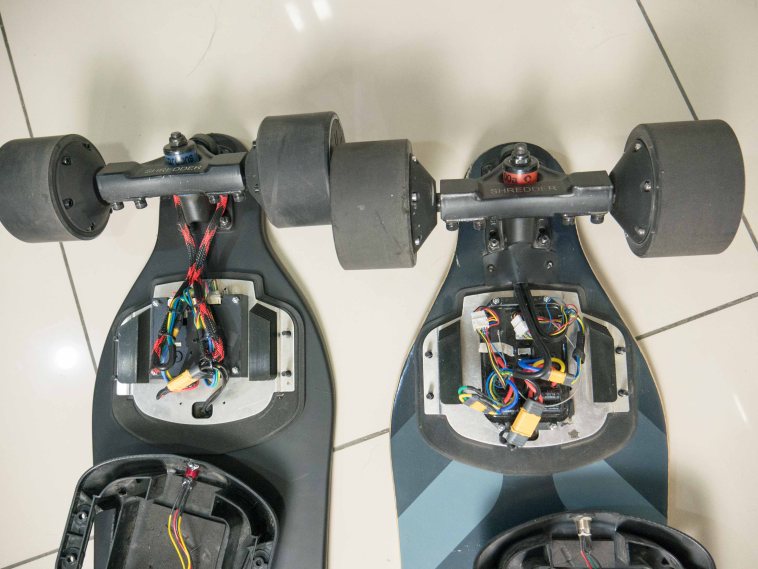
The first change to Hobbywing ESC was a celebrated move, but the recent announcement of yet another ESC change to the new iteration of LingYi ESC is a move that I took with mixed feelings. In my V3 review, I mentioned that LingYi ESC of the V3 came very close to Hobbywing ESC in terms of smoothness and was superior in braking, however, that 5% difference in smoothness does translate to an absolute refined experience vs a smooth ride with some grain to it. 

While the brake is indeed improved with the switch to Ling Yi ESC, the complaint on Hobbywing’s ‘weak’ brakes is one that I heard from friends who tried mine NLS Pro but a view I do not share. After trying countless Hobbywing boards from the 1st gen Hobbywing in the likes of Wowgo 2s, Ownboard W1s, and coming to the 2nd gen AKA Turbo generation Hobbywing like the Backfire G2T, Wowgo 3 and NLS Pro; Hobbywing ESC on NLS Pro is amongst the strongest with no sacrifice on smoothness. 

Although I see why those who are accustomed to strong brakes may find the brake on this Hobbywing ESC weak, I see that as nitpicking and am pretty sure most wouldn’t mind. But what to do, what’s done’s done.


It is important to point out that braking strength in LingYi ESC is adjustable. 1st brake mode offers the same tame brakes of the Hobbywing ESC.
2nd brake mode and above are smooth but significantly stronger. I personally would not go to mode 3 or 4 as I find them excessively strong for safe use.

Another interesting talking point after the change to LingYi ESC is that the 4th acceleration mode (AKA Pro mode) gives a more thrilling and punchy acceleration. I put both ESC on a side by side comparison and it was clear to me that punchier acceleration doesn’t equate to faster acceleration. New LingYi felt aggressive, but it wasn’t exactly faster. Hobbywing ESC in the old NLS Pro is smooth yet as fast as the new LingYi ESC on Pro mode, which becomes smooth only after the initial jerk. This is not to say that LingYi ESC wasn’t good, it’s just that the old Hobbywing ESC is freaking good.

To summarize, the ESC changes give NLS Pro yet another personality change. It converts NLS Pro from a calming comfortable ride to something more edgy and thrilling. Less boring, some had said. (For me? Boring is good.)

While the changes in control may make some happy and some sad, I’m pretty sure the addition of ‘push to turn on’ feature following the ESC change is going to be universally welcomed. ‘Push to turn on’ is a super underrated feature and I’m sure anyone who had tried that feature feels the same.

Handling

Aside from my disagreement on the change brought by the latest ESC change, NLS Pro is pretty awesome in any other aspects.
Having a bigger 100mm wheels and a very flexible deck reduced vibrations from rough roads as much as possible. Many hate hubs because of that thin urethane layer, big hub wheels in NLS Pro addressed that as much as any hub board could.
The most frequent complaint on the original NLS is the wobbliness, which I notice could be solved by changing to a harder and better bushing. With the NLS Pro, Meepo addressed the issue by upgrading to a better bushing that they named as Macroon. 100a Macroon bushing solved the wobbliness for me while still allows the NLS Pro to carve comfortably. This double tall Macroon bushing actually works better than my purple nipples on the shredder trucks (probably because nipples are not double tall bushing and shredder trucks were supposed to pair with double tall. =P). I’m no bushing expert, so I can’t explain why it works so well but it does work, NLS Pro now carves like a dream and still handles top speed like a champ.

Speaking of top speed, this board goes 32mph (51kmh). Crazy! I was able to hit that too! But honestly, 25mph (40kmh) is where my comfort zone ends and although NLS Pro is pretty stable even when pushed to the limit, no way I am staying there.

Wowgo 3 has been dubbed the best carving board of the mid-tier segment with its buttery smooth control and Paris truck set-up. With that said, to compare the smoothness and carving between Wowgo 3 and NLS Pro when it was with Hobbywing ESC is like splitting hair. I personally will take Hobbywing NLS Pro over Wowgo 3 as best carving board.

Just hear me out, Hobbywing NLS Pro is every bit as smooth while much more powerful than the Wowgo 3. It has faster acceleration and stronger brakes. Deck on NLS Pro is more flexible and to me felt better than the one on Wowgo 3. Wowgo 3’s Paris trucks theoretically should be better than the Shredder trucks with Macroon bushing, but honestly, I couldn’t tell. Again, it is like splitting hair. The real difference will be in the wheels size, 100mm wheels on the NLS Pro VS 90mm on Wowgo 3. Smaller wheels ride closer to the ground while with 100mms on NLS Pro I float abit higher.

However, now with LingYi’s NLS Pro, the 5% loss in smoothness after the switch to LingYi ESC lose the new NLS Pro that comparison due to that tiny setback in smoothness. It’s now have significantly better brakes, but on the question are “which one is most buttery smooth?” Wowgo 3 retook the crown.

Specs

When it comes to specs and number, Meepo NLS Pro is without a doubt, one of the best.

Using an 8AH pack of Samsung 40T in a 10s2p setting (288wh), the NLS hits 20miles (32km) range and that 32mph (51kmh) top speed for me. This number is pretty high up there compares to any boards and outside of those high premium boards, only Raptor 2 can best that numbers!

As always, Meepo might not win it all in terms of refinement and polish but it has without fail always having the top performance in its class.

Again, 100mm wheels are practically semi-AT

Conclusion

So, what is the verdict for the NLS Pro with LingYi ESC?

At $699, the NLS Pro is amazing both on paper and in actual riding.
It outperformed its peers in both top speeds, acceleration, and range.
It has good strong brake and control that leans on the aggressive side.
It is very enjoyable in both aggressively ride or comfortable carve.

What more can you ask for?
(Me: I want that 5% of smoothness in acceleration back…)

Check-out Meepo NLS Pro here.

Apsuboards introduce Apsuboard All Terrain GTR Dual

In line with customers changing preferences, more and more manufacturers are jumping on the all-terrain bandwagon. This comes as no surprise as an all-terrain setup is more usable in less than ideal roads. But a mountainboard is a different beast altogether, which allows the rider to conquer all types of terrains. 

Capitalizing on their know-how on belt-driven longboards, Apsuboard has taken their first crack at making an all-terrain board, more specifically, an electric mountainboard. While have seen some all-terrain belt driven boards such as Ownboard Carbon AT, WowGo All-Terrain and the newly announced Backfire Ranger X2, they are no Mountainboards.

While all-terrain hub boards are pretty common now, many still prefer a belt-driven drivetrain for an all-terrain board as produce higher torque for having gear reduction, and torque is difficult to compromise on when it comes to AT.

Let’s have a quick look at what the Apsuboard GTR is.

The motors utilized is a 6384 which is a good size in view of the expected stress that would be put upon a mountainboard. With 3450W total from the dual motors, this should slingshot you from bend to bend with adequate ease.

Battery wise, the AT GTR Dual uses a pack of Samsung 35E battery in 10S5P configuration (630Wh 17.5AH). Apsuboard claims this is adequate to power the board up to a Cruising Range of 40KM (24.85 miles). Expect lower miles on extreme terrains. Although we prefer Samsung 30Q, the recently launched Evolve GTR proved that 35E is not too shabby.

As intended from a mountainboard, a pair of channel trucks with springs is utilized up front and back. The quality of the trucks, especially on a mountainboard, is important for safety, stability and maneuverability reason. The one on the GTR seems to be the typical mountainboard trucks that lean towards stability rather than maneuverability but it’s difficult to tell without actually stepping on one.

From our previous stint with Apsuboard X1, we remarked the choice of using a LingYi ESC(old version) was an Achilles heel to an otherwise outstanding value board. Apsuboard was quick to point out upon our inquiry that the new GTR will be using an updated ESC which is different but it’s not Hobbywing. The verdict is still out on that matter until we have our own review unit. It is interesting to note that the new and cheaper Apsuboard SP2 longboard is using a customized Hobywing instead of LingYi ESC. 

Pushing into the 4 digits price barrier at 1299 USD, not many Chinese manufacturers can claim success within this price range. However, if one wants a true electric mountainboard, this is probably the minimum price of admission. Spec-wise, the price is appropriate with the collection of parts provided but whether it all comes together in a compelling package is soon to be seen. I mean, what are the alternatives? The cheaper but weaker and less refined DIYEboard?

Well… it’s an option.

All things aside, Apsuboards willingness to innovate and push their product line is surely commendable. This remains the first & only electric mountainboard by the Chinses manufacturers. Perhaps this is the start of something greater for Apsuboard and the community at large will benefit too.

Check out Apsuboard AT GTR Dual by clicking here.

Flipsky releases Dual FSESC 6.6 Mini and VX2 remote

On 18th July 2019, Flipsky announced the release of a new ESC FSESC 6.6 Mini and around the same time, they’ve also put up the new VX2 remote for preorder.

Dual FSESC 6.6 Mini ($229)

I think Flipsky needs no elaborative introductions as they are pretty well known for their VESC. For those who don’t know, they are amongst the top options when it comes to VESC, competing with the industry leader Focbox Unity. Many DIYer chose Flipsky for it’s budget friendlier price and instant availability. (Hey Enertion, am still waiting for my Unity..)

Dual FSESC 6.6 Mini is the mini version of their top of the line product – Dual FSESC 6.6 with heatsink. However, besides the smaller footprint (81mm x 77mm x 20mm), Mini has a few more changes:

  • 1 extra UART port (2 in total).
  • Removed switch button.
  • And some upgrade on the more technical stuff like cables and MOSFET design.

Anyhow, here are the specs:

  • Hardware: V 6.6
  • Voltage: 8V – 60V (Safe for 3S to 12S LiPo) for the dual ESC
  • Voltage spikes may not exceed 60V
  • Current: Continuous 100A single, total 200A,
    Instantaneous current 400A per single, total 800A for system instantaneous current.
  • 5V 1.5A output for external electronics for single
  • 3.3V 1A output for external electronics for single
  • Modes: DC, BLDC, FOC (sinusoidal)
  • Supported sensors: ABI, HALL, AS5047
  • 6 shunts in a dual system. Each is measurable for the current.

You can check out the Dual FSESCS 6.6 Mini by clicking here.

VX2 Remote ($99 $79)

When it comes to remote, the old Flipsky’s VX1 was considered the best. It’s comfortable in hand, the throttle wheel has good travel, there is board-battery indicator, cruise control function, reverse mode & speed modes.

Well, Lacroix certainly agrees that VX1 was the best option as they uses VX1 in their Jaws and Nazares line-ups.

The new VX2 which is due to ship on 15th August are all that plus a screen for telemetry. The screen-on-the-top-of-the-remote set up reminds me of the R2 remote, which is a good design unlike the popular screen on the side of the remote set-up which is useless for left-handers.

You can check out the VX2 remote by clicking here.

Chargiot Bomb – Boom or Bust?

Foreword and Introductions

Chargiot was not a brand under my radar when they first approached me to review this particular product – Chargiot Bomb. Apparently, they have been around for almost a year now, selling via Amazon and resellers such as www.ElectricSkateHQ.com (which has totally no connection with us, I am serious in this one.)

Initially reluctant to take on the review as I have just done one on a very similar product in Yecoo GT, Alex from Chargiot assured me that this is not a regular DIYeboard AT setup. This is something with a much more powerful battery, as well as motors which come with an App that allows tuning of the ESC. So I took the review.

After putting this big guy with flamboyant graphic design through its paces, these are my thoughts on it.

Chargiot Bomb

These are the marketed specs of the Chargiot Bomb:

  • Top Speed: 30mph/ 48kmh
  • Range: 15mil/ 24km
  • Weight: 22lbs/ 10kg
  • Charge Time: 4.5hrs
  • Features: 2 x 2400W motors, regenerative braking, handles up to 30% slope, Remote with telemetry, All Terrain ability, Bluetooth speakers.
  • Price: 999USD with shipping included.

Unboxing

Despite the very “in your face” design of the site and the board, the box and package come as plain as it could be. The board is well protected with foams and that’s all that matters really.

The board comes with a bash guard, a T-tool and the charger.

Riding Experience:

Acceleration and Deceleration

Chargiot Bomb uses LingYi ESC and as its typical fashion, it comes with 4 acceleration modes and 4 braking modes. Chargiot added a little bit extra by allowing further adjustment of acceleration and braking (another 4 levels of adjustment on acceleration, braking and gearing).

Straight out of the box, Chargiot had all the settings adjusted to the highest power and that translated into less than perfectly smooth acceleration and weak to suddenly strong braking.

same issue here.

After failing to use the application from android and ending up borrowing an iPhone to adjust the setting, I managed to find a setting that I can live with.

With the adjusted setting, both the acceleration and braking are okay. It’s not perfectly smooth but not jarring either. Average, I would say. One particular trouble that I have is the board will give a jolty start when accelerating from a stop. Chargiot Bomb couldn’t transit from a halt to moving smoothly.

Stability

That said, however, my biggest gripe on the Chargiot Bomb is not the control but the set-up of the board. Most importantly, the biggest of all deck choice. Chargiot picked a 38.5 inches(98cm) deck with Kicktail, and while having a kicktail is one of the unique features that Bomb has, having a kicktail eats into the length of the wheelbase. What’s worse, one couldn’t practically place one’s foot on top of where the truck is because the AT wheels will bite into your shoes and the functional wheelbase is even shorter. At the end of the day, I was forced to ride with a stance not wider than I can have on a shortboard, which doesn’t help with balance.

The problem is compounded with the fact that Chargiot Bomb was pretty tall. It sits on 6″ wheels on a double riser. I felt as if I was riding on heels, and I don’t have the training of what Sookie has to do so.

One way to reclaim a wider stance is to rest the backfoot on the kicktail all the time. That did allow a more stable control and as the Bomb is heavy, you won’t get unwanted wheelies happening to you. However, this patch is not ideal for me as I find that it tired out my leg a lot faster and made turning difficult. On top of that, every minor adjustment of backfoot is wheelbite by shoe waiting to happen.

To compound the problem further, the truck uses a barrel and cone set-up which are pretty soft and made it wobbly at a highish speed. There is always the option of tightening the truck but that will instead make turning difficult. I never attempted to challenge the top-speed of Bomb, 18mph(30kmh) is about the highest I dare to go.

I’ve reached out to Chargiot complaining to them about the design and they’ve informed me that it was a conscious choice to allow the board to be more compact, and for the kicktail to have an extra benefit to be easily draggable (which is totally true… the height and handle on the kicktail made dragging it around so much easier; but I shouldn’t have more fun dragging the board around than I have riding it, should I?)

I totally get what they are trying to do.. I just completely disagree with it. In my opinion, an all terrain set-up and portability should be two mutually exclusive concepts. Trying to accomplish both of these will inevitably leave you in no man’s zone, which unfortunately is where I felt the Bombs are right now.

Chargiot team told me that they are planning to offer other options of wheels kits selections (eg. MBS 100mm), which by theory would address most of the issues I have with it. This would improve the board by eliminating wheel bites by shoes and allowing a wider stance, all while still being a capable semi-AT board.

107mm Flywheel set-up

So Chargiot sent me a set of 107mm flywheels. Unfortunately, I was unable to get a perfect system set-up, as the wheel pulley that I have wasn’t playing nicely with the 107mm wheels and the rest of the motor systems. The two pulleys are not aligned properly, resulting in skip belts. (I think.)

However, I am still able to get a general ride feel on the 107mm’s and I should say, the improvement is as much as expected.

The riding height is much lower and it felt much stable, though I still limit myself below 22mph(35kmh) as it got wobbly for me beyond that.
There was no longer wheel bite by shoes, and you can use the full length of the wheelbase as a standing platform now. 107mm wheels still allow semi-AT uses. For example, it crosses sharp speed bumps without issues and is comfortable on the poorer roads.

A change of wheel doesn’t improve on the speed controls, but it did improve on every other aspect of the ride. I honestly think Chargiot should put 107mm set-up as default, instead of going for the AT version.

Manoeuvrability

I know I said the truck was loose and wobbly, but it is pretty difficulty to turn due to the heaviness of the board. Again, I think this is something that improved significantly after changing to street wheels. Kickturns on the Bomb is pretty difficult to execute due to its weight. A better skater might incorporate it into normal rides but I know I can’t.

Vibration and Terrain capability

Despite my unhappiness with how the board handles, I have to say that it fights through terrain quite well. The 6″ honeycomb wheels and double riser soaks up small vibration completely and rolls through stones, sand, sticks and whatever without any issues. 107mm flywheels are A+ in handling rough pavement too, as expected.

The Bomb would have been a very good vehicle to roll through rough trails in AT if only it allowed a wider stance (deck swap?), but semi-AT uses with 107mm is pretty fine.

Range

I get around 14miles(23km) of range on the Chargiot Bomb.

10S5P 36V, 11Ah, 396Wh Samsung battery pack give me a 14miles(23km) of range. As I couldn’t test the top speed, I didn’t notice any significant sag until the very end of it.

On 107mm flywheels, 12miles(19km) only drain the battery to 66%. Wow.

*Rider weighs around 165lbs (70kg) and was riding in a mostly flat area in a warm climate. 

A closer look at the parts:

Deck

The deck is 7ply maples + 1 ply bamboo. The kicktail is not as functional for me as I thought it would, as the board is heavy and difficult to kickturn (this will change if you ever switch to 100mms). The handle cut out on the tails make the board very draggable when not riding. If there is such a prize, Chargiot bomb would win the prize for being the most draggable eskate ever.

There isn’t much concave on the deck.

Component Enclosures and ESC

The aluminum enclosure, though looks to have generic origin, has some fun spin on it. The ‘radioactive patterns’ are actually LEDs and can glow at night to help you to be seen. Inside the enclosure is also a Bluetooth speaker, which is not of the highest quality, but allows you to blast music to announce your presence.

Wheels

6″ honeycomb wheels works pretty well, almost as well as pneumatic wheels. I like them.

Trucks

Chargiot Bomb uses the generic mountainboard trucks that can be found in DIYeboard. It’s 250mm in hanger width. The stock bushing is a barrel and cone bushing which I blame for the truck unstableness. My opinion is that this set-up put the truck in a no man’s zone. Not turny enough for agility, yet not stable enough for high speed. On a 107mm, a correct tightness and bushing set would work fine, but it was never awesome.

Remote

This is the face of LingYi ESC now. It has a screen for telemetry, which shows current speed, battery and other settings.

The remote itself is pretty comfortable on hand and provides stable connection. As mentioned, there are 4 speed modes available separately for both acceleration and braking. The reverse function is available too.

Verdict

Can an all-terrain board be compact too? I don’t think so.
Chargiot Bomb in its default AT setup proves that you can’t have your cake and eat it too. The big 6″ airless honeycomb wheels are not comfortable on a kicktail deck that is limiting on the standing platform.

On a set of 107mm wheels, however, the board did achieve what the Chargiot team designed it to do.
107mm allows for semi-AT uses.
The shorter wheelbase with kicktail does allow the board to be more compact and allows the board to be dragged around like a luggage bag.
The battery and motor are big and powerful enough for torque and power.

Unfortunately, as the board felt pretty raw overall, be it in control, looks, the ride feels or even the phone app it uses, it couldn’t make it to the top of our list when it comes to boards to recommend.

Checkout Chargiot Bomb by clicking here.

Meepo Classic 2 leaked

As we all know, Meepo products have the iteration cycle of a fruit fly.

6 months after the Meepo Classic was released back in December 2018, Kieran is now already testing the updated version of the Classic 2.

Apparently, Classic 2 is going to be an upgrade over the original Classic and hence the price point, which is going to be moved up from the entry-level price of $400 to somewhere around the $649 price point.
As of today, reviews of the Classic 2 by KAMi JUINs are already available on Youtube.

What changed?

The most obvious change on the Meepo Classic 2 is that it is now using a flatter single enclosure and larger 97mm wheels. Both of these are great news because bottoming out was the number 1 complaint of the original Meepo Classic. With these changes, the Classic 2 now has a 4inch(10.5cm) ground clearance.

The bigger wheels also should bring on a higher top speed. KAMi JUIN’s test put the top speed to 28mph or 45kmh.

The battery size also has more than doubled from the 4AH(144wh) to 10.5AH(378wh), which by my estimation, should take you more than 20miles (32km) in a single charge.

In regards to the remote, my guess is Meepo is going to ship Classic 2 with the NR remote until the new smaller N2 remote becomes available, much like what they are doing with the Mini 2 series.

Other than that, most of the parts have been kept the same with minor updates. The Hobbywing ESC used in the Classic 2 is likely the newer version that is now used on NLS Pro, which gives stronger braking. The trucks have also been updated with newer Macroon bushing.

To think about it, the only thing that Classic 2 is sticking with is the same drop-through maple rocker deck with nice concave, which is my favorite deck from any Chinese brand. (Yes, more than NLS, Wowgo 3’s or Ownboard’s).

Summary:

Despite the likely price of $649, Meepo Classic 2 is shaping up to be the board that has the best value for money proposition. This is after considering that Classic 2 will have a 378wh battery pack – a battery pack that is larger than Meepo V3 with ER battery (288wh), which is selling only $30 cheaper. And, with the gap between LingYi ESC and Hobbywing ESC closing, the difference between V3 ER and Meepo Classic 2 might very well just come down to which deck suits you best.

What do you think about Meepo Classic 2? Let us know in the comment section below.