Propel Endeavor S Review — affordable off-road suspension board is finally a thing!

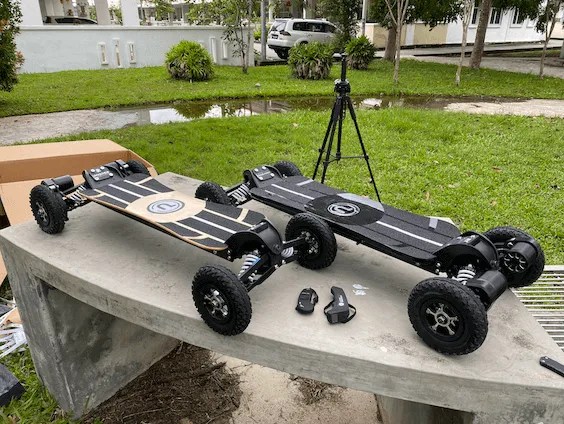
Today we will be reviewing the Propel Endeavor S, which costs only $999—a price point that is nearly impossible when it comes to off-road suspension boards.

Life as an Eskate reviewer can be unexciting when we’re always reviewing the same boards on the same paths…

Once in a while though, a certain brand or board will surprise you and spice things up!

If you haven’t noticed, Propel EV has established its name by creating high-end off-road suspension boards. Since their first board, the Propel X4s ($2299), Propel EV meant business in bringing true all-terrain riding to the masses. Their latest pair of products, the Propel Endeavor S and Pro is Propel latest attempt to refine off-road riding experience. The Endeavor S in particular wants to do that without hurting your wallet. 

The Endeavor S costs $999 and its big brother Endeavor Pro costs around $2000 (depending on configuration).
We will be reviewing the Endeavor Pro next, but the star of today will be the Endeavor S.

As usual, let’s start with the specs.

Propel Endeavor S – Build and specs

  • Board length: 112 cm/ 44.4”
  • Board weight: 37.5 lbs/17 kg
  • Deck: Maple Composite
  • Trucks: Independent Suspension Systems
  • Electronic Speed Controller: 12s LingYi ESC
  • Battery: 12s3p with 15AH or 666 wh
  • Marketed range: 28 miles for a 165 lbs rider and 17 miles for a 220 lbs rider
  • Tested range: 26 miles for a 200 lbs rider
  • Wheels:  8” (200mm) pneumatic wheels

Propel EV Endeavor S is 112 cm or 44.4” long. The actual deck where you’ll stand is only 30.7” (780mm), which is surprisingly short.

A heavyweight shorty

To put this into perspective, a typical shortboard deck is also around 30”. However, being shorter doesn’t really compromise the stability, since the board has a wheelbase that is wider than its deck. The “shorter length,” also helps the board to fit into more car trunks.

Propel Endeavor S may be cuter in terms of size but this baby is still heavyweight as it is 37.5 lbs (17kg). 

Maple composite deck

Unlike the higher-priced Endeavor Pro which has a carbon fiber deck, the Endeavor S is made of a maple composite deck. You can expect the board to be completely stiff thanks to the enclosure underneath. Still, you’ll find comfort on the deck’s concave which is nice and wide.

Let’s move on to the trucks!

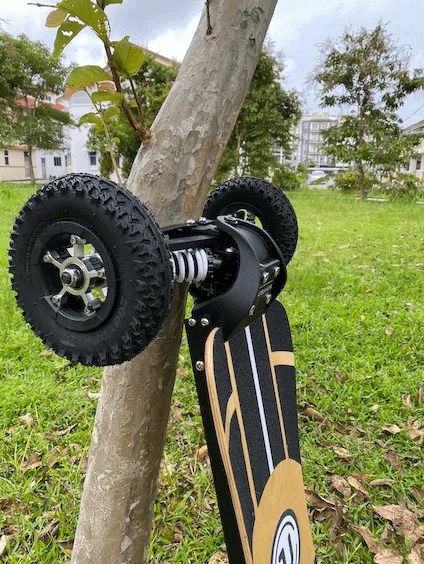
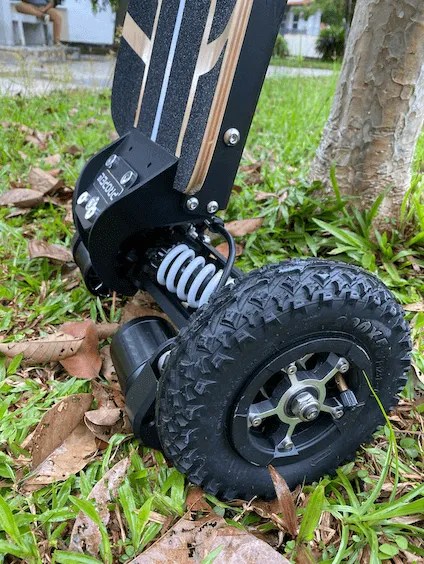
The Propel Endeavor S uses different trucks and suspension systems than the X4s. What remains the same is the feature of each truck and suspension system to move up and down separately from each other. We will talk more about the riding experience with these babies later.

8” pneumatic wheels

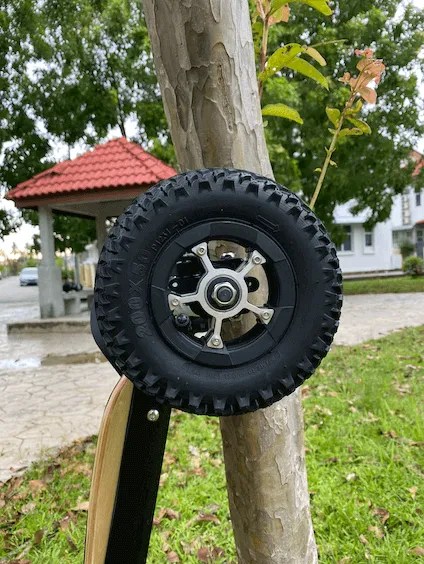
For the wheels, Propel uses large 8” (200mm) pneumatic wheels with tread patterns for better grip in all-terrain use. Since you can adjust the tire pressure of pneumatic wheels, you can always match the wheels to your level of comfort.

To learn how to change pneumatic tires on Endeavor S and Pro, click here.

Now, let’s go over to the electronic parts.

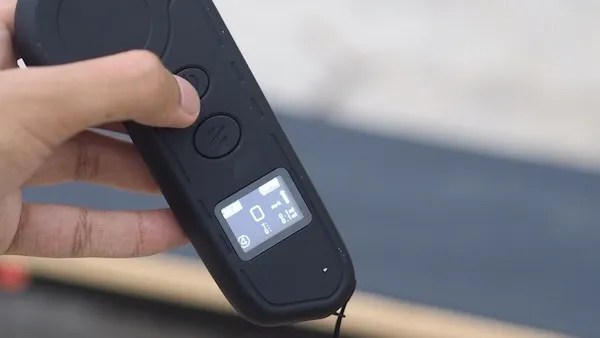
The Propel Endeavor S uses a 12s LingYi ESC with a generic LingYi remote, while the Endeavor Pro uses a VESC with a VX2 remote.

Knowing the ESC, you might already have an idea of the characteristics of the speed control on both boards. If you don’t, not to worry, we’ll talk about it in detail later.

Going with a LingYi ESC also means the Endeavor S has the push-to-turn-on feature, which is always convenient. It wouldn’t be a big deal going without it, though, since Propel brilliantly placed the power button on top of the board. Now that’s pretty cool!

Underrated range

The Endeavor S uses a pack of 12s3p batteries which gives us 15AH or 666wh, while the Endeavor Pro is almost 2 times bigger and uses a pack of 12s5p batteries which is 25Ah or 1110wh in size.

This gives the Endeavor S a marketed range of 28 miles (45 KM) for a 165 lbs (75kg) rider and 17miles (28km) for a 220 lbs (100 kg) rider. Our in-house 200 lbs (90kg) test rider actually achieved a test range of 26miles (42km). It’s refreshing to see a company underpromise then overdeliver with the range, it says a lot about the type of the company Propel is. 

Loaded with value for $999

Going through the specs, it is absolutely mind-blowing that Propel can put in so much value for the price of $999. A regular All-Terrain board from a budget eskate brand would already cost as much. But don’t forget, Endeavor S is not your regular All-Terrain board, and Propel is not a budget brand either. Just look at the kickass polish of the board and you’ll know. It’s amazing!

Oh, by the way, it’s important to mention that the board is not rated to be waterproof… don’t ask us how we found out….

Riding Propel Endeavor Pro in water

Propel Endeavor S – Riding experience

Now that we have broken down all the specs, it’s time to ride!

First, let’s talk about acceleration. Pairing a set of huge motors with a LingYi ESC means that the Endeavor S controls are powerful, but aren’t perfectly smooth like most typical electric skateboards. On a side note, the Endeavor Pro with its VESC is both powerful and smooth.

Very aggressive 4th-speed mode

The LingYi ESC allows the Propel Endeavor S to have four-speed modes and 4 brake modes independent of each other. The highest acceleration mode is very aggressive and is scary to use, my suggestion is just to ignore it. Stick with the first 3 modes, which are much less harsh and already plenty strong. Personally, I absolutely see no reason to use the 4th mode for the higher torque that you won’t need.

The brake modes on the Endeavor S took us by surprise, as they don’t have the same flaw of the acceleration and are strong but smooth.

Now that we’ve talked about speed control, let’s talk about the maneuverability of the board. 

Off-road suspension boards are pretty heavy and have a long wheelbase. This means that the sharpest turns aren’t what you should be expecting for Propel Endeavor S.

We’ve seen lots of other reviews mentioning the Endeavor S is easy to turn, but our experience didn’t match that. We’ve loosened the trucks to the max, and yet we were struggling to make sharp turns. 

The only explanation we have is that we are all scrawny Asians weighing under 160 lbs (70 kg). If you are much heavier than us you would probably turn the board fine, but don’t expect it to be good for carving fun.

Absorbs road bumps for stability

While carving and turning might not be what any off-road suspension board shines at, staying stable on poor road conditions definitely is. Hitting the top speed is easy. 

The board not only accelerates fast, but it is also perfectly stable and absorbs road bumps almost completely. This might be the most enjoyable part of the board, going full throttle without a fear in the world.

Mini-car in urban commuting

Will this board make me fearless in the world of urban commuting, too?

It depends.

Riding the Endeavor S on sidewalks with 90-degree turns would be quite disastrous, and you would be better off getting a double kingpin All-Terrain longboard. 

However, if you ditch the sidewalk and ride on the road itself, you will have a wonderful experience. You fear no road condition because you are basically riding a mini-car.

While the Propel Endeavor S’ usefulness for commuting heavily depends on the kinds of commute you do with it, its performance on off-road adventures will always be amazing. 

To check out another board that’s best for urban commuting, click here.

When riding up and down mountain trails, the Propel S lacks neither power nor stability. Because the shock absorbers in each wheel are independent of each other, all 4 wheels can keep contact with the ground when riding on uneven terrain.

Beware the back wheels’ ground clearance

Propel Endeavor S might be your strongest budget and quality all-terrain board, but even the powerful have an Achilles heel.

And we mean it.

Propel Endeavor S has a weak spot near the back wheels and pulley. While the deck itself has a healthy 4.3-inch (11cm) clearance from the ground, the pulley beside the wheel doesn’t. 

Propel Endeavor backwheel catch on bump

If you don’t plan your approach up and down a bump, the pulley will catch the obstacle and things could get ugly. On a side note, this is a problem that the X4s don’t have.

To check out our review on Propel X4s, click here.

To put things into context in an off-road adventure: The Endeavor S as an off-road suspension board is a league above your typical All-Terrain boards, even when those All-terrain boards might be two times its price. 

But the Propel X4s is even better in the same situation.

THE VERDICT

Now, to summarize:

The Endeavor S is an affordable off-road suspension board that doesn’t skimp on polish, specs, or performance. 

It has 2 main weaknesses.

1) the LingYi ESC gives the board an unusable 4th acceleration mode, and less than perfect acceleration smoothness.

2) given that Endeavor S is an off-road suspension board, it is difficult to turn, especially if you are a lightweight rider.

With that said, when it comes to off-road riding, stability is preferred over maneuverability, and silky-smooth speed modes are often unimportant.

So, should you buy it? 

Well, frankly speaking, if you are looking for a traditional skating experience with lots of carving, off-road suspension boards shouldn’t even be on your list.

However, if you are looking for a mountain trail riding experience and don’t have 2 grand to spend, the Endeavor S will be everything you need… and for the price, there is nothing else that’s quite like it.

If you are interested in buying the Backfire, be sure to check out our affiliate discount link here and use code: “ESKATEHQ” to receive $5 off during checkout.
It will help you get a small monetary discount and help us out too. On top of that, you’ll be tagged as an Electric Skateboard HQ customer and probably be treated better. Cheers!

Tynee Board Pro Review — 8.7AH, Belt-drive, $500?

You can say Tynee Board Pro is an Exway Flex Riot’s clone.
However, for a dual belt-drive electric skateboard to have an 8.7AH battery while only asking for $519, it deserves a closer look.

Tynee Who?

It is common for engineers from well-known and established brands to break away from the company they work with to craft something of their own.

That’s how the brand Tynee Board was born. 

Although Tynee is a new brand, an eskate industry veteran founded the company, so you can trust that the product will skip the painful trial and error phase and be great right from day one.

To prove how ready they are, the lineup of Tynee Boards is anything but tiny.

They have lots of options for their collection, and today we will be reviewing the Tynee Board Pro.
Tynee Board Pro has two variants: a 5.0AH set-up for $489; and 8.7AH for $519.

The founder is more proud of the 8.7AH and that’s the one we will be reviewing today.

Tynee Board Pro 8.7AH – Build and Specs

Tyneeboard Pro Spec Chart

The Tynee Board Pro’s deck is made of original Canadian maple with a mild flex and concave. The camber or rocker is flat, so you can expect that the board won’t be as flexible as Exway Flex Riot.

To check out our review on Exway Flex Riot, click here.

For the electronic speed controller, Tynee Board Pro uses Hobbywing ESC with a very handy and convenient smart power-on feature. Also, the controller has your usual 4-speed modes.

Motors – Hobbywing 5250 belt motors

Trucks of Tyneeboard

Now let’s go to Tynee Board Pro’s motors. This eskate uses Hobbywing 5250 belt motors.

The board’s top speed is 23.6 mph or 38 km/h on a full charge, or 21 mph or 34 km/h on a half-charged battery. Not bad!

Battery – Bigger than average.

As mentioned, one of the specs that caught our attention is the battery size.

Tynee Board Pro also uses an 8.7 AH battery with 313.2 watt-hours. And frankly speaking, the version with 5 AH for $489 is not worth considering as everybody should just pay the extra $30 and go for the bigger battery pack.

For the 8.7AH version, it’s marketed range is 21 miles or 35 km but unfortunately, our tested range is 11 miles or 18 km with a 200 lbs or 90 kg rider.

Although we can only conclude that Tynee Board Pro’s marketed range is grossly overstated, but 11 miles is probably what everyone should’ve expected from an 8.7AH battery on a belt-driven board. (Need I remind you that the Boosted had a similar battery range too?)

Trucks – Proprietary Trucks based on upgraded Paris V3

On maneuvering the board, Tynee Board Pro made their own proprietary truck – “Tynee PE trucks”. These trucks are based on the Paris V3. Although there’s no information on the bushing type, you can be pretty sure that carving is pretty nice thanks to a good return to the center.

It might be a tiny bit inferior to, let’s say, Exway Trist Trucks. The trucks have a good return to center and are biased towards stability.

Tyneeboard Pro

For the wheels, Tynee Board Pro uses 90 MM x 62 MM wheels with a 78A in the durometer. This means that the Tynee Board Pro aims to soften the vibrations of rough roads. We’ll know later if it does the cushioning job right during the riding experience.

Another feature of the board is its IP 55 water resistance. Don’t go crazy with water, though. We all know that the water-resistance certification on eskates shouldn’t be fully trusted. 

Now that we know the specs, it’s time to ride!

Riding experience

So, how does this baby rides?

As expected from Hobbywing ESC, the acceleration is buttery smooth, and the power is decently strong. You’ll also feel silky smooth braking, while still maintaining a strong hard stop. No surprises here.

Next, let’s talk about torque.
Well, you know you will never have to worry about torque with a dual belt set-up. Tynee Board Pro might not have the crazy torque as some belt-driven board such as the Beastboard Viper or Meepo NLS Belt, but it is on par with any belt drive that is not torque-obsessed (eg. Exway’s Flex/ Backfire Zealot) and stronger than any electric skateboard with hub motors.

Basically, not much of an adrenaline rush, but going uphill won’t be a problem.

The deck is on the stiff side with only mild flex, and I will leave it for you to decide if that speaks to you.
A stiffer deck gives the board a responsive control and felt more stable as compared to a flexy deck.
On the downside, vibrations from rough roads were less comfortable, even with 78 A durometer wheels, as the stiff deck didn’t help absorb the road vibrations. Still way better than hub-driven boards though!

Overall, the riding experience on the Tynee Board Pro is quite nice and rivals boards from the mid-market segments ($600-$700) – an impressive feat.

Now that we know the specs and ride feel, is Tynee Board Pro worth choosing over big famous brands?

THE VERDICT

As you can probably tell by now, we were very impressed with the price to value ratio. 

If you’re shopping for a belt-driven board with a budget of $500, Tynee Board Pro is an easy recommendation and one of the best picks right now.

For its asking price, Tynee Board over-delivers both on the specs and on the riding experience.

To check out other budget boards this 2021, click our Youtube Video here.

Usually, we tend to be more reserved in recommending a new brand, but as Tynee is run by industry veterans who know what they are doing, that part is easily forgiven this time.

All in all, we like Tynee Board Pro and would recommend it to everyone.

Ride safe guys!

If you are interested in buying the Tynee Board, be sure to check out our affiliate discount link here and uses code: “ESKATEHQ” to receive $10 off during check out.
It will help you get a small monetary discount and helps us out too. On top of that, you’ll be tagged as an Electric Skateboard HQ customer and probably be treated better. Cheers!

Meepo V4 (Shuffle) Review – A new direction? (Updated)

Finally, Meepo launched Meepo V4 on 20th August.

After the wildly successful launch in 2017, the original Meepoboard kick-started the era of affordable eskate and soon earned itself a notorious reputation for being the most frequently refreshed product in this niche. Within 6 months, we saw Meepo V1.5 which was immediately followed by Meepo V1.51 then V2, V2 Plus, and finally V3 in 2019. 

For a company that’s so addicted to rolling out marginal improvements in short succession, we were more than surprised when 2020 rolled past without a Meepo V4. Finally, in the fourth quarter of 2021, Meepo finally is putting up a new iteration for their best-selling line-up. 

It has been a while, so this better be good.

Unboxing Meepo V4

Meepo V4 Box

And, Oh god this box is not a great start. I didn’t realize Meepo is selling from Toy’R’us now.

Luckily for Meepo this should be easily changed once they realized we are buying eskate for ourselves and not for our kids. If you like the design of the box, please leave a comment below to make your support known, or otherwise, I bet it wouldn’t last beyond the first batch.

Thankfully, the design of Meepo V4 is nothing like the box. 

Meepo V4 Review – Specifications

Meepo V4 Chart

Let’s take a quick look at the spec now.

  • Board name: Meepo V4 (Shuffle)
  • Deck Length (inch and cm):36 inch (91.5cm)
  • Motors: 2 x 620W hub motors
  • ESC type (LingYi/ Customize/ VESC/ Others) :LingYi (LY-FOC 1.0)
  • Wheel: 90mm; 72A Durometer
  • Battery Type: 10S2P 2000mah , 144Wh
  • Marketed Top Speed in mph & kmh: 29mph /46KMH
  • Marketed Range in miles & km: 11 miles/18KM (Depend on riding style, weight, terrain, and weather. )
  • Charging time: 3.5-4H (30min with 8A fast charger)
  • Weight in lbs and kg: 17.2lbs /7.8KG
  • Warranty Duration: 6 months (180days)
  • Price: $469

Meepo V4 – Build

It has been quite a while before we reviewed our last Meepo, and it is a pleasant surprise to see the build quality and polish continues to improve as the year went by. Meepo V4 is a very polished board despite the $469 price tag.

Deck

Testing the flex of Meepo V4

The Meepo V4 deck is a combination of 8 plies Canadian maple and 1 ply fiberglass. 

It has a pretty aggressive W concave, mild flexibility, and a slight rocker profile. I love decks with rocker profiles, I’ll explain later. The deck is also slightly shorter than most longboards, at 36” (typical e-longboard = 38”) which is supposed to help with storage. 

Deck of Meepo V4
Nice aggressive concave (but not too aggressive! unlike the one on Exway Flex)

Electronic Speed Controller (ESC)

For the electronic speed controller, Meepo V4 uses the latest-redesigned LingYi ESC (LY-FOC 1.0).

As always, it comes with a push to start feature. As always, LingYi ESC allows 4 acceleration modes and 4 braking mode to be set independently from each other. When it comes to smoothness, LingYi has been playing catch up with Hobbywing ESC since 2018. As the year goes by, they come close, and hopefully this time they manage to be as smooth as Hobbywing.

Battery

And when it comes to battery, Meepo V4 uses a 10S2P 4AH that’s rated at 144wh. 10s2p battery has been the standard for entry-level board eskate, but a slight disappointment when some of the latest budget eskate, like Meepo’s nemesis Wowgo’s 2s Pro is rocking 12s2p battery. 

Showing Meepo V4 battery rating

Anyhow, Meepo promised a modest 11miles or 18km range for the V4, and our range test yielded us 10 miles or 16 km.

On a related note, the battery allows fast charging which can reach a full charge in 30 minutes.

Trucks – Shredder trucks

For the trucks, Meepo re-do the mold for their proprietary Shredder truck. It’s a pair of 7 inches trucks that are 45°. The bushings are 90A. Meepo says they made a new, more precise mold, which they say should improve its performance. What I can say for sure is that it sure the hell looks better.

Meepo V4 truck

Hub and wheels

For the motors, Meepo V4 uses 640W dual hub motors. Typical Meepo, always trying to one-up everyone else when it comes to motor power. For reference, WowGo 2s Pro uses dual 500W motors; Backfire G2 Black uses dual 400W hubs, and the old Meepo V3 uses a pair of 540W hubs. 

However, higher wattage doesn’t always mean better torque, especially when paired to a modest 10s2p battery. Something our ride test later would test..

These hub motors are currently not compatible with Cloudwheels donuts, but there is always a chance that they develop one.

The durometer for the front wheels are 72A, pretty soft, and the PU sleeve is rated to have 82A durometer. 

Misc

It is worth mentioning that Meepo V4 does have IP6X certification which means dustproof and some water resistance.

Now that we know the build and specs, it’s time to ride!

Riding Experience on Meepo V4

Meepo V4 riding photo

The things Meepo V4 did well

After getting on the board for a while, it becomes apparent that V4 is designed with stability as the priority.

Let me explain:

The deck has an aggressive W shape concave and that helps to lock in our feet.
The rocker deck adds another level of comfort giving as the rocker curve gives our foot something to push against during speed changes.
Only having mild flex on the deck further adds to stability.
On top of that, the rocker deck also means lower ride height which further improves stability. Too bad the lower riding height is a double-edged sword as it also means a very low 44mm ground clearance, causing the enclosure to kiss the floor when we ride over speed bumps.

Meepo V4 enclosure scratched
Scratched

Meepo’s 45° Shredder truck was geared towards stability as compared to 50° trucks which was more carvy (eg: Wowgo 2s Pro’s Poseidon truck). All in all, the new Shredder truck is pretty good. While it does not rise to the level of branded trucks such as the Caliber II or Paris, it’s definitely as good as any other proprietary truck amongst affordable eskate. Decent for carving, good return to center, and absolutely stable to ride at top speed. 

So,
the deck is great for stability, and the trucks are geared towards stability, how’s the ESC? Will the LingYI ESC, which traditionally leans towards raw and powerful, screw up the stability theme for Meepo V4?

Surprisingly, no! I am happy to say that, after 3 years and countless iterations, we finally reach the point where this (LY-FOC 1.0) version of LingYi ESC is indistinguishable from Hobbywing ESC when it comes to control-smoothness. The speed control of Meepo V4 is now as smooth as it can be while still being as strong as it always was.

Finally.

Typical Meepo, this board is freaking strong

Initially, I even found the new LingYi ESC to be boringly safe, with no ‘punch’.

Yes, it’s now as smooth as a Hobbywing ESC, but this was actually a disappointment for a Meepo die-hard who loves Meepo for its obsession with power, torque, and thrill.

If you recall, Meepo V3 was and still is one of the if not the most powerful entry-level electric skateboard out there. Meepo was so obsessed with power that it was willing to sacrifice ride comfort for it when they reduced the hub wheels PU sleeve’s thickness in order to make space for a pair of giant 540W motors. Some Meepo diehard love them for it, and those diehard fans would probably feel disappointed here. 

And then, just after I posted my article review essentially calling the Meepo V4 a “PG 13 beginner-friendly toy”, I was informed by the Meepo team that I wasn’t sent the production ESC. The prototype ESC that all of us reviewers get had its power capped, and wouldn’t give us the full power that the real V4 in production would.

So, our team decided not to make assumptions and waited for the real ESC.

After switching over to the new ESC I found myself cursing the Meepo team, because I now had to rewrite half of my review, as my conclusion on its power did a 180.

After changing to the actual ESC, the Meepo V4 showed its true colors, unleashing the absolute beast that we always expect Meepo to be.

Going for the highest speed mode, the board is freaking strong, with powerful acceleration that would knock you off if you are not prepared for it. The braking is very strong too, smooth, but very strong. Thankfully, for those who prefer relaxing rides, the third acceleration mode and 2nd brake mode have kept their gentle profile.

In the end, the Meepo V4’s modest 10s2p did not end up bottlenecking the dual 640W motors, as the hubs still delivered some of the most powerful acceleration you can find amongst hub-driven boards, and this is now the most powerful hub board we know of at the sub-$500 price point.

To put the torque in context, the Meepo V4’s acceleration is about 30% stronger than its fiercest rival, the Wowgo 2s Pro. Being hub-driven, the Meepo V4 might not have the torque that a typical dual belt drive eskate has, however, the Meepo V4 does have a steeper acceleration curve, giving it a more thrilling start than an average belt-driven board when drag racing on a flat surface.

Writing undertneath Meepo V4
You don’t say

Some other stuffs:

When designing the V4, Kieran (Meepo founder) says he notices his team members favor shorter boards when picking their ride. A longer board although should provide more comfort, his team member ends up always picking shorter boards as they are more practical to use: easier to bring around, fit more car trunks, and allowing tighter turns in urban commute. Hence, when he designed Meepo V4, it was aimed to have all the practicality of a shortboard, and compromised on that by adding 6 more inches for more comfortable rides.

Meepo V4 on poor road
Imagine riding through this with an electric shortboard

And the V4 is indeed more comfortable than a shortboard especially when riding on rough pavements. On poor road, it is ‘merely uncomfortable’ due to the dual hub and stiffer deck, as opposed to agonizing when riding through the same road with hub-shortboards.

Verdict – Who should get Meepo V4?

So, to summarize. The Meepo V4 might not have the biggest battery for its price, but when everything is said and done, it’s more well-rounded, more versatile than ever, while still being as thrilling as we always wanted it to be.

While its nemesis, the Wowgo 2s Pro (another top pick for an entry-level board), has a slight edge in battery size and carving fun; the Meepo V4 excels on both sides of the extremes.

On the one hand, new riders will value the gentle ride and stability the Meepo V4 provides, with its stable trucks, lower ride height, and relaxing control in the lower speed modes. At the other extreme, the V4 became a thrilling beast once you turn the speed and brake modes to the max. Thrilling acceleration, strong brakes, everything that gets your adrenaline pumping.

The Meepo V4 might also be well suited for another often-forgotten group, the eskate commuters. This is due to its 30-minute quick-charge option; as well as it’s shorter length, allowing for tighter turns on sidewalks, easier handling, and a better fit in a car trunk..

All in all, for under $500, the Meepo V4 is among the top 2, if not the top choice in the market right now.

If you are interested in buying the Meepo, please do support us by using our affiliate link here.
It will help us out too and you’ll be tagged as an Electric Skateboard HQ customer and probably be treated better. Cheers!

The Uditer W3 Review – Scooterboard? Huh?

Today we will be reviewing the Uditer W3, a mid-tier electric skateboard that’s $549 after discount.

First of all, Uditer who?

Uditer is yet another new electric skateboard brand from Guang Dong China, and there are good and bad things that come with being the first customer of a new brand, especially in the electric skateboard world. 

The bad thing is the lack of reviews. You never know how good or how bad their customer service is after your purchase.

On the upside, new brands always try harder at the beginning. They also often provide a cheaper version to weaken competitors from established brands.

With that said, when Uditer reached out to us last April to review one of their recent and innovative products, the Uditer W3, we were pretty intrigued!

The scooterboard concept

Uditer invented this concept which they coined “scooterboard,” for the W3. 

Uditer W3 is an electric skateboard that allows a handlebar to be installed, transforming it into a pseudo-electric scooter. 

I’m sure we’re thinking about the same thing—this would either be a wonderful product or more likely, a dumb gimmick that serves no real purpose. 

And you guessed it right, it is the latter. 

Imagine holding a remote on hand while also holding on to the handlebar, since the handlebar has no throttle control installed in it.

When turning, you’ll need to push the handlebar sidewards. It doesn’t work like a bicycle or a scooter where you twist it to the side to be able to turn.

If you think these already suck, let me remind you that the handlebar costs $100. Well, it’s a really high-quality handlebar but for all I care, it could be made out of vibranium and it wouldn’t help with the riding experience at all.

Uditer W3 Handlebar

The handlebar might help a beginner feel more stable on this electric skateboard, but we’re being generous with that remark. For us, the handlebar is more of a mental crutch than providing any benefit in stability.

To watch how to attach the handlebar on Uditer W3, click here.

So yes, the scooterboard idea is a failure but remember, the Uditer W3 can be a $549 electric skateboard. 

The Uditer W3, as a typical electric skateboard, deserves much of your attention. 

As usual, let’s run through the specs.

Build and specs

Spec chart for Uditer W3
  • Board name: Uditer W3
  • Deck Length x Width (inch and cm):38inch*9inch(96.5cm*22.8cm)
  • Motors: 500W dual hub motors
  • Wattage: (eg:2 x 450W):2 x 500W
  • ESC type (LingYi/ Customize/ VESC/ Others) :LingYi
  • Wheel: PU; 90mm*52mm; 78A Durometer
  • Battery Type: 10S3P 2600mah 8C BYD/Changhong, 328Wh
  • Marketed Top Speed in mph & kmh: 28mph/45KMH
  • Marketed Range in miles & km: 20-25 miles/35-40KM (Depend on riding style, weight, terrain, and weather. Can be double even triple range if the customer buy extra batteries)
  • Charging time: 3.5-4H
  • Weight in lbs and kg: 21.6lbs/9.8KG
  • Warranty Duration: 6 months (180days)
  • Price: $549

Uditer W3’s board has a pretty badass diamond design that’s made of bamboo and fiberglass.

The combination of bamboo and fiberglass creates a flexible deck. Uditer W3’s board has no concave and is flat without any camber or rocker.

To check out another eskate with a diamond deck design, click here.

For the electronic speed controller, Uditer W3 uses 10s LingYi ESC with a push-to-turn-on feature, which we always welcome with loving arms.

LingYi ESC also has your typical 4 acceleration modes and 4 brake modes that are independent of each other. Smooth acceleration will never be a problem with Uditer W3. You can expect a buttery smooth speed control.

It also comes with the typical LingYi ESC remote with telemetry on it. This remote is comfortable in hand, doesn’t disconnect, and is 100% functional. 

For the motors, Uditer W3 uses 500W dual hub motors which aren’t massively powerful but won’t disappoint, either. We were able to get its marketed top speed of 28 mph or 45 kph. Pretty cool!

Uditer W3 Hub Motors

What we weren’t able to achieve was its marketed range. Uditer W3 uses 10S3P swappable batteries with 7.8 Amp-hours or 328-watt hours. The marketed range is 20-25 miles or 35-40 km but we were only able to get 13 miles or 21km with a 198 lbs or 90 kg ride on a high-speed mode.

Uditer W3 Swappable Battery

When it comes to maneuvering the board, the carving is decent with Uditer W3’s generic RKP trucks. There is no information on the bushing type because the trucks are factory-made. Still, the board’s stability and rebound to the center are fairly good.

Uditer W3 Paris clone-like factory made trucks

Lastly, Uditer W3’s wheels are the generic 90mm 78A soft and durable PU wheels. 

Given these features, will this eskate give a good riding experience?

Let’s find out.

Riding experience

The ride is tolerably effortless. The deck’s flex helped absorb the road vibrations well. 

Even though the trucks on the W3 are unfamiliar, they are fine and configured perfectly right off the box. 

The ride is carvy, but still stable at all speed modes. It’s as good as most unbranded trucks.

When it comes to speed control, W3 is smooth on both acceleration and braking.

The basis of comparison obviously comes from the recent 12s Hobbywing ESC that is found on many mid-tier eskates right now. If you don’t already know, Hobbywing ESC is the current gold standard when it comes to speed control. 

To check out another eskate using 12s Hobbywing ESC, click here.

Next, we tested the Uditer W3 on different types of roads. It comes as no surprise that the W3 is nice to cruise around smooth pavements but like all hub boards, riding on rough roads can be quite uncomfortable… It’s a good thing that the road vibrations were cushioned by the flexi-deck.

Uditer W3 eskate

When it comes to torque, Uditer W3’s two 500W hub motors did just fine. Going uphill is fairly comfortable.

Now that we know the specs and the ride experience of the Uditer W3, here comes the verdict.

THE VERDICT

Uditer W3 electric skateboard

Well, if you live in a country with a backward law (cough, Germany) that dictates all personal electric vehicles have to have a handlebar, then buying Uditer W3 the scooterboard might be your second best option, right after the first option of moving to another country.

What about Uditer W3, the regular midtier $549 electric skateboard, though?

Well, it depends.

If product polish and brand name aren’t as important for you, getting the Uditer W3 over Meepo V3 ER might be the right choice. You can see Uditer W3 as a low-cost Meepo V3 ER ($599) that rocks a bigger battery of (328 wh vs 288-watt hours). 

For a pricier Lycaon GR ($459), you can consider the Uditer W3 as a version where you pay extra for a hot-swappable battery and a slightly stronger motor. 

Either way, while Uditer W3 might become a meme for the scooterboard it tries to be, just look past the handlebar and Uditer W3 can be a worthy eskate for someone who is looking for a lot of range for an affordable price.

Ride safe guys!

If you are interested in buying the Uditer W3, be sure to check out our affiliate discount link here and uses code: “ESKATEHQ” to receive 3% off during check out.
It will help you get a small monetary discount and helps us out too. On top of that, you’ll be tagged as an Electric Skateboard HQ customer and probably be treated better. Cheers!

Cloudwheels Discovery & Cloudwheels Donut Review – Everything you need to know

Today we will be reviewing iWonder’s Cloudwheels Discovery and Cloudwheels Donuts. 
(This is the updated version of the previous Cloudwheel review here)

These wheels became a showstopper in the eskate community. People are either top fans or serious haters for the Cloudwheels. So what is the real deal? Are these wheels as fancy as they say?

For those who don’t already know, Cloudwheels are $139-169 urban “off-road wheels,” that come in sizes 105mm and 120mm. A donut version is also available for hub boards. The wheels are marketed as all-terrain wheels, which is something that we might not be able to just take their words for.

So, what are the Cloudwheels?

Cloudwheel Discovery Wheels are built with urethane in a durometer of 78a. These babies are very soft because of their foam core. iWonder calls the technology Dampening Foam Core or DFC when they try to sound cooler, I call it “pretty bubbles inside the wheel.” Aside from the softness, the style also allowed a lighter weight as compared with your normal big urethane wheels. 

Black Cloudwheels close up view

A softer wheel should offer more grip, but it’s the opposite for Cloudwheels. This is due to the fact that Cloudwheel has a very narrow contact patch. iWonder didn’t provide a measurement for the contact patch, but it’s pretty obvious to the eye. The curved tread design means only the center of the wheel is in contact when riding on flat ground.

Cloudwheels contact patch

This gave a specific ride feel for Cloudwheels that not everyone became fond of. We will discuss more on the ride feel later.

Abit of scandal on the initial days of Cloudwheels:

Every product can use a little bit of scandal on launch, eh..?

Now, here are a few more things to note about the core. Back when it was launched, the first version of Cloudwheels used a regular ABEC core. This version seemed to crack for some riders. 

To resolve this concern, iWonder used Nylon Fiberglass to reinforce the core and also made the spokes thicker. This design was named Discovery core

Cloudwheels Abec VS Discovery core

Installing Cloudwheels

By the looks of it, the latest Discovery core might still look like an ABEC core, but it’s not! The Discovery core has a thicker spoke than the average ABEC wheels core. Your ABEC pulley might not fit the Cloudwheels. 

However, the Cloudwheels pulley can still be used with your typical ABEC wheels, but there will be slop on the wheels, which means, it will be loose, and that’s not very nice (or safe).

No worries for the pulleys though, since Cloudwheel has made pulley kits for almost every eskate on the market. Cloudwheel has pulleys, if you have coins. (You can check the list of Cloudwheel supported boards by going here)

Now, let’s talk about Cloudwheel Donuts. For hub motor lovers, the Cloudwheel Donuts may just be the greatest thing since sliced bread. Cloudwheel Donuts are basically sleeves for your hub motors. It is not difficult to see where the name came from.

Cloudwheel discovery core breakdown

Donuts are compatible with a lot of hub motors but not all, so be sure to check the list of compatible hub motors first when buying Cloudwheel Donuts. 

To check out other eskates compatible with Cloudwheel Donuts, click here.

It will take around 15 minutes to install these wheels, depending on how quickly you maneuver from unscrewing bolts to slide out the hub motor’s back wheels up to secure all the new screws for the Cloudwheels.

Screwing in a Cloudwheel Donut

For a quick look on how to install Cloudwheel Donuts:

What an introduction, huh? Now let’s go to the part you’re all excited about—the pros and cons of Cloudwheels.

Like we mentioned, people are pretty divided on their opinions for Cloudwheels. They either love it or hate it.

Let’s begin with the good things about these wheels.

PROS

Safer and smoother ride

Obviously, the main advantage that the Cloudwheels can give is a safer and smoother ride.

We’ll say upfront that iWonder’s Cloudwheels are basically semi-AT. We would never even dare to call it all-terrain or made for off-road like how it was marketed. Still, the wheels provide significantly better cushioning on a roughly paved road. The ride won’t be as harsh for you.

Riding with Cloudwheels Donut 105mm
Exway flex with 105mm Cloudwheel Donut

Cloudwheels is probably most popular among eskate commuters who simply aim to travel from point A to B safely but consider the bulky AT set up to be a trouble for carrying around. Not to forget, Cloudwheels are a lot lighter than even the standard PU wheels of similar size. 

Cloudwheels also help a lot in cushioning the ride though super rough roads, making some unbearable – leg-numbing road bearable. And obviously, big wheels means less lightly to get thrown off the board when hitting a stone.

Cloudwheels = All-terrain?

While the 105mm wheel will do enough to make rough pavement significantly more tolerable, the bigger 120mm is obviously better, and almost necessary when you plan to go off the standard path.

To handle grass, small cracks, and stone, the 105mm wheels are enough, but if you’re gonna go through sand and pebbled roads, a safer choice would be the 120mm wheels. BUT, if that’s the kind of terrain you’re gunning for, then you should probably go for AT wheels instead.

Riding over a pothole with 105mm Cloudwheels Donuts
Challenging a pothole with 105mm Cloudwheel Donuts

Pretty good Durability

Another surprise we have with Cloudwheels is their durability. 

We rode the Cloudwheels for almost 200 miles and there was zero chunking. And nope, we weren’t careful at all! Also, regarding the new Discovery core? It held up without cracks too. Combining our experience and the fact that there aren’t any more complaints on the internet after the switch to Discovery core, we are pretty confident that the new Cloudwheel will be just fine.

Cloudwheel that's beaten up
This is an old, pre-discovery core version of cloudwheels.

Now, what are the not-so-nice thing about Cloudwheel?

CONS

Less fun with carving

As we said, you’ll get a less grippy ride with Cloudwheels due to its pretty narrow contact patch. Not to worry though, the narrow contact patch doesn’t actually cause the wheels to lose grip, so there aren’t actually any safety concerns.

Riding with 120mm Cloudwheels with Wowgo AT2
Carving with 120mm Cloudwheels on Wowgo AT2

It did mean that carving became a lot less fun, though, if you compare it with riding on street wheels. Simply put, carving on Cloudwheels will never be as fun as carving on Caguamas; but it’s still better than carving on 6” pneumatic wheels.

Next, let’s talk about the range. 

Decrease range

As uncle Ben used to say, with great wheel size comes great battery consumption. The bigger the wheels, the lesser the range. However, the range drain wasn’t actually as significant when it came to Cloudwheels. This is probably the result of the narrow contact patch on the wheel, resulting in better use of energy.

Regular wheel, cloudwheels and AT wheel

If you do the math, our test showed us that going from 90mm hub motors to 105mm Cloudwheels gave a drop of 25% in range. We got 16.8 miles on 90mm wheels but when we started using 105mm Cloudwheels, we only got 12.4 miles. From a different perspective though, switching to the 120mm Cloudwheels will allow you to size down from all-terrain wheels and your range will significantly be better.

Now that we’re done with the rundown of specs, pros, and cons, what’s our verdict?

THE VERDICT

The Cloudwheel Donuts is hailed as the savior for hub boards, and it might not be an overstatement.

The biggest pet peeve that eskaters have on the hub boards is the thin urethane sleeves and hence agonizing vibration when riding on rough roads. Remarkably, Cloudwheel Donuts basically solved that problem. The 105mm wheels probably won’t open up new ride paths for you, but would make commuting much safer and more comfortable.

The verdict on the regular 105mm and 120mm Cloudwheels (for Belt drive) are pretty clear too. If you like big wheels for its safety, semi-AT use, and don’t mind the less grippy ride feel, you will love the Cloudwheels.

If a big wheel with a narrow contact patch is not your style, then you should already know that Cloudwheels is not for you. Eskate connoisseurs would probably prefer something like 107mm Super Flywheels or 110mm Torqueboard Wheels instead.

Basically, Cloudwheels are just very practical wheels, period.

If you are interested in buying the Cloudwheels, be sure to check out our affiliate discount link here and uses code: “ESKATEHQ” to receive $10 off during check out.
It will help you get a small monetary discount and helps us out too. On top of that, you’ll be tagged as an Electric Skateboard HQ customer and probably be treated better. Cheers!