Wowgo Mini 2 Review— Probably the best shortboard right now

In the world of electric skateboards, shortboard lovers often get the short ends of the stick as most eskate brands spend most of their R&D resources on longboards. It’s very common for most eskate brands to develop a longboard, slap on the same components on a shorter deck, and call it a day. But, not anymore. The Wowgo Mini 2 shortboard just changed the game.

Just look back on Meepo Mini 1 and Wowgo Mini. Don’t we all agree on how uninspired they look? Thankfully, this all changed when the late Boosted made the positively received Boosted Mini, and everyone else followed the craze of making better electric shortboards.

Late 2021, Wowgo finally joined the “make shortboard great” movement as they replaced their pathetic-looking Wowgo Mini with the Wowgo Mini 2—a $559.99 electric shortboard that rocks a 10s2p 187.6Wh battery.

Based on its look, it’s pretty obvious right from the get-go that this is not an assembled-from-spared-parts board. 

As per usual, let’s go through the parts and specs.

Build and specs

  • Deck: Canadian maple, U-shaped concave with kick tail
  • Weight: 15.32 lb / 6.5 kg
  • ESC: Hobbywing ESC 4-speed modes with smart power-on
  • Battery: 187.2 Wh – 10s2p
  • Marketed range: 15 miles / 25 km
  • Motors: hub motors 680 W * 2
  • Marketed top speed: 25 mph / 40 km/h
  • Wheels: 90mm street / 105 Cloudwheel Donuts

First, let’s look at this deck.

The Wowgo Mini 2 went with a deck with U-shape concave, following a pursuit on the popular Boosted Mini. Unlike Boosted Mini or Exway Wave though, the concave is more subtle on this one. 

An aggressive concave would have given the board a more responsive feel but may place some discomfort on our feet. I think most people would find this concave in their sweet spot as it still feels responsive, allowing a comfortable feet placement.

To check out our review on Exway Wave, click here.

Functional kicktail with deck guard

The board obviously has a functional kicktail that sure is useful to those who know how to kick turns. It also has a deck guard under it to help protect the tail. If you want to look cool when braking, you can use the kicktail to brake instead of the remote. 

Shortboard polish looks premium

Beneath the deck, we have a single enclosure that houses both the ESC and battery. It appears that Wowgo put in a good effort in designing this mini-board. Unlike the first generation Wowgo Mini which was just assembled from off-the-shelf parts, the Mini 2 looks and feels premium. You can tell that they thought about the design thoroughly. The details on top of the deck are sick! Underneath the deck, you’ll find a very nice gloss finish. 

Perfectly smooth ride with Hobbywing ESC

Now, it’s time to look at the electronics! 

Wowgo Mini 2 uses Hobbywing ESC with 4-speed modes and smart power-on. For the battery, it uses 10s2p 5.0 Amp-hours with 180 Watt-hours. The board’s marketed range is 15 miles or 25 km. We had a 95kg or 209lbs rider test it out and the result is 11 miles or 18km in range. This is no surprise for a 5AH battery. 

You can also check the battery charge level underneath the deck, which might be helpful when you want to check the battery level when charging.

This battery powers a pair of 680W hub motors which are pre-installed with 90mm street wheels. Wowgo Mini 2 is also compatible with 105mm Cloudwheel Donuts. The package included stickers for the hub wheels as well, and a lot more stickers with other designs. We suggest you should just forget about it, as it easily comes off the wheel and is not worth the hassle. 

The marketed top speed is a standard 25 mph or 40 km/h, which we can hit with no problem.

To check out our review on Cloudwheel Donuts, click here.

Well balanced 45-degree trucks at stock settings

Wowgo Mini 2 shortboard

The trucks are Wowgo’s proprietary 45-degree trucks with double barrel bushings. 45-degree trucks are what most eskate brands go with, as it balances between stability and responsiveness. These are not the same trucks as the Poseidon truck found on Wowgo 2s Pro. Let’s see what it can do later.

Now, to summarize the specs.

On paper, the numbers on Wowgo Mini 2 are the same with most sub-$500 boards from affordable brands. For Wowgo, the slightly higher price is certainly justifiable considering the design and polish. Wowgo also used good quality skate parts, which brings us to the review of the riding experience. 

So, how well does the Wowgo Mini 2 ride? Well, we are pretty surprised at how nice the Wowgo Mini 2’s performance is.

Riding experience

First things first, let’s talk about the trucks. It felt really responsive, allowing the board to feel nimble on the feet, and they did this without sacrificing stability. We’re pretty surprised that Wowgo’s proprietary truck performs this well.

To put the truck performance into context:

If you compare Wowgo Mini 2 to Tynee Board Mini and Meepo Mini 2, Tynee Mini and Meepo Mini 2 did not feel nimble and were less fun to carve around. If you compare it to Exway Wave’s Trist trucks on stock settings, Wowgo Mini 2 is more stable.

I always believe that most people get a shortboard for a quick and easy commute on the sidewalk, in college compounds, and a maneuverable board is extra helpful in tight quarters. Obviously, the kicktail is useful for that purpose, too. 

Fun to ride with great control and maneuverability

Wowgo Mini 2 is exactly what you want from a shortboard. It is very FUN to ride on smooth roads. Riding it for the first time, I was very shocked. 

As we have mentioned, the trucks felt responsive, and the board felt nimble but stable. 

And the Hobbywing ESC on this one? The speed controls were super smooth and intuitive, unsurprisingly. What’s rather surprising is that the acceleration is pretty darn strong, too— you might even mistake it for a 12s set-up. 

Braking is also smooth and very strong. The kicktail is very functional and easy to use, too. The subtle U-concave of the deck helped with the controls while being subtle enough for you to not notice the shape all the time.

So, great speed control and great maneuverability—those are the strengths. Now, let’s talk about the weakness.

Weak at handling road vibrations

Actually, there is just one weakness. 

Wowgo Mini 2 is terrible at handling road vibration which shouldn’t come as a surprise. After all, a shortboard with a stiff deck combined with hub motors is a recipe for a very uncomfortable ride on very rough or poorly paved roads. For most shortboards, you will be standing directly on top of the trucks, and all the vibration from the road goes straight up.

From the road > to the trucks > and to your knees. 

The great news here is that you can easily swap to the 105mm Cloudwheel Donuts and greatly decrease road vibrations. But honestly, you should probably consider getting a belt-driven longboard with a flexible deck and big or even all-terrain wheels if you deal with rough roads regularly.

THE VERDICT

Wowgo Mini 2 Shortboard

So, to summarize.

For $559.99, Wowgo Mini 2 gives you a comfortable and nimble ride. The 25mph top speed and the 11 miles range are nothing extraordinary, but the polished build and riding experience more than made up for it. The obvious weakness for Wowgo Mini 2 is the poor comfort riding on rough roads. However, this is an inherent problem faced by all hub-shortboards, and the Mini 2 fares arguably better for having the 105mm Cloudwheel Donuts option available.  

All things considered, it is very easy for us to recommend Wowgo Mini 2 for anyone that’s looking for a shortboard to use on good roads. It is the best shortboard to get for those who want something more refined than the entry-level $400 like the Meepo Mini 2, and don’t want to pay extra for the $749 Exway Wave for all its fancy lights and removable battery.

I think anyone who is in the market for an electric shortboard should first consider the Wowgo Mini 2, as it’s substantially better than its cheaper competitor while simultaneously not too far behind its pricier counterparts. 

Great job, Wowgo. Love this one.

RIDE SAFE, GUYS.

If you are interested in buying the Backfire, be sure to check out our affiliate discount link here and use code: “ESKATEHQ” to receive $5 off during checkout.
It will help you get a small monetary discount and help us out too. On top of that, you’ll be tagged as an Electric Skateboard HQ customer and probably be treated better. Cheers!

Maxfind FF-Belt Review — Big wheels and beautiful deck.

Today, we will be looking at Maxfind’s flagship, the Maxfind FF-Belt.

In the Olden days, Maxfind has been known as a brand that produces value-for-money electric skateboards, putting out budget buys such as the Max-A, Max-B. These few years, however, they have been shifting their focus away from price and began to focus more on polish. Their price got higher, their customer service got better, and their boards became more interesting.

So, FF-Belt.

FF-Belt is a cool-looking, $899 belt-driven electric skateboard with a double-drop deck, 12s3p hot-swappable battery, dual kingpin trucks, and big 105mm Cloudwheel clones. 

As usual, let’s run through the specs!

Build and specs of Maxfind FF-Belt

  • Deck: composite, flexible, double-drop (polyphenylene sulfide and fiberglass, coated with carbon fiber)
  • Battery: 12s3p Samsung, 376 WH, hot-swappable
  • ESC: 12s Hobbywing ESC
  • Marketed range: 25 miles/40km
  • Motors: 2*1500W belt motors
  • Marketed top speed: 28 mph/45 km/h
  • Trucks: Double Kingpin
  • Wheels: 105mm Cloudwheel clones

The most eye-catching part of the Maxfind FF-Belt has to be the deck. Maxfind FF series uses a super flexible composite deck made of polyphenylene sulfide and fiberglass with a carbon fiber coat. It definitely has a more modern and polished vibe than your usual eskates.

The deck is wide and has a good concave to it, so we can always know where to place our feet during a ride. It also has a double-drop design for a decreased riding height. Double-drop decks are known for good stability on streets. Maxfind FF-Belt is formulating excellent stability for a flexible deck with these specs so far.

Hot-swappable batteries accessible from the top 

Maxfind FF-Belt electric skateboard, hot-swappable batteries accessible  from the top of the deck

The deck also uses rubber grip tape. We prefer this as it doesn’t catch on fabrics and damage them. What makes Maxfind FF-Belt different from other eskates is that it has a built-in electronics compartment that can be accessed from the top. This allows easy access for the hot-swappable batteries and gives the board a very pleasant unibody look. What do you think? Let us know in the comments below.

Fair range for 12s3p batteries with 376 watt-hours

The swappable battery is a pack of 12s3p batteries with 376 watt-hours and gives a marketed range of at least 25 miles or 40 km. I bet you can immediately tell that this is too good to be true, as it is impossible for a 376 watt-hour to deliver 25 miles in a running belt. And sure enough, our 95 kg rider was only able to get 14 miles or 23km out of a full charge. Well, at the end of the day, it’s still a fair range.

As for the trucks, the Maxfind FF-Belt goes with Double Kingpin trucks and pairs them with 105 mm Cloudwheel clones. We will go into details on how the trucks and wheels perform a little bit later.

For the motors, Maxfind FF-Belt rocks a pair of 1500W motors and combines it with the latest 12s Hobbywing ESC, which comes with a smart power-on. This gave the Maxfind FF-Belt a marketed top speed of 28 mph or 45 km/h which we can hit without a problem.

All in all, the Maxfind FF-Belt is very polished and well built. Unlike most Chinese brands that just assemble off-the-shelf parts, slap on a logo, and call it a new product, you won’t find off-the-shelf generic parts on Maxfind here. However, all of this means nothing if the board wasn’t pleasant to ride, so now, let’s talk about the riding experience!

Riding experience of Maxfind FF-Belt

Maxfind FF-Belt electric skateboard's super flexible composite deck

Maxfind FF-Belt is a comfortable ride, thanks to the deck it uses. The composite deck is very comfy, wide, long, and has a good concave. The double-dropped deck allowed lower riding height and added to the stability of the ride.

The 12s Hobbywing ESC is also, as usual, buttery smooth. Like we always mention, Hobbywing has already perfected the formula in speed control, acceleration, and braking. The torque and braking are both strong. It’s not really surprising for a belt-driven board. To give you some context, the torque is stronger than most mid-tier belt-driven boards such as Exway Flex Riot. Maxfind FF-Belt, however, is not as strong as some of the torque specialists, such as the Beastboard Viper and Ownboard W2 Pro.

To check out our review on Beastboard Viper, click here.

To check out our review on Ownboard W2 Pro, click here.

Stable Double Kingpin trucks

Maxfind FF-Belt electric skateboard's stable Double Kingpin trucks

On maneuverability, we previously reviewed the Maxfind FF Street and the Double Kingpin trucks just didn’t work. It wasn’t stable and tended to sway a lot. However, Maxfind has improved on its build and design, and we can finally say that this installation of Double Kingpin trucks is quite alright when it comes to stability and has a decent return to the center. There’s definitely better turning and carving. Being Double Kingpin Trucks, they are obviously easy to turn, and fun to carve in, more so than reverse kingpin trucks for sure. It’s not the best Double Kingpin truck we’ve ever tried, but it’s decent. 

To check out our previous review on Maxfind FF Street, click here.

Cloudwheel clones perform well

Maxfind FF-Belt electric skateboard's 105mm wheels. Similar to Cloudwheels but seem to have less grip than Cloudwheels.

Finally, let’s get closer to the ground and talk about the ones that keep the ride rolling—the 105mm Cloudwheel clones. Maxfind FF-Belt was destined to do well in vibration handling given that it was designed with a flexible deck and big 105mm wheels.

Riding on rough roads with this one wasn’t too bad, but we have to say that these wheels are inferior compared to the original Cloudwheels. These 105mm shock-absorbing wheels are harder and seem to have less grip than Cloudwheels. Even though these Maxfind wheels absorb less shock compared to the original Cloudwheels, these wheels still do their job well enough to reduce the vibrations. Size does help, after all.

THE VERDICT – Should you buy the Maxfind FF-Belt?

Maxfind FF-Belt electric skateboard - no glaring weakness in build and specs

So, to sum it all up here’s the verdict.

When it comes to value, paying $899 for a 12s3p belt-driven board with a beautiful composite deck and swappable battery feature is not a bad value proposition by any means. 

However, the critique I have for Maxfind FF-Belt is that, while it does everything well—torque, range, speed control, maneuverability up to vibration handling, that’s all it is. The Maxfind FF-Belt is pretty good, but it wasn’t amazing in any of those categories. 

What it is, however, is a good-looking board that has no glaring weakness, and isn’t that how a lot of us choose our cars?

RIDE SAFE, GUYS!

If you are interested in buying the Maxfind, be sure to check out our affiliate discount link here and use code: “ESKATEHQ” to receive $25 off during check out.
It will help you get a small monetary discount and help us out too. On top of that, you’ll be tagged as an Electric Skateboard HQ customer and probably be treated better. Cheers!

Tynee Board Ultra Review—13s batteries for a mid-tier eskate?

So! Today we will be looking at the Tynee Board Ultra, the flagship product of the Tynee board brand.

In our previous review of Tynee Board Pro, we’ve mentioned that Tynee Board is a company that’s not so tiny since they are founded by giant industry veterans who parted ways with a major eskate brand. Tynee has put out a lot of muscle with its very competitive products since its founding, and today, we will be reviewing Tynee Board’s latest flagship board—the Tynee Board Ultra.

The Tynee Board Ultra is a $609 board or $729 if you’re going to get it with Cloudwheels, so it’s a mid-tier electric skateboard playing in the same ballpark with Exway Flex Riot ($594) and Wowgo 3 ($529).

To check out our previous review for the Tynee Board Pro, click here.

Formulated boosted-style

As a matter of fact, these three boards are built with the same formula—using flexible decks, plus Hobbywing ESC for the smoothest control, and adding on some dual belt drives for power and tada! You get a recipe similar to the late-Boosted board—a comfortable board that’s strong in power, smooth in control, and fun for carving.

To separate Ultra from the rest, Tynee packed this board with 13s batteries for better power. To give you a little background, most boards at this price are still with 10s batteries and at best, 12s. Now the question is, can Tynee Board Ultra truly demonstrate a stronger power with these extra series of batteries? We will see. As usual, let’s go through the specs.

Tynee Board Ultra – Build and specs

  • Deck: bamboo and fiberglass; flexi-deck, no concave, camber
  • Board weight: 16.9 lbs/7.7.kg
  • ESC: 13s Hobbywing ESC with smart power-on
  • Batteries: 13s2p 18500, 281 Wh, 7.8 Ah
  • Motors: Hobbywing 5255 dual belt, 2 * 600 W 170kv
  • Trucks: Tynee PE trucks (Paris V3 clone)
  • Marketed top speed: 28mph or 45 km/h
  • Marketed range: 18.6 miles or 30 km
  • Wheels: 90 MM x 62 MM 78 A; 105 MM Cloudwheels

Tynee Board Ultra’s deck is a combination of bamboo and fiberglass with no concave and is flexible with camber. 

Ultra also uses a 13s Hobbywing ESC with 4-speed modes and smart power-on. Its electronic enclosure is made of nylon and fiberglass, and it’s pretty sleek. 

What do you think about Tynee Board Ultra’s very classic vibe? Let us know in the comments section!

Tynee Board also mentioned that the board is IP 54 waterproof, but as always, we would advise not to take any waterproof rating of any boards too seriously.

Better power but with measly range

Now let’s go to their upgrade, the 13s2p 18500 cell batteries. These add up to 281 Watt-hours or 7.8 Amp-hours in size. A higher series of batteries promised better power, but that didn’t add up to the range.

Tynee Board Ultra has a marketed range of 18.6 miles or 30 km. There’s a chance you can go that far by riding slow, but that won’t utilize the power of a 13s board.

We tested the board riding fast, and our 155 lbs (70 kg) rider got only 10 miles or 16.5 km for range. Our 200 lbs or 90 kg riders only got a measly 8 miles or 13 km. Let’s just say it left us wanting more.

Tynee PE trucks as Paris V3 clones

For the trucks, Tynee Board uses its proprietary truck named Tynee PE trucks, which are based on the upgraded Paris V3. Tynee seems to be pretty confident with their trucks, backing it up with a lifetime warranty. We will talk about how the trucks will ride a bit later.

As for the motors, Tynee Board Ultra uses Hobbywing 5255 belt motors, 2 * 600 W with 170kv. These motors compete on the same level as most belt-driven boards at this price range. 

Combining these motors and ESC allowed the board to have a marketed top speed of 28mph or 45 km/h, which we were able to hit pretty easily. Tynee Board Ultra retains a healthy 25mph or 40km/h top speed even as it drops below the half battery, which is not something every board does, mind you.

Lastly, Tynee Board Ultra is available for both street wheels and Cloudwheels. The board uses your typical street wheels in 90 MM x 62 MM with a 78 A durometer and is also compatible with 105 MM Cloudwheels.

As you can see, the polish of the Tynee Board Ultra is pretty good. It does not shout premium, but it is definitely well built.

Tynee Board Ultra – Riding experience

Now that we’ve run through the specs, it’s time to ride!

The best trait of Tynee Board Ultra is the smoothness of its ride feel. Carving is fun with its flexible deck that also helps reduce vibration from the road. If you’re the type who can’t tolerate road vibration at all, you can always spend an extra $120 and get the 105 MM Cloudwheels.

PE trucks handle top speed with a smooth ride feeling

Moving on to the trucks, we still prefer branded Paris trucks over Tynee PE trucks, but these PE trucks aren’t that bad. It has a good return to center and is very responsive. It can also handle high speed without compromising the silky-smooth ride. The board is quite stable, although the bounce of the flexible deck can take away some stability at top speed, especially on rougher roads.

Acceleration power with a massive punch

When it comes to speed control, the Hobbywing ESC has always perfected a very smooth and intuitive control across all 4-speed modes. 

So, let’s now talk about power. The acceleration power for Ultra is very strong, indeed. The 13s batteries did not disappoint, either. More powerful than most of its peers, you will be hard-pressed to find similarly priced boards that pack a massive punch than the Tynee Ultra. Among the boards we’ve tested, only a few do better than the Tynee Ultra in the torque department. (For example, the Beastboard Viper – Torque Specialist and Ownboard W2 Pro).

To check out our review on the Beastboard Viper, click here.

You wouldn’t need to worry about going uphill with this board, ever. The braking is very strong and smooth, as expected from the latest gen of Hobbywing ESC.

Eliminates voltage sag

Another special factor about Ultra’s ESC configuration is that it eliminates voltage sag. The board retains its strong power down to the last 10% battery. One downside with this configuration though, is that the board sometimes allows us to ride it down to 0% battery. This can surprise you if you aren’t being careful. Thankfully, all electric skateboards at present are programmed to brake gently to a stop upon disconnection.

With that, the power of the Ultra can come as a double-edged sword. 

First, it allows a strong ride even when the battery is low. You get to drain through the battery really fast as a result.

Second, the board has a higher top speed (28mph or 45km/h), and utilizing them with a bouncy flexy deck is quite scary. It might come out as a fancy feature after all.

These are obviously minor nitpicks, but it’s worth considering a board with a stiffer deck if going fast is high on your priority list.

THE VERDICT – Is Tynee Board Ultra worth your money?

Alright, time to summarize! 

The Tynee Board Ultra is a well-polished, boosted-style board deserving its $609 price tag. You get a smooth riding experience and strong power that lasts down to the very last percent of the battery, which, unfortunately, happens too soon (8 miles) when riding fast.

When it comes to the brand Tynee, I do feel comfortable recommending it as it is run by industry veterans who have proven that they know what they are doing. This young brand has also kept its reputation intact, which is harder than it sounds among Chinese eskate brands.

So, for those who expect a lot of range from a mid-tier electric skateboard, the Tynee Board Ultra should not be on your buying list. But for those who do not want to compromise on torque and power, even during the last leg of the ride, I’m sure Tyneeboard Ultra will make you very happy.

If you are interested in buying the Tyneeboard Ultra, be sure to check out our affiliate discount link here and use code: “ESKATEHQ” to receive $10 off during check out.
It will help you get a small monetary discount and help us out too. On top of that, you’ll be tagged as an Electric Skateboard HQ customer and probably be treated better. Cheers!

Propel Endeavor Pro Review — A $2000 all-terrain suspension board

Propel EV is a company that dedicates itself to making off-road suspension boards. Last year (2020), they introduced their brand with Propel X4s ($2299)—a giant heavy-duty monster of a board and then this year (2021) released the Endeavor Series: the Propel Endeavor S at $1199 and Endeavor Pro at $1999. 

Compared to the X4s, the Endeavor boards are slightly smaller in size and are two-wheel drives instead of All-Wheel Drives. With that being said, I would still classify every one of them as huge heavy-duty all-terrain vehicles because, well, that’s what they are!

Propel X4s
This is Propel X4S

We’ve reviewed the Propel Endeavor S last time. And spoiler alert: despite having some flaws, Endeavor S was still an awesome board for anyone looking for an off-road suspension board without spending two grand.

To check out our review for Endeavor S, click here.

Today, we’re going to focus the spotlight on Endeavor Pro.

We’re pretty excited to try this out for a ride but first things first—let’s take a closer look at the upgrades.

ENDEAVOR PRO VS ENDEAVOR S

Propel Endeavor Pro and Endeavor S
Propel Endeavor Pro(front) and S(back)

Endeavor Pro shares very similar specs with the Endeavor S except for a few upgrades. Here are three main upgrades worth pointing out:

One: instead of a maple composite deck, Endeavor Pro has a carbon fiber deck that’s 10/10 in the design department. The engraved logos are slick! The board is stiff with a wide concave. 

Closed up of Propel Endeavor Pro's Deck

Two: Endeavor Pro also has a bigger battery. We’re talking about 12s5p VS 12s3p on the Endeavor S. 

And three: from a LingYi ESC in the Endeavor S, Endeavor Pro uses Flipsky VESC paired with a VX2 remote. For those unfamiliar with VESC, this speed controller is commonly used for DIY boards. It’s highly configurable and always silky smooth.

To check out our unboxing for the Propel Endeavor S and Endeavor Pro, click here.

Using VESC would allow the Propel Endeavor Pro to have a higher range, top speed, and a significantly improved riding experience. We will talk about that in detail later.

Now that we have gone through the difference between Endeavor S and Pro, let’s look at Endeavor Pro’s specs alone.

Build and specs

  • Deck: carbon fiber deck; stiff; wide concave
  • Board weight: 43 lbs/19.5 kg 
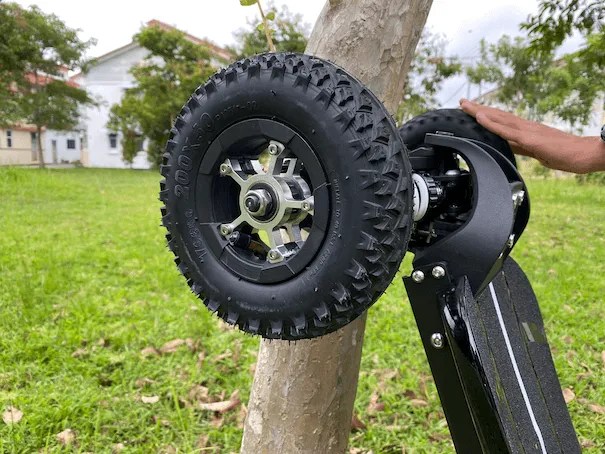
  • Wheels: 200 MM 8-inch rubber pneumatic wheels; two-wheel drive
  • Shock absorber: adjustable 350lb coil over shocks
  • Motors: 2 x 6374 belt motors
  • Batteries: Samsung 25Ah/1110Wh, 12S5p
  • Hill climb: 38%
  • Electronic speed controller: 12s Flipsky 4.2 VESC
  • Marketed top speed: 31 mph or 50 km/h
  • Tested top speed: 31 mph or 50 km/h
  • Marketed range: 71 KM for 75kg or 50 km for 100 kg rider
  • Tested range: 39 miles or 63 km for a 90 kg rider.

First, let’s pick up where we left off and look at the brain of the board, the VESC. Endeavor Pro started by using  12s Flipsky 4.2 with a Flipsky v1x remote. The ongoing chip shortage means VESC is hard to come by, and there was a shortage of Flipsky 4.2 VESC. During the VESC 4.2 shortage, Propel upgraded all the placed orders to VESC 6.6 with no added cost, and decided to keep both VESC options available going forward.

Endeavor Pro Logo

Don’t worry! Since Propel has configured the setting of both VESCs to be the same, both versions with different VESCs are expected to have similar performance, at least this is what we were told. This also means, if both options were available, I would rather choose to save $100 and go for the VESC 4.

With VESC, Propel Endeavor Pro loses the push to turn-on feature that Endeavor S has. It would be a significant drawback if the power button was placed below the deck, but fortunately, Propel has the great design sense to place that button right on top of the deck, saving you the trouble of becoming Elastigirl in The Incredibles.

Propel Endeavor Pro Power button
Power button is on the top

Powerful motors handle heavy-duty off-road riding very well

Speaking of superheroes and superpowers, Endeavor Pro uses 2 x 6374 belt motors. The board’s motors are powerful and not that noisy. This is the same set of motors as the one on Endeavor S, and we already know that they can handle heavy-duty off-roading very well.

Unique suspension system 

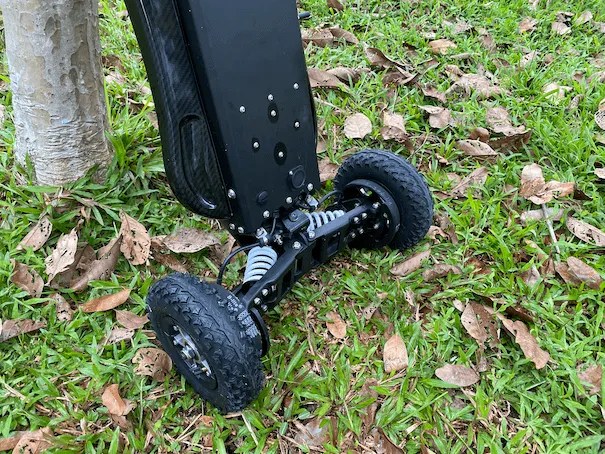
For the wheels, Endeavor Pro uses 200 MM 8-inch rubber pneumatic wheels. Both Endeavor Pro and S use a suspension system that’s different from the X4s. In both setups, each truck has its own dedicated suspension system and can move up or down independent of the others. It is notable that Endeavor Pro’s “trucks” work better than what Endeavor S has installed. We’ll explain further during the riding experience.

Tested range meets marketed range

The batteries are 12s5p with 1110 watt-hours and 25 Amp-hours. The tested range is 39 miles (63 km) for a 90 kg rider. This is insane! Propel was true to their marketed range. Even Endeavor S which has a lower price range has a tested range of 26 miles (42 km). Pretty sweet!

The top speed is 31 mph (50 km/h) which the board can hit easily and quickly.

This board is definitely a monster but every monster has a weakness. Endeavor Pro, though rugged, is not waterproof. We, unfortunately, found out about that the hard way.

Before we get into the riding experience, let’s just take a moment to appreciate how beautiful and polished this machine is. The attention to detail is almost unexpected on a board that’s meant to be ridden in very harsh conditions. 

Riding experience

Now, on to the abuse!

Our first question when testing this out was, what improvement in the riding experience does the Endeavor Pro make when compared to Endeavor S? The answer is EVERYTHING. Everything’s better, and the reason is obvious. The VESC made a lot of difference.

Flipsky VESC for the smoothest control

Our biggest complaint of the Endeavor S is the rawness of the speed control, and the Endeavor Pro avoided that downfall by using a VESC. “Avoiding the problem” is actually an understatement. The smoothness of control is one of the best qualities of Endeavor Pro.

As often is the case, an ESC upgrade makes a huge difference. There are 3-speed modes on the Endeavor Pro, and all of them are intuitive and smooth.

Endeavor Pro’s smooth control makes the ride supremely enjoyable and more comfortable. Being stronger yet smoother means the Endeavor Pro reaches its top speed fast. Even faster than the already stupidly strong Endeavor S, yet does so in a smoother manner. No more sudden jolts and jerks! 

Strong and smooth braking with reverse

The brakes are strong and smooth, too. The braking control is very accurate and strong. It can come to a complete stop and ‘lock’ the wheels when going down a steep incline. On a flat surface, keeping the throttle on full brakes, and the Endeavor Pro will start to reverse at a slow speed after a small pause. This function makes three-point turns easy and is helpful when you slightly overshoot your stop.

The improvement of speed control from upgrading to VESC is easy to explain; what wasn’t easy for us to explain was the smoother turning ability.

Turning the Propel Endeavor Pro should be as hard as the Endeavor S, as they use the same trucks, but that wasn’t the case. 

After messing with the truck settings on both boards, the difference is pretty significant. The Endeavor Pro felt much easier to turn. It’s not to say that the Endeavor Pro is an agile board with amazing carving experience, this is just impossible for any all-terrain suspension board; yet somehow, the Endeavor Pro is easier to turn than most suspension boards. 

Could it be since Endeavor Pro is slightly heavier than Endeavor S, and the added weight makes the truck easier to turn? We’ve no exact answer but that’s the theory that we are going with.

Better than typical all-terrain off-road suspension boards

Next, let’s talk about how well the Endeavor Pro does in off-road situations. Obviously, being an off-road suspension board means the Endeavor Pro is better than a typical All-Terrain board when it comes to handling road vibration. In off-road and regular road situations, the suspension system will cushion off any road vibration completely. This is what we enjoy most about the board – going full throttle, enjoying the speed, and not be bothered by any road condition.

The motors are plenty strong to challenge any uphill trails, however, you would need to put some thought into it when approaching a bump or crack. You see, while most parts of the board have plenty of clearance, the spot near the back pulleys doesn’t have much ground clearance. If you are not careful while going up a bump, the back pulley might get caught, get stuck, and leave you flying forward. This is obviously a flaw shared by the Propel Endeavor S and a problem that the bigger X4S does not have. 

Prople Endeavor Pro back pulley caught the bump
Backwheel pulley may catch a bump

To check out our review for the monsterboard Propel X4s, click here.

We also broke our external antenna on one of our rides, probably after bumping it into something. It left us with a shorter connection range for the remote, which doesn’t actually cause any problem to the riding experience or usability, or board safety.

THE SUMMARY

Now, let’s summarize.

Propel Endeavor Pro is an amazing all-terrain suspension board. If I were to nitpick, I would point out that the board couldn’t handle as harsh terrain as something like the Propel X4S could due to the lower clearance near the back wheels. I’d also warn you to not ride it into a pool as we did.

However, some minor nitpicks wouldn’t be able to shadow just how beautiful and powerful this machine is. It has massive power, amazingly smooth and intuitive control, a massive range, and almost no limits to where you can ride on.

Need I remind you that Propel EV is also a company with a great reputation for taking care of its customers? 

THE VERDICT

So, here’s the verdict,

For anyone who wants an electric skateboard for a city commute or carving fun, anything from Propel EV would likely be overkill and a mismatched choice. But, for someone who is looking for an off-road suspension board, the Propel Endeavor Pro is an easy recommendation, if you have the budget. 

In fact, we’d recommend Endeavor Pro over the Endeavor S because it is just so much more fun to ride with, the VESC alone would’ve made the upgrade worth it, and maximized the enjoyment you can get out of these powerful machines.

If you are interested in buying the Propel, be sure to check out our affiliate discount link here and use code: “ESKATEHQ” to receive 3% off during check out.
It will help you get a small monetary discount and help us out too. On top of that, you’ll be tagged as an Electric Skateboard HQ customer and probably be treated better. Cheers!

Verreal RS—among the top 2 affordable DKP all-terrain boards with beefy specs?!

Today, we will be reviewing the Verreal RS. 

For those who don’t know, Verreal has been around since Oct 2018 and is already a veteran in budget e-skateboards. It made its name with the Verreal F1, a board that provides a relaxing and comfortable riding experience for a reasonable price. 

Affordable and comfortable has always been Verreal’s design language since then. And today, we will be reviewing the Verreal RS, their flagship product released back in 2020 and has its all-terrain kits available this 2021.

To take a look back at Verreal F1, click here.

Designed with Evolve Formula

Now, a quick overview of the RS.

Verreal RS was crafted with the Evolve formula: a double-drop deck plus double kingpin trucks with a dual-belt set-up that allows easy conversion between all-terrain and street. 

In fact, Verreal RS is the most affordable Evolve clone out there. The 10s4p street with 576 Wh costs $759 while the 10s4p AT version costs $1179. For more context, the Evolve GTR street with a 10s4p battery will cost you $1549. That’s double the price of Verreal RS street. Pretty sweet!

Build and specs

Now, as per usual, let’s dive deep into the specs.

  • Deck: 7-ply Canadian Maple, 2-ply Bamboo; mild flex; subtle wide concave
  • Camber/rocker: Drop-down deck
  • ESC: 10S Hobbywing ESC; 4-speed modes; no smart power-on; generic Hobbywing remote
  • Motor type: 6368 belt motors, 2 x 1500 W, 170 kV
  • Marketed Topspeed: 25 mph or 40 km/h on AT wheels; 27 mph or 43 km/h on Cloudwheels. 
  • Trucks: Forged DKP Trucks
  • Wheels: Street wheels: 90 mm / 97 mm; Cloudwheels: 105 mm, 120 mm; All-terrain: 7-inch pneumatics
  • Battery: 16 AH (576 Wh) – $779; 20 AH (720 Wh) – $979; All-terrain – $1179
  • Marketed range: Street wheels: 16 AH – 25 miles (40 km)/20 AH – 31 miles (50 km); All-terrain wheels: 20 AH – 28 miles (45 km) for a 75kg rider; 17 miles or 28 km for a 100 kg rider

Verreal RS has a deck with a mild flex. It’s made out of 7-ply Canadian maple combined with 2-ply bamboo. Sticking with the Evolve formula, the deck used is a double-drop deck with subtle wide concave. 

The electronic speed controller is a 10S Hobbywing ESC with 4-speed modes paired with a generic Hobbywing remote. This is likely an older generation of Hobbywing ESC and the board doesn’t power on automatically by turning on the remote.  

Belt motors have the same rating as the latest Evolve Hadean

Verreal RS also uses 6368 belt motors with 2 x 1500 W and 170 kV which has the same rating as the one on the latest Evolve Hadean. 

The marketed top speed is 25 mph or 40 km/h on AT wheels and 27 mph or 43 km/h on 120mm Cloudwheels. 

To know more about the specs of Evolve Hadean, click here.

For the trucks, Verreal RS said they use forged Double Kingpin trucks. Double Kingpin trucks will allow easier changes in direction with tighter turns. We’ll talk more about the quality of carving later during the ride experience.

3 options for wheels

What took this board on another level though, is its selection for wheels. Verreal RS offers 3 types of wheels to choose from. You can use street wheels in 90 mm or 97 mm, Cloudwheels in 105 mm or 120 mm, and all-terrain pneumatic wheels in 7 inches.

In this post, we will be reviewing the all-terrain set-up and 105 mm Cloudwheels set-up.

Having 3 options may seem really cool, but we hesitate to recommend regular street wheels for the RS since the board already has a pretty low ground clearance even with our 105mm Cloudwheels. We shudder to think how terrible it would be if regular street wheels are used.

Aside from a selection of wheels, Verreal RS also allows 2 battery options: 16 AH (576 Wh) for $759 and 20 AH (720 Wh) for $979. You’ll need to top-up $200 more for the all-terrain version which costs $1179.

For this review, we will be using units with 20 AH batteries.

The marketed range of Verreal RS is 25 miles or 40 kilometers for the 16 AH battery, and 31 miles or 50 kilometers for the 20 AH battery.

Range might be the best thing about this board

Using AT wheels, this board was marketed to get a range of 28 miles or 45 kilometers for a 75 kg rider. For a 100 kg rider, the marketed range is 17 miles. 

When we put it to the test, we got 28 miles or 45 kilometers of range with 105 mm Cloudwheels and 22.5 miles or 36.2 kilometers with AT wheels.

For its price, Verreal RS really does provide a lot of range. It is arguably the best part of the specs.

Riding Experience

Now that we know the build and specs, it’s time to ride!

Riding Verreal RS felt like Wowgo AT2 but with way more stability. The deck felt a little shorter compared to other AT boards, but the subtle wide concave is nice. 

The control is very smooth, and the board’s acceleration strength is not crazy strong even on mode 4. It felt a little bit less strong compared to Wowgo AT2, but the feeling of not getting thrown off the board even when changing to top speed is awesome.

Much more stable DKP trucks

Overall, the ride felt really stable due to Verreal’s version of double kingpin trucks as compared to other brands. To put in some context, the Verreal RS is a much more stable ride compared to the likes of Wowgo AT2 and the Exway Atlas. This also means that it is not as carv-y as the other double kingpin trucks, but that is not a problem. Double kingpin trucks are already more carv-y than your regular reverse kingpin trucks.

This also means that you can easily change into top speed without getting off-balanced with the Verreal RS. Going uphill won’t be a problem, either.

To watch our real-world range test for Exway Atlas, click here.

Enjoyable low ground clearance

The double drop deck of Verreal RS also allows a very low riding height. This again, adds more stability, but we also like the carving feel of being this close to the tarmac. It is as if we are one with the road. The bottom enclosure clearly didn’t enjoy this as much as we did, though! 

Also, I’ve always found that a drop-through deck has a way of reducing road vibration. You’ll still feel them when using 105 mm clouds, but if you want to reduce the vibration more, 7-inch pneumatics is the way to go. 

THE VERDICT

I’m sure you notice we have been using Wowgo AT2 in comparison a lot in this review, this is no accident as Wowgo AT2 was our favorite budget Evolve clone up to this point. So this begs the question, after we’ve tried the Verreal RS, do we now have a new favorite?

When you are looking for a budget Dual Kingpin all-terrain board, Verreal RS is amongst the best choices you have at the $1000 mark, but so is Wowgo AT2.

Here’s our thought: It depends (duh)! Compared to Wowgo AT 2, Verreal RS can give you 25% more battery and more stability. On the flip side, Wowgo AT does have nicer things such as slightly better post-sale service, slightly better polish, and some nice features such as the smart turn-on.

To summarize, Verreal RS offered beefy specs, superior range, comfortable control, and a comfortable riding experience that‘s geared towards stability. It’s also very versatile for supporting different wheel configurations. If you are willing to put up with the inconsistent post-sale service, the Verreal RS is definitely amongst the top 2 choices when looking for an affordable Dual Kingpin all-terrain board.

Click here to check out Verreal RS