Backfire decided to start their 2020 conquest with a belt drive release: the Backfire Zealot. I guess we all sense that belt-drive is coming back to fashion and now every major Chinese brand has a belt board, well every brand except Meepo, which I bet will soon join the movement too. By the way, I think Zealot is a pretty appropriate name for a belt board seeing those who like belts are often very fanatical about it. =P
The board is now pre-selling at $699 and is due to ship on 30th April 2020. Its official retail price will be $899 but seeing that competition is pretty tough in this product segment (Exway Flex & Wowgo 3x), I seriously doubt that it will ever be sold at full price.
So what about the board?
First things first, here are the specs:
Looking at the product photo it is very easy to see that Backfire Zealot is practically a “belt-driven Backfire G3” so much of what Zealot will be can be known by referring to Backfire G3 (click to read review) .
Breaking it down:
Backfire Zealot has the usual good things going for it. A good top speed (28.5mph/ 46kmh), a flexible bamboo deck with an aggressive concave that has proven to be very comfortable.
Same deck as the Backfire G3
Then, there is the Caliber II Front truck. The back truck that mounts the motor is unfortunately not from Caliber but is Backfire’s proprietary truck. No worry though, Backfire’s proprietary trucks are usually pretty good.
(Edited at 22th May 2021: The motor has been updated) Backfire Zealot is using 2 x 5255 5250 motors. These are slightly smaller than 5255 that are pretty standard in production boards and are seen in the likes of Exway or Wowgo 3x. They are rated as 650W 750W each and are from Hobbywing., so I assume they are the same set as the pair on Wowgo 3X, which had proven to perform well.
Going with belt-drive also means we can be very flexible with wheel choice. The stock wheels are 96mm 78A with ABEC core. And soon they will be 105mm Cloudwheels option available. (It will be the updated Discovery core, for those who are following the latest eskate news.)
(Eskate historian here: Did you know, despite Backfire’s focus on hub motor all these years, their first board was a belt-drive?)
The original Backfire!
Things that I’m not optimistic about:
The things that I’m really worried about will be the range. Backfire Zealot has a marketed range of 22miles (30km). This is very likely inflated to some extent seeing that the Backfire G3 Plus with a more efficient hub setup and a bigger battery was only making 15 miles (24km) in our range test – That was only 60% of the marketed range. I’m pretty pessimistic about the range for Zealot.
Even trying to get a theoretical estimate of the range is difficult as the disclosed battery specs are pretty confusing. For instance, I really like to know what cells Zealot is using as the numbers don’t quite add up.
21700 cells
12s2p
4000mah per cell
This should bring us to a 346wh pack and not 311wh given by Backfire. Oh well, maybe just a typo somewhere. I wish I know what cell they use though.
For reference, Backfire G3 Plus is using 12s2p setting with 4000mah 21700 cells (Samsung 40T) and gives a 346wh pack.
So would it beat the current top choices?
Regardless of the nitpicks, Backfire Zealot is pretty promising. All the parts should come together to give a great riding experience and the promised new smartphone app is just the icing on the cake.
In short, I’m pretty excited for the Zealot and would like to see if it can snatch away the throne of the “Best mid-tier belt board” from Exway Flex.
It seems like Meepo releases a new budget board every half year. We have the Original Meepoboard, Meepo 1.5, Meepo V2 &V2P and finally, in 2019, Meepo V3. Seeing that Meepo refreshes their product lines very frequently, we were pretty surprised that the V3 is still here to stay as of March 2020! Meepo, however, makes the Meepo V3 an even more appetizing deal now that there is a sea-shipping option that slashes the price down to $379 (as long as you are willing to wait a month for it to arrive.)
Meepo V3
Top Speed: 28mph/ 45kmh
Range: 11mil/ 18km
Weight: 16lbs/ 7.2kg
Charge Time: 3hrs
Price: 429USD with shipping included.
Features: 2 hub motors, regenerative braking, handles up to 30% slope, MR remote (with telemetry), swappable PU.
Unboxing
This time around, we are happy to say that Meepo has continued to improve in terms of packaging and design compared to their previous packaging styles. The Meepo V3 was nicely packaged in a smooth black ‘shoe-box’ with professional graphic design details. It’s good to see that they’re constantly improving, especially in the little things that we pay attention to.
As for what’s inside the box, the Meepo V3 comes with a handheld remote control with a screen (MR remote), 2 different sets of bushings – softer 83A (white) and harder 96A (blue) – that you can swap easily for your pleasure which is a great move (the one installed are 90A in yellow), T-tools, a board charger, and a bunch of cool stickers for the deck.
Riding Experience
Acceleration and Braking
In the realm of budget electric skateboards, LingYi ESC has always been lagging behind Hobbywing ESC when it comes to perfect control smoothness. Hence, we were very sceptical when Meepo announced that they would be sticking to LingYi ESC on the Meepo V3, especially when some of their lineups have moved on to Hobbywing ESC and they were well received too.
Although they promised that this latest iteration of LingYi ESC would be as smooth as Hobbywing’s, we weren’t that convinced initially. Some of the other boards we tested that still uses the LingYi ESC were pretty subpar so our expectations were low.
Surprise, surprise. Turns out, this latest iteration of LingYi ESC that the Meepo V3 uses is as good as promised and it’s the most pleasant surprise we’ve received from the V3 yet.
The acceleration is almost as smooth as the Hobbywing ESC in the first 3 speed modes, while the pro mode offers a much punchier acceleration, intended for those with more ‘extreme’ tastes. Not something that I use much but still appreciated. Side by side comparison with Hobbywing ESC will have the LingYi ESC felt a little bit ‘less refine’ than the Hobbwing ESC.
Update: Kieran (Meepo’s creator) later point out that the lack of ‘refinement in smoothness’ is mainly due to how LingYi ESC performs when the board re-accelerate from cruising – it usually accelerated more abruptly. A yet newer LingYi iteration released in July 2019 addressed the issue via a firmware update name “Flux”. So, I expect the Meepo V3 after July 2019 to have acceleration as refined as those of Hobbywing ESC.
The braking, which traditionally was the Achilles heel of LingYi ESC, is now more than perfect too. It’s gradual and strong, stronger than any Hobbywing variation but still perfectly smooth and under control which is great for riders.
The Meepo V3 is designed to be the first one that takes off from the line and in pro mode, the acceleration is indeed very punchy and thrilling. The board boasts a 0 to 30km in 4.5 seconds, which almost halves the time of what it took for the V2. We didn’t actually objectively test this out, but the acceleration indeed felt very powerful.
To test out the difference between the latest iteration of Hobbywing ESC vs this latest iteration of LingYi ESC, we tested V3 (LingYi ESC) side by side with the NLS Pro in 90mm wheels (Hobbywing ESC) and the result is pretty surprising.
We expect V3 to outperform NLS Pro in a drag race, as LingYi ESC felt punchier, however, that didn’t happen. Though V3 felt punchier, it actually only accelerated just as fast as an NLS Pro in 90mm hub. Our conclusion is, on acceleration, the slight sacrifice of smoothness of V3 doesn’t translate to better acceleration. Sad.
Honestly, part of me actually prefers this LingYi ESC over Hobbywing ESC as I like strong brakes and LingYi ESC still has the smart turn-on features that Hobbywing ESC doesn’t. And the difference between smoothness is almost negligible now. I think many would share the same preference so finally and for once, Hobbywing ESC doesn’t reign supreme anymore.
Stability and Maneuverability
All in all, the shredder trucks and double tall barrel bushing that Meepo always uses are pretty nice. You can change the bushings according to your preference and your weight to have a setup that suits you the best, I suggest most people try out the 96A blue as for a 150lbs (68kg) me the yellow felt too soft.
Carving on the Meepo V3 is fun thanks to the flexible deck and it’s pretty stable for me. For instance, I can keep near the top speed quite comfortably once I switch to a harder bushing. We are also able to hit the top speed of 28mph(45kmh). (our sports tracker record 28.3mph/ 45.7kmh as the top speed!].
Vibration
Unfortunately, vibration is where the V3 is weak.
The V3’s priority is torque and power, and this leads to choosing the biggest hub. But a bigger hub motor also means there’s only a very thin layer of urethane between the motor and the ground so the vibration dampening ability is pretty poor.
Despite using a fairly flexible deck, the Meepo V3 is not the most comfortable board when riding in less than perfect roads, which is quite unfortunate given that its siblings from Classic to NLS Pro all did quite well in this aspect.
Thankfully, there’s the option of buying and switching to 100mm hubs sleeve and wheels which would really improve this feature but in terms of the on-stock version 90mm, the Meepo V3 gets a B-/C+ from me when it comes to vibration handling.
Range
The Meepo V3 uses a 10S2P Battery Pack with a 20R cell which gets me 18.9km, about the range the base model Meepos aim to achieve. It’s not too bad as it’s sufficient for most people and more than most belt-driven electric skateboards as hub motors are much more energy efficient.
A closer look at the parts
Deck
The Meepo V3 uses 7 layers of true Canadian maple which are pretty flexible, but not as flexible as the deck on the NLS. Although with a deck this flexible, you can actually smash the enclosure to the ground if you jump on the deck.
With that though, it’s still a Vanguard clone as it has the same design as the previous gen. There’s a very subtle concave to help your feet feel comfortable on it, and the handle cut out might turn some people off but those who have used it before would know how practical it is.
Component Enclosures and ESC
As expected, this is the same plastic enclosure found on the other Meepos. They’re really strong and lighter than aluminium, but only time will tell if they’ll crack on the screw holes but so far I haven’t heard any incidents of that happening. Fingers crossed! The battery indicator is outside too, which is a good touch because I’d love to know how much the battery has charged up when charging.
Wheels
The Meepo V3 uses 90mm wheels with 78A durometer wheels. The PU sleeve on the hub motor wheels is swappable, and can be swapped to 100mm sets which as mentioned before, should make navigating on poor road more comfortable.
look how thin the PU sleeves are.
The bearings that the Meepo board uses, although not branded, are surprisingly good. They spin forever when put on freerolls, so that’s a win for us.
Trucks
I’m echoing my review of the Meepo Mini 2 ER’s trucks for this one too, but adding on that the stock bushing for the Meepo V3 (yellow 90A) might be too soft for most people. My suggestion would be to switch over to 96A if you weigh anywhere more than 150lbs(70kg).
As a personal preference though, I’d rather Meepo ship the 90A, 96A, and 100A than the 83A, 90A, and 96A that they’re currently shipping now.
Remote
The V3 uses the MR remote, a remote with a screen. It’s the new face of LingYi ESC now but Meepo’s version is using soft-touch plastic as a finish so it feels nice to hold and it’s quite comfortable (read: ergonomic) to grip.
The remote allows the separate adjustments of acceleration and braking modes without disconnection. Although the ‘reverse’ label is mislabeled which can be confusing to some, it’s actually the speed mode. You move into reverse instead by double-tapping the power button.
Verdict
From the original to V1.5 to V2, Meepo’s ‘version’ lineups have always been the de facto face of budget electric skateboards. Judging from what we’ve reviewed and experienced though, we can see that the V3 is likely to carry that torch from the V2 and continue to be the most popular budget board in the community.
With the improvement of the current LingYi ESC, together, it elevates the V3 to another level. The first 3 speed modes are almost perfectly smooth, along with its aggressive, punchy acceleration for thrillseekers.
As per Meepo’s typical fashion of pushing the envelope just a little bit further, the V3 tried to maximize the power and torque by using a stronger and bigger hub. Although it was achieved with impressive acceleration and hill climb ability, unfortunately, it resulted in its bigger weakness – a stiff hub with a thin urethane sleeve that led to a really rough ride on poor roads.
Thankfully, there’s always the option to switch to 100mm wheels to save the day. You can see the V3 as a watered-down NLS Pro as it falls a bit short of the refinement that we experience from the NLS Pro in both ride feel and specs, but a watered-down NLS Pro is still a very good deal for $429 if you ask me. And for those who have the patience for sea-shipping, the V3 at $379 is without any doubt, the best deal for a budget board that anyone can dream of.
Overall, the Meepo V3 has every reason to retain the throne as one of the most popular budget electric skateboards as its polish, feel for ride, and sheer performance are still second to none in the realm of $400 entry-level boards.
Back in 2018, we saw the first wave of budget
electric skateboards. Retailing below $400, the typical budget electric
skateboard back then was raw but serviceable.
In the past 3 years however, we have seen that their quality has improved, and the price slowly hiked. Today, most budget boards retail at around $450. There are a few exceptions, and the star of today’s review Apsuboard V3 is one of them.
The Apsuboard V3 takes the price war to an extreme, it retails at $319 with shipping included, undercutting all of its competitors. Although they aren’t among the biggest Chinese brands, Apsuboard has been around for a couple of years now and has always been a brand that focuses on value per dollar. They also do have some good products, for instance, we consider the $465 Apsuboard’s X1 to be the best budget belt drive on the market right now.
Apsuboard V3 Review
So, back to the V3. What corner did they cut to get to this price? The answer is – a little bit of everything.
Speed Control
The Apsuboard V3 uses LingYi ESC as its speed controller. Those who had ridden a LingYi ESC board will find the control similar. It has 4 acceleration modes and 4 brakes mode that can be chosen independently from each other. However, Apsuboard perhaps is using an earlier generation of LingYi ESC as the controls do feel a little more raw than the current-gen ESCs, nothing too jarring but noticeably less refined.
Acceleration in the 1st and 2nd modes are beginner-friendly; 3rd mode is for the veteran and 4th mode for the thrill-seekers. With the adjustable brakes, beginners can start with soft brakes and gradually move up the strength. At maximum strength, brakes with LingYi ESC can be pretty tight. Last but not least, LingYi ESC comes with everyone’s favorite feature ‘kick to turn’ on. A very handy feature indeed.
Update: I’ve suggested Apsuboard to make Hobbywing ESC available as an option to the base version of V3 (LingYi ESC), and they took that suggestion. Starting from now, for $20 extra and a total price of $339, the V3 will come with standard Hobbywing ESC. For those who don’t know, Hobbywing ESC would be silky smooth in both acceleration and braking and would be my recommendation for most beginners. The trade-off would be softer brakes and going without the kick-to-turn on feature.
With that said, I believe the Hobbywing version would be a better version.
Motors & Wheels & Decks
Enough about the ESC, next we move on to the
hubs. The 250W 90mm hub motors are pretty weak when it comes to torque and
acceleration and they can be noisy. Even a medium slope will be a challenge to
overcome.
The front wheels aren’t the softest, and that,
plus the hub motors and the stiff deck, makes the V3 an uncomfortable ride on
rough roads. However, the deck does have a subtle concave to it, which is a
plus point.
Trucks
Other than that, the other parts on the V3 are
pretty generic. A pair of generic trucks, generic enclosures, and one of the
nicer generic remotes that features telemetry readings.
Summary:
Riding the Apsuboard V3, I feel like I’m back
in 2018, when every budget board was raw and purely functional. As mentioned,
the controls on the V3 are only satisfactory, turning and carving with the
generic trucks felt pretty average as well. This is somewhat subpar compared to
major Chinese brands, which have all pretty much transitioned into using
proprietary trucks for their budget line-up, and genuine brands for their more
premium feel. What’s on par for the V3 is the battery. 10s2p 20R cells are
still the standard in budget boards, and Apsuboard put them into the V3 too. They
give it a 9 mile or 15km range. Since we’re talking about numbers, the top
speed we got is a modest but adequate 23mph or 37kmh.
Verdict:
With all of that said, what is my opinion of
the Apsuboard V3?
Remember in 2017, the first Meepo came out for
$380 after shipping and everyone went crazy for it? The Apsuboard V3 is almost
the exact same board, selling at an even lower price, but featuring a bit more
polish! The only thing that changed compared to 2017 is that we have options
now in the sub-$500 range, so those who weren’t about to compromise don’t need
to.
Still, the beauty of a truly affordable board
transcends time. For those of you who want the biggest value per price, or
doesn’t mind an unrefined riding experience, you would be happy with the
Apsuboard V3. It is certainly cheaper than all of the parts combined if bought
individually, and the parts certainly come together to be a decent board. If I
was building a board and concerned only with the price, I would probably build
it the same way.
So, if $300 is your budget, or you just want a simple electric skateboard – the Apsuboard V3 is a great option. Think about it, a single VESC would cost you almost as much!
Apsuboard
X1 is special, being the rare budget ($449) belt-driven longboard available on
the market. For its price, it also carries an unusually large 10s4p 8AH
battery. But we have been here before, haven’t we?
Long-time viewers might remember we reviewed the Apsuboard X1 last year (priced at $599 then) and heavily criticized its control:
We
suggested the Apsu team change the ESC from LingYi to Hobbywing, and it turns
out they took our advice. (Or it could be from not just us and they just say
that to get on our good side.)
So, with the X1 already giving huge value on the specs, is a new ESC going to make it our new darling in the budget segment? Read on.
The
Apsuboard X1 Review
This the specs of The Apsuboard X1:
Top Speed: 29mph (46kmh)
Range: 12.5mil (20km)
Weight: 15.4lbs (7kg)
Charge Time: 3.5hrs
Features: 2 belt motors, regenerative braking, handles up to 30% slope, remote.
Price: 599USD 449USD with shipping included.
Build
Quality
Packaging
The bigger the battery, the less sophisticated the packaging it seems. You can be sure that Apsuboard doesn’t invest in the unboxing experience. The board is well-protected with a foam pad, and that’s about it. It is as we have learned to expect from new Chinese brands.
Deck
Apsuboard
X1 uses a 7-layer Maple + 1-layer bamboo deck. From the photo, I was expecting
it to be the same generic deck as the Wowgo 2s or Ownboard W1S; I was proven
wrong. As you may recall, I hate those generic decks for being completely flat.
This deck that X1 uses has a subtle concave, helping my feet to feel
comfortable. It also has as good a flex as the Wowgo/Ownboard deck.
Good deck, I am pretty happy with it.
Component
Enclosures and ESC
Flipping
the deck onto its back, we see the typical 2 enclosure setup. Apsuboard X1 uses
an aluminum enclosure, which should be able to withstand more abuse than its
plastic counterpart.
There
is a USB port on the enclosure, in case you fancy using your 15lbs board as a
power bank or, more practically, as an emergency power source to charge your
remote.
It
is pretty awesome to know they manage to pack 40 batteries into such a small
footprint.
Inside the enclosure lies our typical Hobbywing ESC and the whole point of updating this review. The hope is, with a typical generic Hobbywing ESC, Apsuboard X1 can at least have a typical generic Hobbywing ESC’s control – because that would already have eliminated its greatest weakness and make it a good board!
ESC swap
Wheels
The
Apsuboard X1 uses 90mm 80A wheels with an ABEC core. I wouldn’t say they are
mind-blowingly good, but they are good enough.
There will be more on how the wheels impact the riding experience later.
Trucks
Apsuboard X1 uses a pair of generic Chinese trucks that can be found in most budget boards. They are okay, they don’t break, and are not the most maneuverable but hey, they are pretty stable.
Performance
Note: The range test and speed test were done with old LingYi ESC, because this happened before I got to do the test.
This is what happened when you drove hard into a drain. I’m not injured, thanks for asking but WHO THE F**K LEFT THAT HUGE DRAIN UNCOVERED!?
Range
When
a company claims a range of 17miles(27km), you can be sure that I will be
putting that claim to test.
The Apsuboard X1 is rocking a 10s4p 288wh battery pack with 20R cell. On paper, 288wh can get you 28km or slightly over 17miles of range on a hub motor (using the formula of 10 wh = 1km of range). With that being said, we all know that Belt drives use battery fast. I would ballpark it to last around 20km (12.5miles).
Sure
enough, the board lasted 19.8km(12.4miles) before it completely stopped.
The
board has pretty negligible sag though. It still goes up to 21mph(34km) at the
very last few minutes. It pushes well up to the last half miles, slows down
just a few minutes before it stops.
*I
weigh around 154lbs (70kg) and was riding in a mostly flat area in a warm
climate.
Speed
and Torque
According
to Strava, I did manage to go over the marketed top speed and hit
29.5mph/47.5kmh. When the battery wasn’t full, the top speed (according to the
remote) is around 26.7mph(43kmh).
The
X1 uses two 1000W Motors, and being a belt-driven board, it has no issue
climbing hills. It certainly accelerates fast, even at the higher speeds,
reaching the top speed quickly and with ease. At no point will you feel that
the board couldn’t push you as fast as you intend. The top speed felt more like
an electronic setting than the physical limit.
The
board is pretty stable for high-speed riding. Riding at 25mph (40kmh) is not
too scary, which is good. We will discuss this more later.
Riding
Experience:
Acceleration and Deceleration
After
the switch to Hobbywing ESC, the smoothness on both acceleration and braking
are not in question. Acceleration of Apsuboard X1 is the typical smooth acceleration
from Hobbywing that we have known so well.
The
braking is smooth now but too tame this time around, as expected from an
un-customized Hobbywing ESC. This would be preferable for beginners who are
usually unable to tolerate tighter brakes, but any seasoned veteran will agree
that it’s too weak, especially when you REALLY need to stop.
With
that said, this is still a HUGE improvement over their previous braking control
on its LingYi ESC version. Huge, huge improvement.
Stability & Maneuverability
Apsuboard
X1 strikes a good middle point of stability and maneuverability.
The generic truck is not too tight, but at the same time is not too turn-y, so speed wobble wasn’t a big issue with X1. The deck has enough flex to be comfortable and ease vibration but not too much to bounce you off the deck.
Vibration
The
belt drive had a distinct advantage over the hub wheels in the smoothness of
ride, as they have 2 real longboard wheels in place of 2 stiff hub motors.
Even with the generic 90mm 80A wheel that X1 is using, the board handles
vibration better than any hub driven board could.
The
use of a flexible deck further improves the experience.
In short, this board scores an A- in vibration handling.
Remote
Switching
to Hobbywing ESC means we get the generic Hobbywing remote.
There
are no telemetry readings and nothing fancy.
3 ride modes, forward and backward mode; just a typical, trustworthy remote
that doesn’t drop the connection.
Customer
Service
After
more than a year in the business, the company still is pretty clean when it
comes to reputation. No customer complaints found online, and I didn’t receive
any anecdotal complaints from our viewers. Probably because they haven’t been
selling enough boards to create enough sample size but, so far, no red flags.
My
experience in dealing with them over the months has been pretty pleasant too.
Fast and polite responses.
Verdict
So,
the TL;DR version of this review:
The
new Hobbywing of the Apsuboard X1 is a great deal for its price. At $449, there
is simply no belt-driven longboard that competes with its value and riding
experience.
Yes, the brake is tame, but there will be as many people who love it that way as those who see it as a deal-breaker. Yes, the range may not be as good as marketed but still beats other budget boards of similar price soundly.
So yeah, a simple ESC change and a price cut 180-degreed my opinion on the Apsuboard X1. If you want a budget board with a slightly bigger battery than its peer, consider Apsuboard X1. If you want a budget belt-drive and don’t mind a soft brake, your best choice, for now, will have to be Apsuboard X1.
If you are interested in buying a Apsuboard board, be sure to check out our affiliate discount link here and uses code: “ESKATEHQ” during check out. It will help you get a small monetary discount and helps us out too. On top of that, you’ll be tagged as an Electric Skateboard HQ customer and probably be treated better. Cheers!
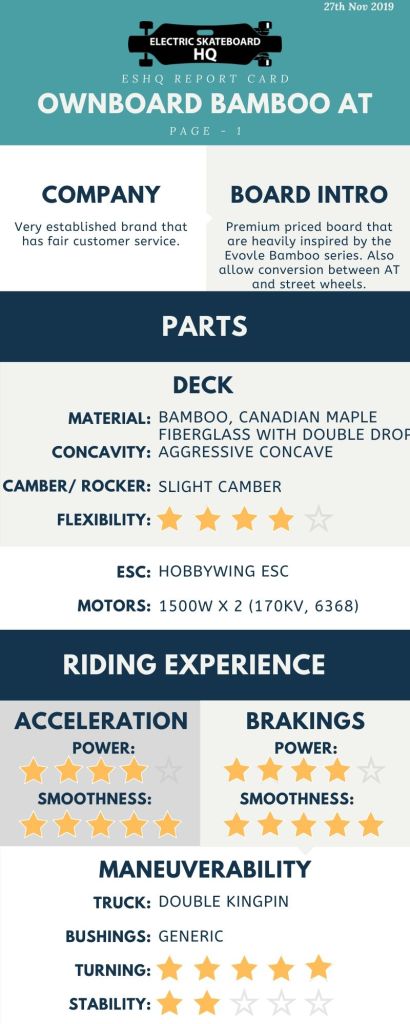
In late 2019, many brands, as if on cue, simultaneously came out with their own versions of an Evolve clone. First, we have Fabian’s Faboard Black Carve, followed by Ownboards Bamboo and Carbon AT, which was then followed by Verreal RS and several more by smaller brands.
Needless to say, the most notable among these Evolve contenders are the Ownboards, as they are a major Chinese brand, and hence we have high hopes for them to put out a quality product and be the Evolve killer. Obviously, Ownboard is not trying to hide their intentions in going after the Evolve crowd. Ownboard Bamboo and Carbon AT were made with every feature that the Evolve Bamboo and Carbon GTR have, including the ability to switch between AT set-up and street set-up, the use of double Kingpin trucks, double drop decks and belt motors. To top it off, Ownboard achieves all of these with the price of $999 which undercuts Evolve by half.
So, today, we are going to find out if the Ownboard Bamboo AT and the cloud wheel set-up (named Bamboo GT) have what it takes to be the Evolve Bamboo killer.
Components
Deck
Right off the bat, let’s talk about the components used in the Ownboard Bamboo AT. Ownboard uses a broad, flexible deck made from Fiberglass, Bamboo and Canada Maple that has an aggressive concave. Unlike the Evolve, Ownboards deck features an aggressive drop in its double drop deck, allowing a lower ride height and therefore a far more stable ride, which is sorely needed in the Bamboo AT. Unfortunately, this also means the option of using normal street wheels is off the table, as even with the relatively large 120mm cloudwheels I still bottomed out pretty often.
Thankfully, the flexible plastic enclosure below the deck looks like it’s durable enough to endure the scratches.
Trucks
The Double Kingpin trucks on the Ownboards are maneuverable to a fault and allow for a super-narrow turning radius. I honestly think Ownboard should use better and harder bushings for these trucks. I tightened them to the max and the wobbles were still bad, limiting my speed to below 22mph (36kmh) in the AT set-up. Even after switching to the smaller 120mm cloudwheels (GT set-up), going at 25mph (40kmh) still felt pretty sketchy to me.
Of course, any Evolve rider will tell you that Double Kingpins are not meant for high-speed, but with a bushing swap, Ownboard AT could achieve much higher stability. In fact, with harder bushings in the cloud wheels set-up, cruising comfortably near top speed would’ve been possible, thanks to the very low riding height.
Wheels
On the topic of wheels, both the 6″ airless honeycomb wheels and the 120mm cloud can go off-road. Though you don’t get to play with the tire pressure like you do with pneumatic tires, the airless honeycomb felt on par with pneumatics when it comes to absorbing bumps on rough terrain. Even the freaking HUGE cloudwheels are big enough to render most obstacles harmless. However! Riding the cloudwheels off-road is definitely not something you should be doing often, as the wheels are soft and will damage easily on harsh terrain, and those wheels aren’t cheap. I tested them off road and I have to admit that I was nervous about my wheels the whole ride.
Many people ride fast and look to big wheels
to stay safe from bumps and cracks. For them, my advice is to go with the GT
cloudwheel set-up. Though the big AT wheels can roll through sticks or stones
at high speed without issues, the wobbles are a big problem. On the other hand,
riding on the smaller cloudwheels is a much more stable ride, and equally
crack-and-bump proof!
ESC and Control
Next, let’s talk about the controls. Similar to the other Ownboards, the Bamboo uses a 10s Hobbywing ESC for this board, and for those who are familiar with Hobbywing ESC the controls need no further explanation- they are known for Intuitive, responsive control that’s perfectly smooth in both acceleration and braking.
Update: New OLED remote with telemetry is now available
Power and Performance
Before receiving the board, I was worried that the 10s ESC might not be able to deliver the required power and torque for an AT set-up. After my test, I am happy to report that this baby is plenty strong and has no issues on steep angles.
The two 6368, 170Kv, 1500W motors should definitely be powerful enough for most people. Those who dislike Hobbywing for its tame braking power are still going to be disappointed by this board’s brakes. They are not at the level where tight-brake lovers will enjoy it, even though the dual belt set-up did increase the braking strength. Comparing Hobbywing’s control to the Evolves, Ownboard Bamboo is smoother in acceleration but tamer when it comes to brakes. Which is better? That comes down to personal preference, just like the everlasting argument between Hobbywing ESC VS LingYi ESC.
Range
Now, it’s numbers time.
The 504WH, 14AH Sanyo GA 10s4p battery pack is marketed to last for 19miles(30km) in AT set-up, and 26miles(42km) in the cloudwheels GT set-up. I am happy to report that my range test yielded results that exceed the marketed numbers for both AT and GT set-up. Perhaps the test is slightly conservative this time, as the speed wobbles kept me from going as fast as I usually go, but the numbers are still impressive. One thing to note though, voltage sag does set in at around 25% battery level and when that happens the board will have a delay when drawing power for acceleration. However, the acceleration curve does stay smooth and the power picks up eventually, so I think that’s forgivable. Fun fact, the Evolve Bamboo GTR has the exact size 504wh battery with Samsung 35E cells and promises similar range.
Ownboard AT Full range test
Speed
Marketed top speed for the AT is 24mph(38kmh) while for the GT it is 26mph(42kmh). Again, these numbers are similar to the Evolve GTR. While testing Ownboard’s range, I had no trouble exceeding the top speed in both AT and GT set-ups. The board even felt like it could have given me more speed, but it was too wobbly for me to really test the limits. If anyone has managed to get to the true the limit, please do tell in the comment section.
Verdict
All in all, I think Ownboard has a winner here, and I especially love the GT set-up with the cloudwheels. There are just so many great things about the Ownboard Bamboo. Carving on it is super fun thanks to the Double Kingpin trucks, the flex deck, and the soft cloudwheels. And it’s relaxing and carefree, thanks to the safety that larger wheels provide and the smoothness of the Hobbywing control. It also has great range, great torque, and good top speed. It really is one of the best boards to come out last year.
With that said, I wish Ownboard went all the way and strived for perfection. My wish list for this board would be better bushings, no voltage sag, and tighter brakes. Sure, none of these are deal-breakers, but at least some of them could be easily fixed by Ownboard and probably should be!
I also wish they didn’t have this thing written under the deck. Thankfully nobody sees it.
VS Evolve GTR?
Is Ownboard Bamboo AT worth buying over the Evolve? The answer is Yes, especially if you don’t care about brand names. Evolve may have better style and use more well-known skate parts, but when it comes to value and price? Ownboard is a clear choice.
If you are interested in buying a Ownboard board, be sure to check out our affiliate discount link here and uses code: “ESKATEHQ” during check out. It will help you get a small monetary discount and helps us out too. On top of that, you’ll be tagged as an Electric Skateboard HQ customer and probably be treated better. Cheers!