Verreal F1 Review – Making every penny counts.

Verreal F1 – Review

Foreword

Following the success of MeepoBoard, many Chinese companies took the same approach and began to offer their own brands of electric skateboards into the market.

These Chinese electric skateboard companies share a similar business model, that is, acting as ‘aggregators’ rather than manufacturers. They pick existing parts, available in the market, assemble a board, market it and sell it under their brand, and hopefully provides meaningful customer service.

As the time of writing, 4 of such companies stood out from the crowd: Meepo (the OG), Wowgo, Ownboard, and Verreal, which arrived slightly late to the party.

In essence, all of them are similar, yet each provides a slightly different flavor, and with each of them having very short iteration cycles, the race to be the budget board champion never truly ends.

Today, we will be reviewing the Verreal F1, the latest iteration offered by Verreal.

Introduction to Verreal

Shenzhen Verreal Technology Co.,Ltd is founded in November 2017 by Vic Duan and 3 other team members.

Verreal launched their first product, Verreal V1 in December 2017.

Following the budget electric skateboard formula laid out by MeepoBoard, Verreal managed to carve out a space for itself largely thanks to the very visible efforts of the founder, Vic, in the areas of pre and post-sales service.

Best remembered as a scrappy small company which tries its best to put out quality boards at the lowest possible price, Verreal operates with a small team. It currently has 12 team members, selling 3 similar products: – Verreal V1S, Verreal Mini and the Verreal F1 that we will be looking at today.


Verreal F1 Specs

The Verreal F1 is a very well rounded board.

  • Top Speed: 23.6mph (38kmh)
  • Range: 11mil (18km)
  • Weight: 15.9lbs (7.2kg)
  • Charge Time: 3 Hours
  • Features: Swappable PU Sleeves, Regenerative Braking.
  • Price: around 430 USD.

Build Quality

If you are looking for an amazing unboxing experience, well, look away.

While most of the budget brands have come a long way in improving their packaging and presentation, Verreal doesn’t even try. There aren’t much in the box, just the bare essentials. (No wall hangers, lights etc.)

The protection put in to prevent damage in delivery is just the bare minimum.
It does not use a double-box packaging method: the box it came in broke during the delivery, exposing the wheels to the outside. Inside the box, there are only protective foams surrounding the trucks, and some recycled card boxes to protect the deck.

Thankfully, in my case, the board didn’t sustain any damage during delivery.

This slideshow requires JavaScript.

Deck

To differentiate itself from other Chinese budget boards, Verreal F1 has added in its own special flavor with its deck choice.
Using a stiff 7-ply Maple deck with a micro-drop and a radial concave is a smart move.

Comparing it with other Chinese brands, the micro-drop deck felt rather cheap, using mixture of North China maple and Canadian maple.

With that said, it doesn’t have any negative impact on the riding experience.

In fact, as the micro-drop allows a slightly lower ride, it allows a more stable ride feel-
and the concave on the deck is just enough to help my feet stay on the board.

ESC & Remote

On its belly, Verreal is using a single enclosure set up.
The enclosure is made out of aluminum, which adds points in durability.

SONY DSC

The single enclosure set up does make the board a bit tail heavy – not something you will notice during riding but definitely something you will feel when carrying the board.

Inside the enclosure, the Electronic Speed Controller (ESC), which Verreal F1 uses is currently shared by the Meepo 30″, Ownboard and Wowgo. It’s known to provide one of the smoothest control – something we will talk about in depth later.

Wheels

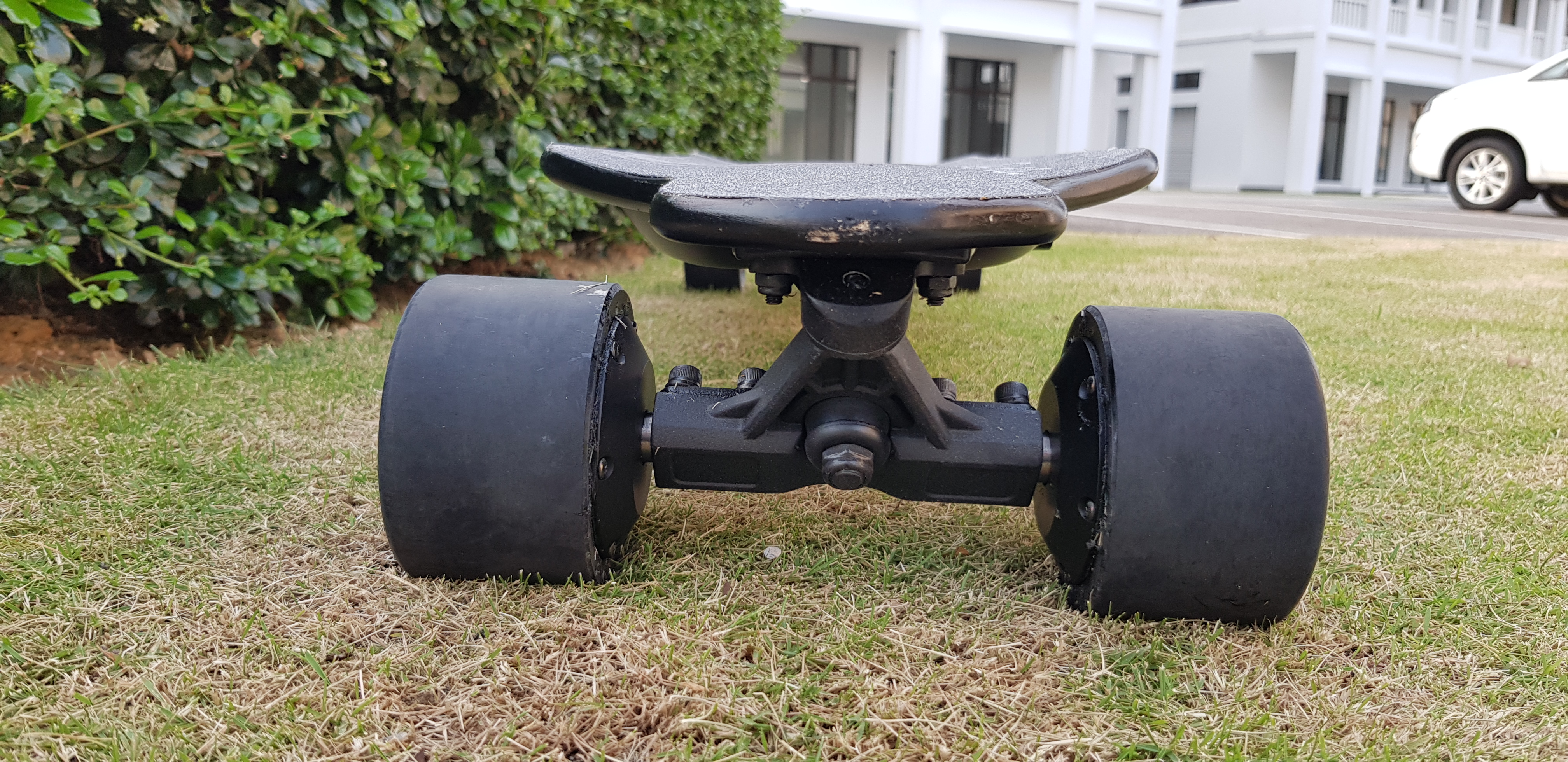
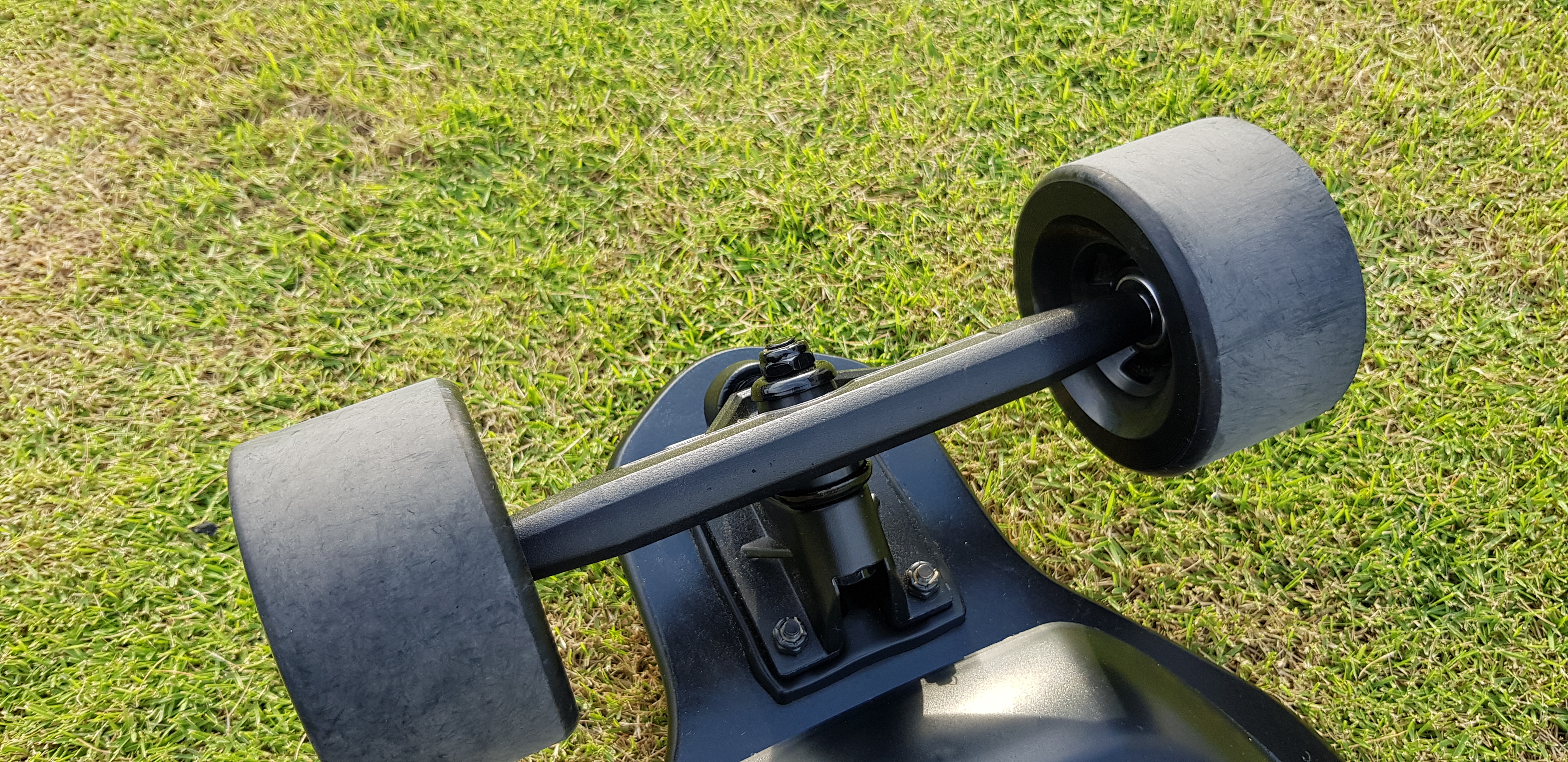
Verreal F1 opts for the industry standard 90mm wheels – which should get you over most bumps and allows for riding on less than perfect roads.

The PU sleeves on the hub motors are swappable, an important feature that most modern hub-drives have.
Verreal claims it has improved the elasticity and durability of the hub motor.
I can’t comment on the durability, just yet, but I didn’t notice any significant difference in softness between Verreal hubs and other hubs.

And while swappable PUs are a great feature to have, Verreal is selling each urethane sleeve at $45. With a hub motor priced at $70, you probably might just want to swap the entire hub motor out when you have used up the 2 spare urethane sleeves that come with the board.
(or maybe even swap out to a 97mm Meepo hub? Or Skullboard’s 105mm rubber wheels?).


Trucks

Verreal F1 is using the same truck shared by… well, every Chinese budget board…
And there is nothing wrong with that.
They come with a soft green bushing which allows easier carve, something I really appreciate.

Back Truck
Front Truck

Summary of Build Quality

Understandably, you can’t meet the $428 price tag by without cutting some corners, and Verreal did the right thing by taking a knife to non-essential parts and not compromising the riding experience.

The result is a board that while it looks and feels low cost, still shows promise in performance and durability.

The poor packaging and finishing make it an unimpressive gift though.

Riding Experience:

Acceleration and Deceleration

There are 3 ride modes:

  1. Slow mode with a top speed of 12.4mph/20kmh
  2. Medium mode with a top speed of 18.6mph/ 30kmh
  3. Fast mode with a top speed of 23.6mph/ 38kmh

Let’s start by talking about the acceleration and deceleration.

As mentioned, Verreal F1 use the same Electronic Speed Controller(ESC) as the Wowgo, Ownboard, Harvoo, Meepo 30″.

By consensus, this ESC is touted as offering the smoothest control by ace-ing with precision, latency, and consistency in control.
Even better than Boosted some may say.

Many other ESCs allow speed changes to come like a gradual wave – when accelerating, you feel the power slowly flow into the board and you sort of have to time that.
Not this ESC, this ESC allows you to dial into the speed that you want, in a precise manner, without any delay. A feeling that is appreciated universally, as it results in smooth and predictable speed control

(Side notes: Accurate control without any assisted speed ramping also means that it won’t stop you from trying to make drastic acceleration or deceleration. Push the throttle to the max and the board will try its best to zap off, which some absolute beginner who has poor throttle coordination finds it very intimidating.
But once gotten used to Eskating, most love the control to be the way it is.)

The control certainly passed my newbie test – where I lend the board to a completely skateboard-naive person and they are able to learn to ride it within minutes.

On the 3 riding modes, all of the modes from Slow to Fast have the same acceleration and braking pattern, just with a different top speed cap.

Without the worry of jerky control, I just stay in Fast mode all the time. Why not?

Vibration & Stability

Stiff deck + hub motors, well, you know how it gonna be.

The improvement that Verreal have put into the hub motors was evidently not enough to battle the vibration I got from the rough roads I ride on. I feel every vibration from the road when going over rougher roads.
Installing a softer shock pad between the trucks and the deck might help.

Don’t get me wrong, the 90mm wheels do go over small bumps well and the size does help, but its just not enough.

Swapped the front wheel to 85mm Orangatang Caguama, it helps abit

On the other hand, stability is where the Verreal F1 shines.

The combination of the smooth control and the micro-drop deck with a concave really makes F1 one hella stable ride. The micro-drop concave deck essentially locks your foot in place while allowing a slightly lower ride. No worries about maneuvering at high speed.

Top speed all the way.

Remote Control

Verreal uses the same remote that most of us are familiar with. And it is a great remote.

It’s ergonomic and fits nicely in the hand.

The dial is springy and with a good amount of resistance for better control and it has a reasonable amount of travel.

It is a simple remote without many bells and whistles, and no disconnection. (unlike some premium brand. =P)

Summary of Riding Experience

The riding experience is superb.

The smoothness of the control, the soft bushing, the micro-drop deck makes riding on the Verreal board a comfortable experience.

I like to describe the ride as feeling like riding on a skiff. It felt quick and responsive to maneuver as opposed to some other boards that give a sturdy, powerful and surf like feel.
It is a ride feel that I personally do not prefer; yet still find it very enjoyable nonetheless.

It’s so objectively good that I just can’t not like it!

Verreal F1 gets an ‘A’ from me for riding experience.
(As long as I am riding it on a smooth pavement that’s it.)

Capability

Verreal F1 is on par in its capability with the other Chinese budget boards.
Meaning – good value for money if compared to boards from any other segments.

Range

There are three battery options for the Verreal F1.

  • 4.0AH, standard battery (144wh) -8.7miles/ 14km range
  • 6.4AH Panasonic  (230wh)  – 13miles/ 21km range
  • 8.4AH Sanyo (302wh) – 18.5miles/ 30km range

The board that I am reviewing has 4.0AH standard battery. and it can definitely achieve 14km range in mixed riding in high-speed mode.

As the marketed range correlates with the battery size, (watt hour/10 = expected range in km)
I have no doubt that the marketed ranges on the other battery options are also reasonable and not exaggerated.

Speed

Marketed top speed is 23.6mph/ 38kmh, and most of us hit 25mph/40kmh without any issue.

The stability and the smooth control makes Verreal F1 one of the few boards that I feel comfortable hitting and staying at top speed.

Torque

The dual 250W hub motors are pretty fair.
Allowing the Verreal to climb most hills.

It passed the standard stop and go test on a 15% incline.

Customer Service

Customer service is a big part of an eskate purchase, even for an affordable brand.

During the one year in which Verreal has been around, it has established a good reputation for its pre and post-sales service.

Vic Duan, himself, is the person who looks after the bulk of customer service, and he has been very responsive and helpful.

Verdict

Is Verreal F1 the best affordable electric skateboard right now?

Well, no doubt it’s one of the best.

The smooth control combined with the stability of the micro-drop deck provides some of the best riding experiences any eskate can have.

Comparing the F1 with the Meepo V2P, which has 97mm wheels option/ better ‘Shredder’ trucks and a better quality deck, Verreal F1’s smoother ESC and better stability may make it the preferred choice for many people.

Not to mention Verreal F1 is almost just one deck difference away from the Wowgo 2s and Ownboard W1S.

So, it depends:

What’s for sure though is even for those who do not consider Verreal F1 to be the best budget board, they will have no trouble enjoying themselves riding on the F1.

Beside the refinement and the polish, there is no real deal breaker for the Verreal F1 –
making it an easy recommendation for anyone and everyone looking to buy an Eskate.

Good job Verreal!

Use coupon code ‘EskateHQ’ during check out to receive $45 off from on your Verreal purchase.
($55 off for now)

Visit Verreal @ https://verrealboards.com/


update 14th October 2018:
Verreal has improved the packaging and finishing. Here is some photo from the latest production model.

Exway X1 – The New Golden Standard of the East?

Follow the discussion on Reddit here

If you want the TL;DR, see end of review

So What’s The Rub?

Many recreational vehicular hobbies follow a similar pattern of development. They almost always start out with a small group of super passionate people who manage to shoehorn something together that’s fun and exciting and gets the adrenaline going. Then, more of the same sort of DIY minded people come together, sharing expertise and experience, until there’s a sizable community.

Now a problem arises, where the DIY vehicles look and feel very DIY, with gotchas and wacky issues and weird configurations. So, inevitably, somebody starts making and selling parts that solve these issues. Pretty soon, manufacturing becomes serious business and companies start springing up providing ready-made parts. Reliability and consistency increases.

With the beginnings of market saturation taking place, the race to drive down the price while upping the quality starts. The main drivers in the beginning are usually boutique manufacturers who make high quality but expensive vehicles. Then as soon as there’s a market for such gear, the manufacturing wheels begin to turn in the East. Low budget, cheap products begin to pour in, saturating the market with wares. It usually takes the target audience a little bit to adapt. Those who will settle for the cheap products do, and those who want high quality and have a big budget continue to purchase expensive, quality products, or simply DIY.

But what about the people in the middle? What about the ones who are willing to spend a bit more for great quality but are unable to spend a lot for their gear?

I believe this is the stage at which electric skateboarding as a hobby is currently. At the high performance, high price end, we have Evolve Skateboards, Boosted Boards, Metroboard, and similar. At the low performance, low price end, we have the Meepos and Teemos of the eskate world. However, there’s a slowly emerging middle class that combines a sub $1k cost with performance, versatility, and quality. These boards are aiming to appeal to the section of the rider demographic who are willing to spend for more quality than one would get with cheap stuff but won’t cross the $1k line. Right now, there are very few players in this space. But manufacturers have been making moves, and already, Boosted Boards has all but cornered the market segment with their Mini series, with Backfire also trying to carve out their chunk of this space. But do they have a new challenger with Exway? Is the X1 a winning formula against the established heavyweights?

Hardware

The hardware on the X1 is seriously nice. America sourced Seismic Aeon downhill trucks, 90A Seismic bushing, and a contoured, stiff multilayered (bamboo, CA maple, fiberglass, carbon fiber) deck layup makes riding at speed controllable and responsive. The dual electronic speed controller or ESC, a collaborative effort between Exway R&D and Hobbywing (A long time player in the hobby hardware category), is directly configurable, updatable, and capable of pushing 110 amps peak in “Variable Frequency Soft-start” mode, or what we typically call “FOC” mode. The dual 1000 watt hub motors are developed in house and feature easily replaceable urethane (comes with both 80mm and 83mm sleeves standard). All this is driven by a 12S li-ion polymer battery that’s integrated into the deck, allowing for a deceptively thin profile. It’s really quite an impressive package.


Remote

The Exway remote is really my favorite remote by far. It’s ergonomic, solidly built, extremely responsive, and finished in a nice, matte, soft touch material that’s just amazing to run your hand over. It also features a bright OLED display that displays live updating telemetry for both the board and the remote, and is easily viewable in direct sunlight. In addition to all that, Exway also built in nice details, such as the ability to automatically turn on the board when you turn on the remote, ability to display the charge level of the board while the board is plugged in, and a whole settings panel that allows for fine grain adjustment of throttle min and maxes, pairing with different boards, and some other stuff regular users probably shouldn’t mess with to be honest. The remote also features a vibration motor that alerts you to speed mode changes, low battery, and a variety of other things you should be aware of while riding.

The user experience of the remote is great. There’s no lag at all, and control is precise and unfailing. Despite my best efforts, I was never able to make the remote disconnect no matter how many times I rode through areas that would usually make Evolve and Boosted remotes disconnect. This is the standard manufacturers should adhere to.

Technical Testing

Testride route:

Rider specs: 125lb, 5’6″

As part of my reviews, I perform a series of measured, purely technical tests on review units. These tests are meant to push the units to the extreme that their electronics can handle and reveal any problems that may have not been revealed by simple riding tests. Technical tests are done under the most favorable conditions possible.

Acceleration

It’s great. Deceptively quick, insanely smooth, and outruns a Boosted Stealth in casual testing. However, it’s worth noting that by default, the X1 actually comes with the highest speed mode, mode 4, set at only 80% power. This can be remedied by simply connecting to the board via the app and pushing the acceleration and braking sliders all the way to 100%. At 100%, I was very surprised at how mean the ramp-up gets. It’s still insanely smooth, but if you’re not careful you might slip off the back. Don’t ask me how I know this. Suffice to say, you will pretty much never want for torque.

Worth mentioning is the fact that as of mid-August, Exway has pushed out a firmware update for the board and remote that ups the max possible acceleration rampup. 100% acceleration is now even meaner.

Top Speed

Measured, my speedometer says 25mph going up a 5% hill grade. This is in line with Exway’s figures. It’s also notable that a friend who weights significantly more than I do (185 lbs) gets the same speed going up the same hill. In the same mid-August update I mentioned above, Exway has increased top speed to 27mph. That’s some speed.

Range

When I leave the X1 at its “recommended max settings”, or how it’s set up out of the box, I get around 9-10 miles of heavy riding in a very hilly city (San Francisco) with a bit to spare. In my opinion, this makes it a good mid range board. If you’re looking for something long range that will take you 20 miles on a charge, this is not it.

Braking

The brakes are pretty great. As with acceleration, control is precise and smooth. This is very important, as braking is paramount to rider safety. Strong, predictable brakes means a safer ride, and the X1’s brakes certainly make me feel safe. As of the same software update mid-August, the brakes are now even better. Braking distance is now significantly reduced and max braking power has been increased.

Stress Handling

As part of my acceleration tests, I do a series of full accelerating and full braking to test responsiveness, acceleration/braking curve, and power delivery. The X1 passes with no issues, and it still consistently impresses me with how nicely it handles this test.

Turning Radius

Unlike most boards available at retail, the X1 comes with quality hardware. Seismic’s bushings produce no slop and stay self lubricated, which means predictable maneuvering at both max and min speeds. All Seismic Aeon bushings will work here, which means you can dial your trucks exactly how you like. Personally, I prefer Seismic’s 86A bushings since I’m lighter, but the stock 90A Seismic bushing the X1 comes with are likely the way to go if you’re heavier.

Ride & User Experience

There’s really no debate here. The X1 is a great board to ride if you like speed and power. However, it’s also a great board if you want a thoughtful user experience. So many manufacturers ignore the user experience to their detriment, but here is where the X1 really shines. If you’ll allow me, I’m going to list a few things I really like about the X1’s UX:

  • Magnetic charge port with magnetic cover means that I can pull the board off my rack, have the charge port cover automatically snap back into place, and not have to worry about water ingress running through puddles.
  • Turning on the remote turns on the board as well. I never have to fumble around for the on button.
  • I can easily see the charge level down to the percentage when the board is plugged in and charging just by turning on the remote.
  • The remote’s display runs at 30fps, providing smooth animations and responsive feedback.
  • There’s a cruise control option as well as a reverse braking option, which enables the Exway to have a mode similar to Mellow’s Endless mode as well as Boosted’s braking reverse control scheme.

As an aside, I’d like to mention that for the initial review unit, Exway USA asked me to abuse the daylights out of it to see if it would break. It didn’t break and I never had a problem with it.

A Word On Customer Service

Historically, Chinese manufacturers have not been great with foreign customer service. It can often be a huge headache getting support, especially for a product category like electric skateboards, which tend to break down more often due to the nature of the sport. I personally have seen and heard many horror stories from various people of unanswered emails, unintelligible “Engrish”, and even refusal of support. However, I’m happy to report that I’ve had no such problems with Exway USA. They’ve been prompt in their communications and interactions with me (not that they’ve needed to take any significant action) and have a retail presence in many local skate shops on both the East and West coast, meaning getting help could be as easy as hitting up your local skate shop.

Verdict

So how does it stack up?

Well, I’ve had months of experience with the board now, and it’s performed admirably and held up exceedingly well to abuse. Since I’ve begun testing it, it’s gotten speed and control upgrades and new accessories (Exway now makes a shock absorbing grip tape for the X1). It’s become my go to board for running errands around the city. It’s slim, easy to handle, and easy to stow in tight spaces. It’s water resistant, easy to use, and even scratch resistant. I’m already chomping at the bit for a proper long range board from Exway with the same electronics and UX as the X1. But for $888 USD, what more do you want?

Winboard Panther Review – A new benchmark for the mid-tier board.

Winboard Panther – Review

Foreword

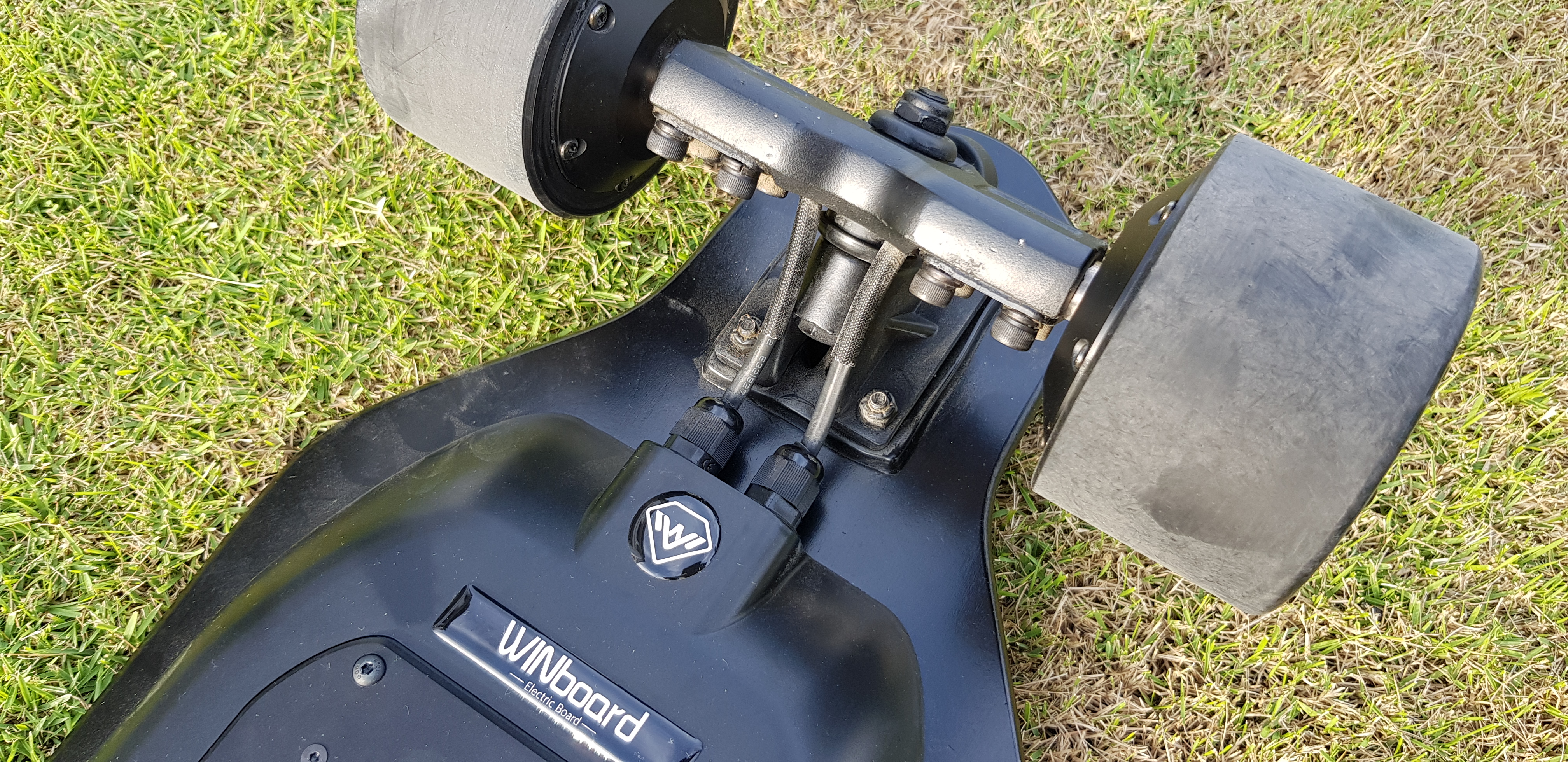
After spending years in the OEM/ODM sphere, Winboard finally decides to join the action by launching their own line of products. This is no doubt going to be huge for us Eskate consumers as Winboard has been one of the biggest players in Eskate manufacturing with a long resume of working with brands such as LouBoard, and HaloBoard. It is also the manufacturer of the beautiful carbon fiber deck for the Predator Banshee – the same deck featured on the Lynx series.

On August 18th, Winboard is going to jump into the market with 2 lines of products, the shorterLynx, and the longer Panther. My buddy Drew has already reviewed the Lynx Challenge, this is my review of the Panther.

Let me start out by saying that I expect the Panther to be the benchmark for future mid-tier electric skateboards. And it’s not just because of the stunning graphics on the grip tape.

Introduction to WinBoard

Founded in 2015, Winboard has always been one of the top Eskate manufacturers specializing in carbon fiber materials and hub motors.

They have a variety of products available for purchase but their focus was never to sell directly to the consumer. For that reason, I have been very critical of buying their products as an individual buyer, due to the fact that you probably wouldn’t get any post-sale support.

And that’s why things got really interesting when Winboard set-up their retail branch, and it seems that they are really serious about it.

How serious?

  1. They set up a fully functional website for retail.
  2. They are launching two very competitive products simultaneously- the Lynx and the Panther, on August 18th 2018 – with a grand opening lucky draw to have a random 5% buyers get their boards for free. (and extend the original 6 months warranty to 1 years for free for all.)
  3. They opened 4 branches worldwide to support sales and customer services – in theUS, Australia, Czech Republic, and Spain. Repairs and service will be handled by the local distributor (in the US, it will be at Las Vegas)

A big manufacturer, going into retail themselves with a head full of steam, I wouldn’t want to compete against that.

Winboard Panther Review

“Wow”.

Is what everyone says when first shown this board.

A lot of effort was put into designing a new grip tape graphic for the Lynx and the Panther, and I am sure you will agree with me that it was money well spent.

Call me superficial but the gorgeous graphic really did make me like the board better.
I felt proud to be seen riding this around on this gorgeous board, but looks aside, does it have any substance to it?

Winboard Panther Specs

The Winboard Panther is a very well rounded board.

  • Top Speed: 25mph (40kmh)
  • Range: 20mil (32km)
  • Weight: 17.5lbs (8kg)
  • Charge Time: 3 Hours
  • Features: IP 65 Waterproof, swappable PU Sleeves, Regenerative Braking.
  • Price: 749 USD.

Build Quality

Looking past the beautiful grip tape, the board doesn’t have a particularly innovative design. Unlike the Lynx, which rocked a carbon fiber deck to house everything, the Panther has a typical setup – a maple deck with an enclosure underneath spanning the length of the board.

All in all, the board is very presentable- from the sturdy built to the small graphics on the wheels, it is not hard to see that the board came from an experienced manufacturer.

Deck

The Panther features a maple deck with a nice concave.

It’s not too aggressive. Just nice enough for me to feel where my feet are and make controlling the board more comfortable.

As usual, stiff decks help with stability at high speed while sacrificing the comfort of a flexy deck.
Considering that the Panther can go pretty fast, I think using a stiffer deck is a wise choice.

Still has some flex to it.

Wheels

The 90MM 76a wheels are big and soft.
90mm (and above) is the size that I like my wheels to be as I don’t have the smoothest roads where I live, and softer wheels help with rougher roads significantly.

The PU sleeves on the hub motor are swappable, an important feature that most modern hub-drives have.

Trucks

They look and felt sturdy. Closer inspection shows nothing wrong with them.
(No lopsided screw holes or anything like we found on our Lynx review unit)

Summary of Build Quality

The Panther looks and felt really solid.
Nothing I can complain about really. I couldn’t comment on the packaging as I was told that part wasn’t finalized yet.

By the looks of it, it is well worth it’s $749 price tag.

Riding Experience:

Acceleration and Deceleration

There are 4 ride modes:

  1. L mode with a top speed of 10mph/16kmh
  2. M mode with a top speed of 20mph/ 32kmh
  3. H mode with a top speed of 25mph/ 40kmh
  4. H+ mode with a top speed of 25mph/ 40kmh, but with crazy acceleration.

Let’s start by talking about the acceleration and deceleration. I have to say, it’s very well configured.

I heard that Winboard had programmed the board to smooth out speed changes in an effort to eliminate jolts, and that effort is noticeable.

When pushing the throttle hard, the board will flow easily into the acceleration, even in H+ mode.

When letting go of the throttle, either by choice or by accident, the board doesn’t experience a sudden loss of speed. The board will ease out that deceleration smoothly.
Even trying to kill myself by going from full-throttle top speed to full braking, the board tries to ease me into it.
(But I have to admit, I didn’t commit to testing the full-throttle top speed to full throttle braking that strictly, I still pull the throttle back a bit before committing to full braking, because a previous test on another board sent me flying and I’m too chicken to do that test properly now.)

I think this configuration helps a lot in making newer riders feel safe, knowing that accidental input is not going to throw them off.
Some may like a more raw and untamed board, but that’s clearly not what Winboard is trying to be.

So, back to the 4 riding modes:

The L-mode is very gentle on both starting and braking – it passed what I call a newbie test, where I give the board to someone who has never ridden an Eskate before and see if they complain about anything.

I did it twice and both times, both newbies felt comfortable on the Panther within 5 min – not zooming around per-se but at least moving tentatively and starting to learn to turn.

Once the training wheels can be taken off, the M-mode is where the majority will spend time for relaxing rides and cruises. The acceleration and braking are still gentle, but less boring speed-wise.

H mode is where the veterans of Eskate will reside. Strong braking, quick acceleration.

And that H+ mode? I think it was made for the top 5% of veteran eskaters. Waayyyy too fast for me.
Good for drag races, but I don’t see myself using that, ever.

Vibration & Stability

Vibrations are tolerable on the Panther, even with the stiffer deck. I am not entirely sure what to point to but vibration on the road felt muffled on the Panther, perhaps due to the soft riser or perhaps it’s the softer, large wheels?

At 17.5lbs(8kg) Panther is not light but that heaviness makes riding it feel stable. The sturdiness makes the Panther a very comfortable ride at high speed.

Remote Control

One of the best remotes I’ve ever used.

It’s ergonomic and fits nicely in the hand.

The dial is springy and with a good amount of resistance for better control and has a reasonable amount of travel.

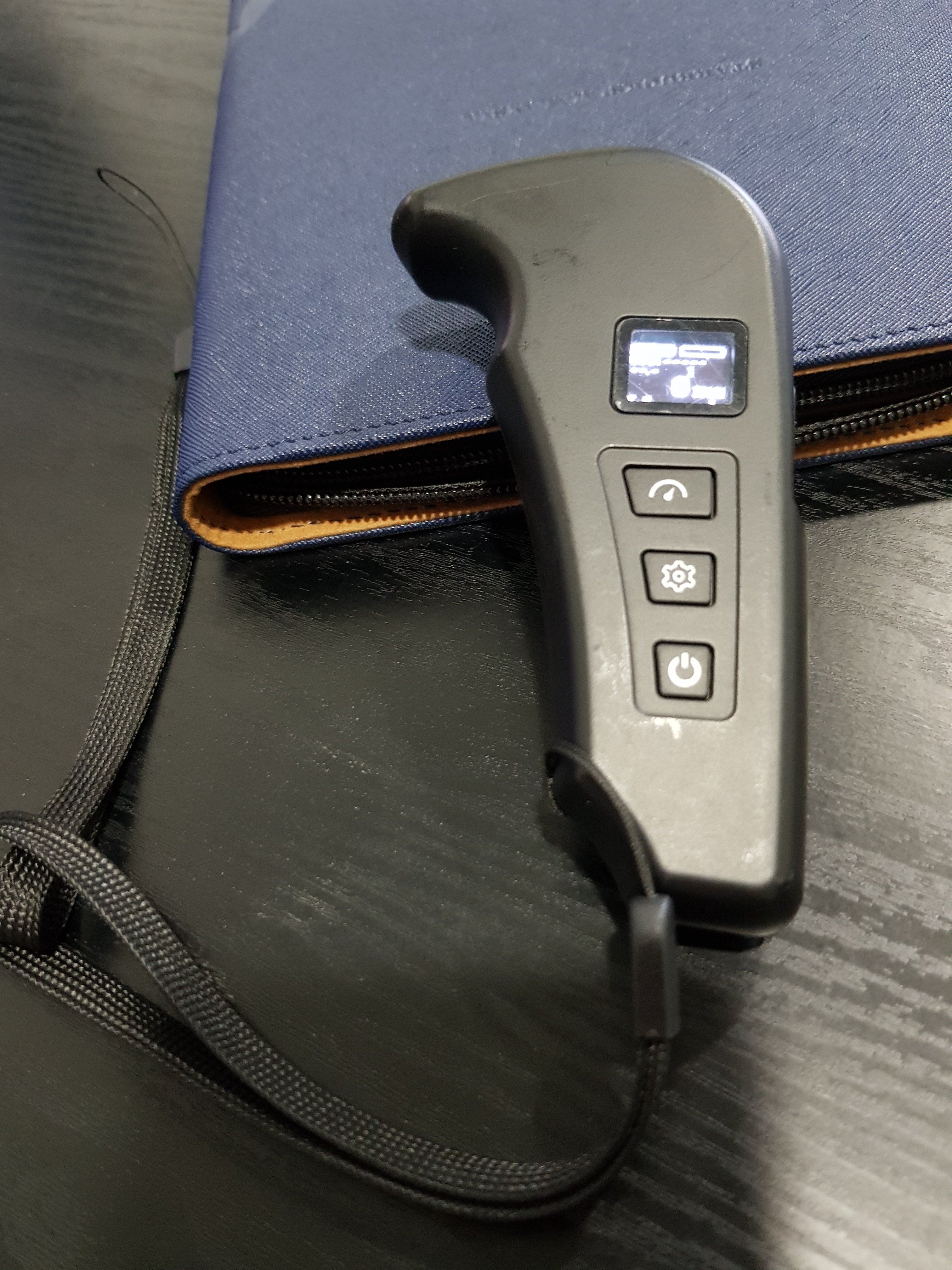
The remote also has a screen that shows all the important information – Battery life of remote and board, current speed, ride modes and even an odometer!

There is also a cruise control mode available, press down the middle button and the board will maintain the same speed until you tell it otherwise.

Of course, no disconnection during testing. It’s a great remote.

Summary of Riding Experience

Oh I l love it, but it wasn’t perfect.

I set up my trucks to be on the tight side, to make it as stable as I could for speed, but even with it loose, I don’t see how the board could be as carvy and maneuverable as other eskates on the market.
Perhaps changing the trucks and bushing might help with that, but at the stock setting, the board doesn’t allow very tight carving.

Cruising on an open road at higher speeds is where the Panther truly shined.
Big carves on an open road, feeling stable on turns, reliable and comfortable control really helped to get the most enjoyability out of a nice cruise.

That stability and smooth control will also allow more conservative riders to expand their speed limit, and we all know eskating is more fun when it’s fast.

Capability

Panthers are amazing things.
The more I learn about them, the more they amaze me.

Panthers can run up to 50mph, and travel up to 20miles per day.
they can also leap up to 40 feet up! Crazy!

Ops! wrong Panther.

I got you, didn’t I?

The Winboard Panther, the skateboard, er..hem, are very capable as well.
About as good as a real panther in range per charge, with a very good top speed; leaping ability though wasn’t specified by Winboard so I’m not too sure about that.

Range

The Winboard Panther is shipping with either a

  • 9AH, Samsung 30Q 10S3P battery (324wh) or
  • 10.5AH Samsung 35E 10S3P battery (378wh).

Same price and you get to choose.
Please refer to your nearest DIY guy/gurl or my short battery guide if you can’t make sense of the differences.

Both batteries should perform the similarly with this set-up but I personally prefer Samsung 30Q because it was what I received 😛 — and because it has better continuous current output.

The advertised range for the Panther is 20miles(32km). Which is by no means an inflated estimate and you can tell by the size of the battery.

My personal range test, running on a flat surface on mostly M-mode lasted me a bit more than the advertised 20miles (32km) before the battery went dead.

Of course, if you go full throttle top speed all of the time, you will get much less than 20miles(32km) range.

Voltage sag: Top speed began to drop to 40 km/h by the half bar, and at 36 km/h by 25%. It is still capable of going at a ride-able speed until the very end which is good!
(my weight 165lbs/ 75kg)

Speed

Marketed top speed is 25mph(40kmh).

Like the case of Drew with the Winboard Lynx, we both have no problem passing that. I hit 28 mph (45kmh) with a speed tuck.

Winboard told me they made the decision to market it as 25mph (40kmh) as they would rather under-promise and over-deliver than the other way around. This gets a brownie point from me!

Torque

I am not really worried about the torque that this board provides at all, and I can’t really find any hill that it can’t climb over.

My Standard stop and go test is on a 10% incline. No problem for the Panther. In fact, it’s not even breaking a sweat.

This is but a 10 percent hill.

Retested on a 15% climb, and it still didn’t break a sweat doing a stop and go.

Notably, though, the board couldn’t brake to a stop while braking downhill. It can slow to almost a crawl, just not to a complete stop. Only a few boards we have tested have been able to achieve this feat.

Customer Service

The best prediction of the future is the past, and Winboard, at least the retail branch, has no past history to base any prediction on.

However, things have been done to make Winboard a safe recommendation, even on day 1.

For instance, they have installed local distributors around the world to handle customer service and repairs.

On top of that, they didn’t get any random Joe to man their businesses. They manage to get Michael Espinosa from the Esk8squad to be their brand ambassador in the US and to help with servicing, and that alone would be enough to assure me on the post-sale support.

Other Features

The Panther isn’t packed with features per se. It’s a relatively simple board.

  1. It has swappable urethane on the hub motors, which is nice.
  2. IP 65 waterproof rating that I am not going to risk testing. The board looks quite sealed against water getting in, but water is never good for an eskate. Think of the motors, think of the deck.
  3. If you need head and tail lights, they do offer a 25% off coupon for Shredlights with purchase of the board.
    (It’s a pretty good deal, in contrast our “EskateHQ” discount code will just get you 10% off. Check out our atypical Shredlight review on a OneWheel here.)

Verdict

The Eskate community has seen more unicorns than Shrek in fairy tale so it is often unwise to get too hype on a pre-launch product.

I am aware that “Winboard the manufacturer” has had some ‘disharmony’ with its business partners. With that said, this new “Winboard retail” has done enough to gain my trust and alleviate much of my concern:

  1. They chose to skip the crowdfunding route which historically has been problematic for eskate projects.
  2. They skipped the pre-order wait and released a products that are available right away and should be arriving at doorsteps within a month.
  3. They planned out the way they would handle post-sale service, and they got a reputable eskater to be their ambassador.
  4. They are being honest with specs, not trying to exploit those who are not in-the-know.
  5. And from my dealings with the co-founder, she has a very anxious profile and cares a great deal about serving customers.

And, at the end of the day, the Winboard Panther is a great board. It looks elegant, it rides nicely and it’s powerful.

I have no doubt that this will be the benchmark of mid-priced electric skateboards in the future.

Click to enlarge

So, Winboard is trying to gain a reputation and consumer goodwill by selling their new products, the Lynx and the Panther, at below market price – leveraging the advantage they have as a big manufacturer.

They will launch on August 18th, 2018, and there will be a launch day promotion happening:

  1. One in 20 random customers will get their boards for free.
  2. Everyone get their warranty extended from 6 months to 1 year.

*Promotion only valid for customers who order on that day.

And of course, to top that up, use “EskateHQ” code during checkout to get an grip tape eraser, extra grip tape and Bones reds bearing.
(We know what our readers want. You’re welcome.)

Check out our review on Winboard Lynx

Lynx Infinity Review – By Samuel James

Click here to check out the Winboards

The WINboard Lynx Challenge Launch Review

“WINboard? Never heard of it” was what I told my editor when I was told I would be reviewing a new full-carbon fiber eskate a month ago. He quickly educated me that WINboard is a company that has been around for a while and actually has a history in the eskating game, helping to produce parts for boards like the Predator Banshee, Haloboard, and Louboard for a couple of years now.

“Alright, I am a sucker for carbon fiber, send it along.” was my response, and then a week or so later, I was greeted by this crazy little guy at my doorstep, I knew almost instantly that we would be friends.

EskateHQ readers, meet the Lynx Challenge. The faster, big-brother of a new lineup of eskates being released by WINboard this month.

The Looks:

The Lynx has perhaps the sexiest look of any eskate that I have had the pleasure of reviewing. The unibody carbon fibre deck is a sight to behold, and the stylized covers on the in-hub motors, along with the gorgeous grip tape has made this board stand out from the pack. I have even had reactions from non-skaters who are quick to call out what a sexy hunk of carbon fiber this board is.

(WINboard also sent me a gorgeous second option for grip-tape that featured a lot more purple. I am saving it for when I ruin my first roll.)


The short, rigid deck, set up on 90mm stealth-black wheels truly makes the Lynx look unlike any other board out there. And while this particular setup has its drawbacks, it is surprisingly rideable as a high-speed city commuter.

The full carbon fibre deck also makes this board very light, and extremely easy to bring on board the bus or train. I was able to commute to the train and then simply pop the board between my legs and stand over it, even in a packed rush-hour car load of people. The Lynx is an ideal size and weight for a city commuter who is always on the go.

The Remote:

The remote is light and feels very cheap in the hand, but allows for good control and has a ton of useful information right on the tiny screen. After riding the Lynx for a couple of week, my remote is not too broken up, but I have had the wrist strap slide right out of the little notch, which appears to not connect all the way through. These are all acceptable problems for a budget board to have, but would also be an easy fix for WINboard.

The coolest thing about the remote (besides the dope display) is the fact that it has a forward/reverse toggle. I may be newer to the eskate game, but I had a ton of fun shooting the board away from me and then shifting it into reverse and having it come running back. Kind of a stupid feature, I know, but still something that a potential buyer should know!

The Performance:

This board has some POWER. Two 1500 Watts is a lot of power, and bolting these two powerful hub motors onto a small, rigid deck really puts that power into perspective. I was able to take the board up to 27 mph (44 kph) pretty regularly over the time I spent testing it and it still felt solid as a rock. We are used to seeing companies over-promise when it comes to top speed and range on their boards, but in WINboard’s case, they have underestimated what their board is capable of by listing its top speed as 25 mph.

This power was difficult to manage at lower speeds however, as the board was a little jerky in starting and stopping. I have most of my riding experience with Boosted boards and One Wheels, so I know that I am a bit spoiled in regards to smooth acceleration and deceleration, but it took me a couple of days to really get used to (and brace for) the power that the Lynx puts out when you push on the throttle.

The remote has 4 riding modes that you can toggle on-the-fly:

My brand-new friends enjoyed learning the board on S and then would graduate to M after a couple of rides. My mode of choice was mode H which gave me access to all of the speed that the board had to offer, but calmed down the crazy accel and decel that the Lynx was capable of.

The H+ mode was like letting a rabid cat out of its cage. It “thrusted” very quickly from a stop or slow push and was a challenge to stay on under partial throttle or hard braking. More veteran eskaters might be able to handle it, but it has the same top speed as H, so why risk it? As a rider, flow is very important to me, and running my board in a mode that ruins that flow, just so I can have more power on-hand, is counter-productive.

It should be said that setting up this board for deep carves and tight turns is nearly impossible. Due to the nature of the 90mm wheels mounted over the short sop-mounted deck, it is very easy to get wheel-bite. WINboard has taken this into effect and shipped the board with a very rigid setup that does not bite, but after taking the board into my laboratory and attempting to replace the trucks and bushings to get some lean out of the damn thing, I found myself getting wheel-bite almost immediately.

(In the end, I ended up swapping out the bushings and front truck for a Paris 180mm, also adding some Shredlights (use discount code “EskateHQ” for 25% off!) to decrease some of our “Stealth” factor during night riding.)

I would recommend that inexperienced skateboard builders keep the board in its stock, not-turny, setup unless you are willing to dance with death every now and then and know how to avoid biting on hard turns (I still have not mastered this and ate total shit on a sidewalk in Boston at 1 AM….such is life as a skater).

The Stats:

For the price, this board’s stats are insane:

With a higher top speed and the same range as a Boosted Stealth for around half of the price, the Lynx is an amazing eskate for the money. Add to that the awesome form factor of the small size and light-weight, and you have one amazing deal. It is also worth noting that the board is IP65 waterproof (I took mine out in the rain a lot!) and perfectly shaped to keep the rider dry above-deck.

As with all untested brands, time will tell on the quality of the Lynx, but based on my couple of weeks riding, and beating the hell out of mine, it should stand the test of time. The board has all of the indicators of a manufacturer who cares about quality, from the redundant waterproofing measures on the battery wires, to the spacers used in the wheels.

The one concerning feature I noticed when taking my review copy apart was the fact that the front truck was not quite symmetrical. I found myself unable to get the provided skate tool around the mounting bolt on the underside of the front truck because it was closer to the center than the other bolts.

This indicates that the QA for the trucks might not be the best, and while we have had a recent spate of truck failures in the eskate community this concerning, but the rest of the board appeared rock-solid.

Conclusion:

If you are looking for an eskate that out-performs a boosted board at nearly half of the cost and can deal with slightly less-smooth starting and stopping, this is the board for you. The carbon fiber looks amazing, the speed and range are some of the best-in-class and its small enough to fit in a locker. I am honestly considering buying another so that I can teach more people how accessible and fun eskating is.

The entire Lynx line goes on sale from WINboardUSA on August 18th, and the boards will be on sale at launch for $829 with an extended 1-year warranty (if purchased on launch date)! Definitely worth a pickup if you need a fast, sexy little commuter. Be sure to use coupon code “EskateHQ” at checkout to get a free grip tape eraser, extra roll of grip tape and extra red bones bearings. Additionally, 5% of all orders on launch day will get their boards for free (I have no idea how this works, but it sounds really cool so I wanted to include it here.)

Wanna learn more about the other Winboards?

Lynx Infinity Review – By Samuel James

Winboard Panther Review

Click to enlarge


Riptide R1 Elite. So what’s the verdict?

Follow the discussion on Reddit here

Early last week on a sunny Sunday, full of chocolate from the SF Chocolate Salon, I headed over to Pier 48 to take delivery of a loaner production Riptide R1 Elite. I’d previously ridden the Riptide when it was still in prototype phase and had some thoughts about it at the time, so was excited to try the production version and see how much further along Eric and company had gotten on their flagship product.

If you want the TL;DR, see end of review

Testride route: (Unavailable due to tracker issue… I’m sorry…)

Rider specs: 125lb, 5’6″

Hardware

The base hardware has not changed since the prototype. The same fun kicktailed deck is present, with all the same maneuverability and agility as the prototype. It’s important to note that there is no concave on the deck so it’s not as comfortable as it could have been, but it’s still very serviceable and not a bad ride overall. As usual with inexpensive boards, skate hardware is somewhat lacking as the stock bushings left me wanting. However, it’s trivial to replace them with something much more conducive to your own riding style. I did not get a chance to try the wheels on the standard version of the Riptide, so I can’t comment on that, but the ABEC 11 wheels that came with the Elite performed admirably. Oh, did I mention I love the kicktail?

Make no mistake, I quite like the look of the board as a whole. It’s small, cute, and dorky. Just my thing!

The electronics that are in the Riptide, however, are very obviously geared towards the casual rider. The thing is, the Riptide Elite is just… OK. Acceleration is just OK, braking is just OK, and remote responsiveness is, unfortunately, just OK as well. You won’t find any performance here, so if you’re looking for a shortboard with power, you should be looking elsewhere.

Remote

Now we must talk about the remote. The remote is the same generic nano remote you can find almost everywhere. This isn’t necessarily a bad thing, as it’s a tried and true remote commonly used by manufacturers and DIYers alike all. Not fancy, but definitely gets the job done. However, for whatever reason, the Riptide’s setup has somehow unintentionally introduced latency to the control scheme. On other boards I’ve tried with similar remotes, latency has not been an issue. Response has been immediate. On the Riptide however, it performs OK most of the time, but sometimes, when releasing the throttle, the board will keep accelerating a little bit more before actually stopping acceleration. This happens just often enough for me to be concerned. I’m not the only one concerned about it either, as other experienced riders corroborate my findings. I’ve mentioned it to Eric so he’s at least aware of the issue, but I haven’t been able to reproduce it reliably. The same thing happens when braking as well. It’s very curious.

Technical Testing

As part of my reviews, I perform a series of measured, purely technical tests on review units. These tests are meant to push the units to the extreme that their electronics can handle and reveal any problems that may have not been revealed by simple riding tests. Technical tests are done under the most favorable conditions possible.

Acceleration

Takeoff on smooth, flat ground on all modes was pretty normal and nothing special. However, once in a while, the curve is slightly different. It’ll take longer to get up to top speed or take shorter, suprising you and making you lose your balance slightly. Takeoff up a hill past around 5% grade, however, induces something I call “cogging motor syndrome”. This really just means that you will have a bit of a lurchy start. The issue is easily remedied by kickpushing to start up a hill, but should be noted anyways.

Top Speed

My speedometer said around 19MPH when full battery and 17MPH when not, which is close to the advertised top speed for the Elite. Riptide states that the top speed of the Elite should be 20MPH. Close enough.

Braking

In my prototype review, I’d mentioned that I thought the brakes were pretty good. Unfortunately, at the time, I was not able to see how it handled for heavier folks. I’m hereby correcting my previous statement to “Braking is pretty good… If you’re not on the heavier side.” It’s adequate for me, if a bit soft, though it will *not* stop you down a hill if you’re heavier. A friend of mine got on it in the middle of a downhill section of my test route, and actually accelerated while on full brake. He did not stay on it for very long. This is unfortunate for any board as braking is of huge important at the speeds electric skateboards usually travel at, and the lack of strong braking is usual detrimental to safety. I recommend purchasers of this board to practice foot braking as your life might depend on it one day. I was able to talk to Eric about the braking, and here’s what he has to say about it:

“Ahh I’m glad you got to spend some time with it! That’s funny you ask that, a lot of people say the brakes are too hard and take getting used to. We picked a level that could be used by a first time esk8er rather than making than as hard as we would prefer”

I would tend to agree that softer brakes are easier to get used to. However, I’m not too sure if softer brakes should be the norm. Most beginners trust their lives to the brakes, assuming that they can always rely on them to stop properly. Soft brakes such as the ones found on the Riptide might not perform how those beginner riders expect…

Stress Handling

As part of my acceleration tests, I do a series of full accelerating and full braking to test responsiveness, acceleration/braking curve, and power delivery. Unfortunately, the curve issues I highlighted in my prototype review still exists. Fortunately, if you’re used to bracing for acceleration and braking, it should mostly be a none issue.

Turning Radius

There are wheel wells on the bottom of the deck that allow for sharp turns. The kicktail helps immensely as well as you can put weight on it to bring the nose around sharply. Very nice!

Ride & User Experience

Riptide meant for their first line of boards to boil down to two things: safe and convenient. Here’s what Eric, Riptide’s founder as well as founder of Shredlights, says about them:

“It’s really meant to be a utility board for getting around. I was riding the Boosted everywhere (class, groceries etc.) and I noticed that almost 50% of the time I had the Boosted, I was actually carrying it. Then I always wanted a kicktail for quicker maneuvering. I bought one of the first Arc Boards and the carbon fiber deck was wayy to [sic] flexible and the wheelbase was too short so it was sketchy to ride at 20 mph; which is why the R1 has a longer wheel base and wide deck”

It’s true. The Riptide is a great board to carry around due to its built in handles, small form factor, and relatively light weight profile. Maneuverability is great, with the kicktail providing the ability to sort of lever the nose around. Eric is also correct in saying shorter wheelbases tend to make sketchier riding at higher speeds. The Riptide line has a nice wheel base, not too long and not too short.

Where it falls flat is user experience. It’s the little things, the small niggles, that prevent me from fully liking this board. Braking is ok, but should be stronger. Acceleration curve is OK, but should be more consistent. The remote handles OK, but the lag that happens once in a while puts just the slightest damper on the experience.

It’s a shame because it’s otherwise a good product.

Verdict

So what’s my verdict? Are you going to be traveling short distances with minimal hills in environments that require maneuverability? If so, this is the board for you. If you want top notch UX and peak safety, the Boosted Mini might be a better bet.