Update: Check out our NLS Pro full review by clicking here.
The Meepo NLS is already well known for being one of the most comfortable rides among electric skateboards. However, the crew at Meepo has just outdone themselves with the newly released Meepo NLS Pro. The new board has several notable upgrades to it including an increased power by 30%, added range up to 20 miles, and some atheistic improvements for a relatively small $100 increase to the price tag.
old NLS
new NLS PRO
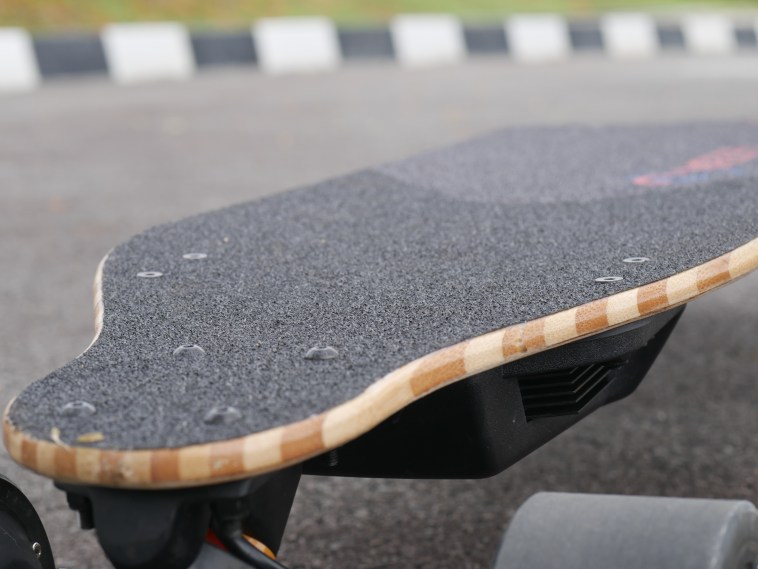
To build upon the well-loved Meepo NLS, the Meepo NLS Pro deck uses the same deck, which is a combination of three layers of bamboo and two layers of fiberglass. What Meepo adds on the new PRO, however, is a thick, shock-absorbing layer of grip tape, providing an additional layer of comfort for the rider. The added grip tape also helps to conceal the wire running along the top of the deck, which though doesn’t impact the ride, is an absolute eyesore.
With looks aside, the three speed Meepo NLS Pro doesn’t require a turbo mode for a temporary increased torque to allow the board to reach its marketed top speed of up to 32 mph(51kmh). The switch to a better Samsung 40T battery also means that NLS Pro now has an increased range of 20miles(32.2km).
Significant performance upgrades aside, the most anticipated change still has to be the switch to customized Hobbywing ESC. A less than perfect control has been the Achilles heel of the original NLS, and switching over to Hobbywing ESC will promise a perfectly smooth acceleration and braking.
It’s worth noting that NLS Pro will come with some pretty useful accessory including a free-standing skateboard rack and extra macaroons bushings (83A White, 96A Blue).
Meepo currently has the Meepo NLS Pro in stock and advertises shipping from their China base warehouse within three business days.
Expect a full performance review of the Meepo NLS Pro by us in the coming weeks.
Update: Check out our NLS Pro review by clicking here.
For the non-skater who just arrived in the eskate scene, you might feel lost in selecting and comparing decks.
An eskate deck is basically just a longboard deck (or a skateboard deck). It’s helpful to understand all the features of a longboard deck so that you know what you’re looking at.
In this guide, I will try to be as comprehensive as possible in explaining all the features of a longboard deck and how those features are implicated on an electric skateboard.
Anatomy of a deck:
When it comes to decks, there is a longboard deck and there is a shortboard deck. The typical length of a longboard deck ranges somewhere between 33″ and 60″. They are obviously longer than the traditional skateboard (27″-32″).
Wheel base
The wheelbase is the distance between your board’s inner mounting holes. This distance is what determines how far apart your front and back wheels will be. Wheelbases measurements are typically between 13″ and 15″.
The wider the wheelbase, the more stable the board will feel. However, the wider the wheelbase also means the larger the turning radius. Generally speaking, you should pick a wheelbase that is as narrow as you are comfortable with in order to maximize the turning ability.
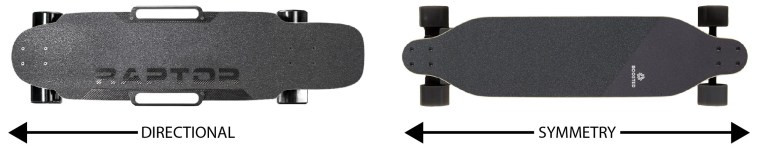
Directional vs Symmetry
In example: Raptor 2 and Boosted Stealth
Directional boards are meant to have a forward facing side (nose) and a backward facing side (tail). The deck shape will generally make it clear which way should be forward and vice versa.
Directional boards are great for downhill boarding, carving and cruising. Symmetrical boards have the same feel no matter which way the board is facing. In the longboard world it is often used in freestyle and free riding style.
Having a motor means Eskate are always directional in purpose (unless you don’t mind riding in reverse gear or riding motor mount forward) but you can of course use whatever deck you want.
Kicktail
In example: Riptide R2
When you look at a regular skateboard, you will see kick tails on both ends. Their purpose is to let you lift one end of the board off of the ground so you can hop curbs, make quick turns, tail brake and do tricks.
When it comes to longboards, directional boards can have kick tails on just one end and on symmetrical boards, kick tails on both ends. They are a necessity on many freestyle boards. They’re really handy on cruiser boards as well.
There are a few noteworthy commercial Eskate with kicktail – Enertion Raptor 2, Boosted Mini and shortboards such as Riptides and other Chinese budget shortboards.
PS: When doing a DIY build, a kicktail practically forces the motor to be front mounted (like how a Boosted does.) This limits the size of the motor you can use.
Motor in front of the wheels
Motor behind the wheels
Wheel well/ cut out
Wheel wells and cutouts are there to prevent wheel bites. (When your wheel rubs the deck and throws you off the board.). They are important in eskate as we do use wheels that are a lot bigger than a traditional longboard.
A good design cut out allows your foot to be placed as near to the truck as possible. The closer your feet are to the trucks, the more responsive the control will feel.
Concave/ Shape
Flat skateboard decks give you extra room for your feet on the board. This is ideal for doing many tricks, as well as board walking.
In Eskate, flat deck is a pretty bad idea, you will find it difficult to find your footing.
Eg: Ownboard W1S, Wowgo 2s.
Convex boards have a deck that arches upwards, which is much different than other decks. This provide riders with a more instinctive foot placement, which is ideal for skaters who love downhill riding. They are more uncommon than most other boards.
It didn’t receive much love in Eskate world though.
Eg: Original Meepo v1.
The radial shape is the most common of all the deck shapes. It has a distinct U-shape curve. The level of deepness of the curve can vary between decks. All types of skaters prefer this deck shape because its concave gives you a lot better grip. This comes in handy for all kinds of skateboarding.
The progressive shape is basically a more intense adaptation of the radial concave. With this deck, you get an even more secure feel due to the wider base and rail walls.
Flat-cave, or tub concave, is when the rails are extended and angled from the deck. Flat-cave is much like a radial board but without the subtle curvature. You may be able to feel more energy shifts, but overall tub boards make for a more easygoing ride.
W-concave is similar to regular concave in many ways. It’s main function is to help keep your feet staying put on the board. It really gives you a lot of grip. It can be described as having two side-by-side concave sections. The W-concave feature can be a bit pricey. It comes on some pretty expensive boards.
Some says W-Concave gets in the way of kick pushing. Not something we need to worry about in an Eskate! Hurray!
Eg. Meepo V2.
Asymmetrical concave raises the deck rails up at different angles, ultimately giving the rider a boost of power through the heels. This is ideal for skaters who like to make a lot of turns or who do a lot of weaving in and out.
Board Flex
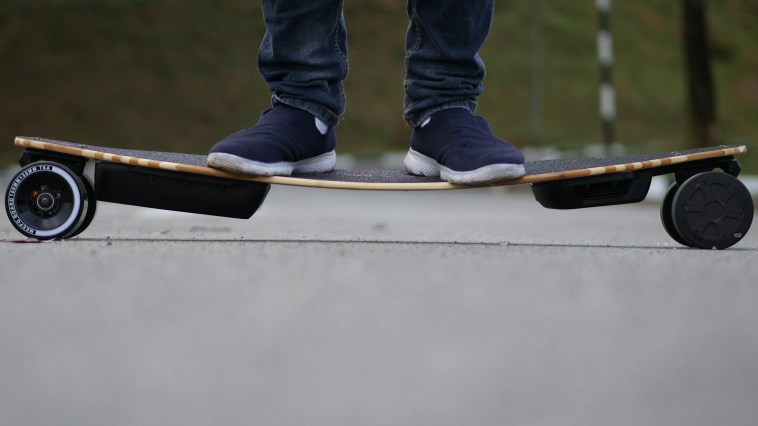
When it comes to different board flexes, there are many different levels of flex. Flex is dependent on materials used and amount of plies. While more flex means better shock absorption, it can be unstable when riding at high speed, as the deck can become like a trampoline and throw you off the board.
The Loaded Vanguard deck used by the previous gen Boosted are known for it’s flex. The recent Meepo NLS also has one of the most flexible decks.
Meepo NLS with it’s crazy flex.
Stiff decks are great at maintaining stability at the highest speeds. However, will not do well on rough pavement, however. You will feel everything.
PS: In the DIY world, flex deck adds another layer of challenge as electronics, battery and component housing aren’t flexible.
Ply
Backfire Galaxy Deck, you can practically count the ply.
The thin layers of wood that are pressed tightly together to make the longboard deck is called the ply.
Instead of utilizing one piece of solid wood, many manufacturers opt for creating a super strong board by layering the wood in a cross-grain pattern. Most boards are not over 9-ply. Typical skateboards are closer to 7-ply.
The ply number obviously affects the flex profile of a deck.
Camber-rocker
There is a curve running the length of your skateboard that determines the feel of the deck and the type of ride you get on it.
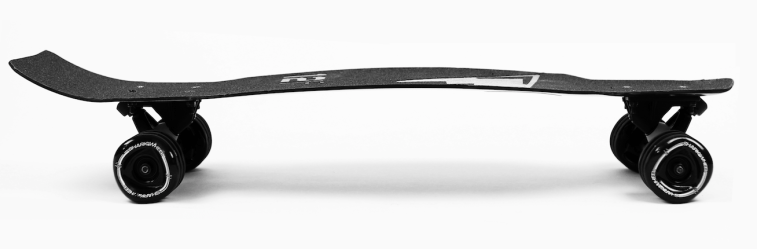
Longboard decks with a raised middle are known as camber longboards and when they have a dropped middle they are referred to as rocker longboards.
The angles are pretty subtle, but can still affect the level of flex of your deck.
While camber and flex seems to be in fashion, a rocker deck comes with some important benefit. The obvious advantage is lower ride height, giving a more stable ride.
Secondly, when accelerating and decelerating, rocker curve gives your foot something to push against, making speed changes more comfortable.
The notable eskate with rocker deck out there is the Meepo Classic, which realized all the advantages of a rocker deck and gives an addictive ride.
Meepo Classic
Mounts
The most common type of truck mounting you will find is the top-mount. Top-mounts are screwed onto the bottom of the deck to ensure that the trucks stay positioned under your feet at all times. This is the most popular mount style because it allows the perfect amount of control and leverage for a variety of skating styles.
A drop mount combines the characteristics of a top mount and a drop -though. You cannot see the truck from the top of the deck because it’s positioned into the deck instead of through the deck. With a drop mount, you will get less leverage than a top mount, but more leverage than a full drop-through.
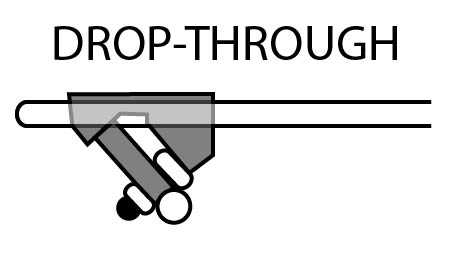
Drop-through mounts are different than a traditional top-mount because you do not screw the hardware through mounting holes in order to attach the trucks. Instead, you drop the trucks through cut-outs made in both the nose and tail and attach them on the sides. We are seeing more and more longboards and cruisers with drop-through truck mounts. This mounting style make the deck not as responsive as a traditional top-mount, but you will get more stability.
Drop deck is not a mount type, I’ve included it here as it’s best explained by the same graphic.
A dropped deck is when the deck literally drops down in the middle, which makes the nose and the tail raised. The extremity of the drop can vary between decks. Due to the low center of gravity, boards with a dropped deck get better overall control and stability.
A double drop is when drop-through truck mounting is used in conjunction with a dropped deck. It’s important to select the right sized wheel diameter to counteract how low your board is. In doing so, you will prevent rail bite, which is when your board comes into contact with and “bites” the ground. This can be a dangerous event that you should strive to avoid.
Deck Material
Of course there is a variety of choice when it comes to choosing material for the deck.
Maple Maple is a material that is commonly used in many wood working projects due to its grain pattern. This makes it a go-to choice for skateboard decks. Maple wood is known for withstanding the test of time, meaning it’s very sturdy and reliable. It can endure even the roughest skateboard riding.
Maple decks
Bamboo Bamboo is a popular material for many things due to its incredibly light weight and flexibility, which is specifically ideal for skateboards. Bamboo skateboards are a perfect choice for someone looking for a board for commuting and cruising. It’s light weight makes it a breeze to carry.
Bamboo Deck of Meepo NLS
Carbon Fiber By far the most expensive material option for a skateboard would be carbon fiber. Carbon fiber boards are often used as professional boards. They are made to help you easily maneuver around turns, as well as quickly boost you speed. To help reduce some weight, these boards are designed with a foam core.
Eg: 121C Aileron
Styles of longboard Deck
As different ride styles require a different set of features, longboard deck can be classified accordingly.
I think Tactics Board shop did a very good job walking through those deck styles, so I will just link to them here.
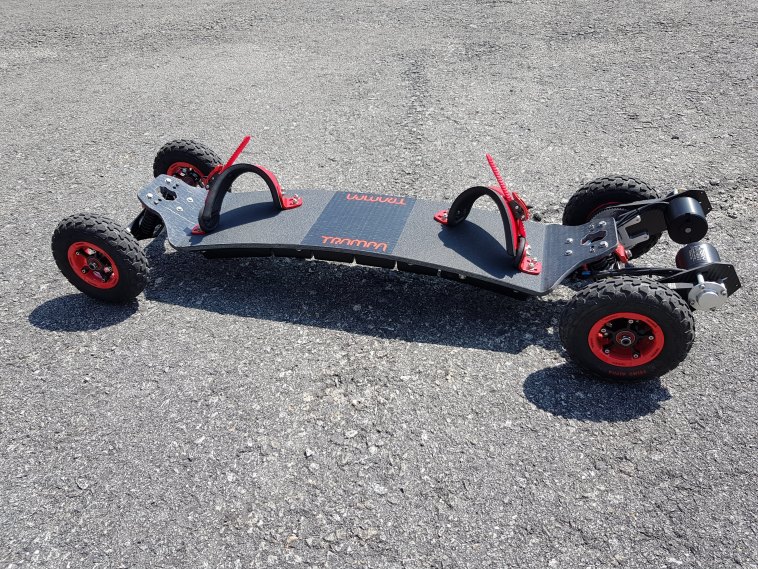
When you are going off-road, a good sturdy deck is needed.
Trampa deck is one of the most used deck for DIY off road build.
Made from re-enforced glass and plastic thermo composite, it is a strong deck that can stand up to abuse.
Some special decks
As Eskate became more popular, some decks that gear towards eskate has been made – in small scales.
Best example would be the HAYA deck, a DIY friendly integrated deck designed for builders.
It has 2 routed segment for battery array and Integrated cable routing built in. Helping the process of DIY build.
With companies like Loaded attempting to build Eskate specific deck (Motherboard is not, for now, a good attempt on that), there should eventually be a wider selection of deck which caters specifically to eskate.
I hope this helps!
For reference, here are some of the decks that are commonly used for builds and deck swap. Let me know if you think something else should be on this list!
Some of you might remember that back in 2016, a Kickstarter campaign for ‘World’s 1st Single-Dual Motor Switchable Electric Skateboard’ was launched. It’s called the Buffalo board. The project was successfully funded and delivered, but Buffalo the company fizzled out pretty soon after that.
At 2019, out of the ashes of Buffalo board, rises a new brand – The Peak. The Peakutilized some of the design left over by Buffalo board and created a new product of their own. It was as if this was Buffalo reincarnated.
You shouldn’t assume they are the same product though, even though I never get to put my hand on a Buffalo, just by reviewing the ‘literature’, I found the similarity of both these products starts and ends with the look.
The Peak Review
This the marketed specs of The Peak:
Top Speed: 25mph (40kmh)
Range: 9mil (14.5km)
Weight: 17lbs (7.75kg)
Charge Time: 4.5hrs
Features: 2 belt motors, IP64 waterproof, Regenerative braking, handles up to 30% slope.
Price: 599USD with shipping included.
Build Quality
Packaging
The Peak came double boxed and cleanly packed. Nothing fancy, nothing flamboyant, just one practical package.
Deck
The Peak uses a deck made out of 7 layers of bamboo material with two layers fiberglass. I love the defined concave that this deck have, but is disappointed that it is actually a pretty stiff deck.
I have no problem with stiff deck, but I just think that it is wasteful to have a good flexible battery configuration and battery case yet didn’t make use of it. From my research, I think the old Buffalo has a pretty flexy deck.
‘Though the deck still has some flex to it, it’s still pretty stiff.
Component Enclosures and ESC
The enclosure of The Peak is the most defining feature of the board. It is designed to allow a huge array of 18650 batteries to flex, but unfortunately, as mentioned, it didn’t take good use of that.
There is a USB port on the enclosure, in case you fancy using your 17lbs board as a power bank.
I couldn’t recognize what ESC The Peak is using, but more on its performance later.
Wheels
The Peak use 83mm 85A wheels with an abec core. They are not the most comfortable wheels, but that the advantage of a belt drive isn’t it? You can easily swap the wheels to flywheels of your fancy.
More on how the wheels impact the riding experience later.
Trucks
The Peak uses cloned Paris truck, which is my preferred version of Chinese generic truck. Outside of branded truck or Shredder truck, this cloned Paris is the best a Chinese manufacturer could pick.
It provides better maneuverability than another generic variant, and was pretty stable too.
Capability
Range
The Peak is rocking 10s2p Samsung 25R battery pack. That amounts to 5AH and 180wh.
It needs to, as the nature of using dual belt drive really eats up battery. I would expect a 5AH to go at least 11miles(18km) with dual hubs but with The Peaks dual belt set up my range test ends at 9miles (14.5km).
The board has pretty negligible sag though, it still goes up to 18.5mph(30km) at the very last few minutes. Be careful on challenging the range though, as unlike other board which you can feel the battery drying up, this one just push till it can’t accelerate anymore. And being a dual belt drive it really can’t freeroll so don’t think about kick pushing back home.
*I weigh around 165lbs (75kg) and was riding in a mostly flat area in a warm climate.
Speed
Hitting the marketed top speed 25mph/40kmh is not a problem. My top speed on the sports tracker shows exactly 25mph.
It’s not the faster board for acceleration, some belt drive does do better than that.
Torque
The Peak uses two 1200W Motor, and being a belt drive, it has no issue climbing hill.
Riding Experience:
Acceleration and Deceleration
The Peak allows you to change the acceleration and braking mode separately. Both have 3 different strength to choose from.
The control works alright, but it is definitely not the most refined control I have ever use. And it is pretty difficult to describe the flaw. I would say the flaw lies within the consistency of the control. Sometimes the acceleration comes pretty instant, sometimes it seems to have a delay. I never notice any delay with the braking though, always the acceleration, and especially when starting from a standstill.
The acceleration is definitely smooth enough, so even when the control doesn’t seem to be all that consistent, there wasn’t too much of a jolt and at no point, I am afraid of the board. It is pretty annoying though.
The smoothness of the braking largely depends on the strength setting. In the weakest mode, the braking is pretty tame, and the strongest mode, strong.
When applying the strong brake at a faster speed, sometimes the brake seems to bite and release in alternate succession, causing a few jerks before fully stopping. Again, this is not a consistent finding on every braking attempt. It’s not a big issue as you would already be bracing yourself before braking strongly, but it does take away from the experience.
Stability & Manoeuvrability
Stiff deck, low riding height with 83mm wheels makes The Peak a pretty stable board. I have no problem riding on top speed. (Or maybe just me getting better on an eskate?)
The board is pretty maneuverable, with the Paris truck clone, turning and carving are pretty comfortable. Nothing to write home about though.
Vibration
Belt drive’s had a distinct advantage over the hub wheels in the smoothness of rides as they have 2 real longboard wheel in place of 2 stiff hub motors. This advantage, however, is something The Peak didn’t take advantage of right out the box. The stock 83mm wheels are just not that good, and despite not having stiff hub motors, the board still vibrate pretty bad on rough roads.
This is made worse as the deck, as I mention, is pretty stiff.
This, I am pretty sure, can be addressed by swapping over to better quality and bigger wheels. But it is up to you to do the switch.
Remote
Argh, this is by far the worst remote I ever used.
Having a dead man trigger is thoughtful, making it stiff and at an awkward angle is not. After pressing down hard on the trigger for half an hour, I felt as if my hand is gonna cramp.
The awkward placement of the dead man trigger in relation to the throttle dial also means I am unable to reach the full throttle with one hand as I am pushing down on the dead man trigger.
Remember I mention about the board not being consistent in control? Part of me wonders if that is due to the dead man trigger not engaged properly. I have no way of testing that, pretty frustrating situation.
The remote has telemetry on it, telling you the speed and allowing you to change speed modes. It has a calibration setting for it but I have no idea what it does. I played around with it and nothing happened. Can’t find any instruction on the manual either.
In short, this is a bad remote design. It’s usable, but just… uncomfortable.
Customer Service
The Peak is pretty new to the scene and pretty unknown even to me even after some research. They offer a 3-month repair warranty and they do not entertain a refund.
They promise to provide customer service over email, or you can reach them via Facebook. If you purchase it via online retailer EskateboardPark, they too will offer their after-sale service.
Verdict
When I see The Peak, I see a board with a lot of wasted potentials. It didn’t use a flex deck to take advantage of its battery and enclosure set up; it also didn’t use good quality wheels to take advantage of the belt drive system.
The flaws in control and remote is not deal breaker, but pretty annoying.
All in all, the board from top to bottom, are pretty average.
It is a good base for DIY though, imagine what you can do with the flexible enclosure and battery packs. hmmm.
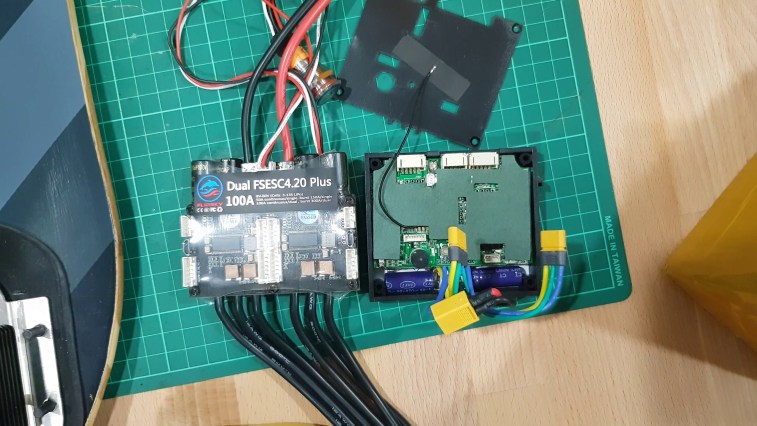
In my Meepo NLS review, I mentioned that I have installed Flipsky FSESC Dual 4.20 plus into my NLS and it has completely unleashed the potential of the board.
Besides improving the smoothness of the acceleration and braking (they are both now perfectly smooth), Flipsky ESC also unleashed a stronger torque and hence faster acceleration.
Flipsky powered NLS now dusts Backfire G2T in a drag race. It’s not even a contest.
Drag Race: Flipsky powered NLS VS Turbo G2T
I’ve received a lot of message on how to install Flipsky into NLS. Though most are just asking about the settings, I decided to write the full tutorial for those who never installed a VESC prior to this. For those who are just looking for the VESC-tool settings that I used, just skip to the end of the post.
If you are not a fan of reading and want to see a 7 minutes silent video of the actual footage on how we install this, you’re in luck! Click the link below.
WARNING: Changing the ESC should void the manufacturer warranty as it pushes your board to a limit not intended by the manufacturer and may fry your parts. Do this at your own risk.
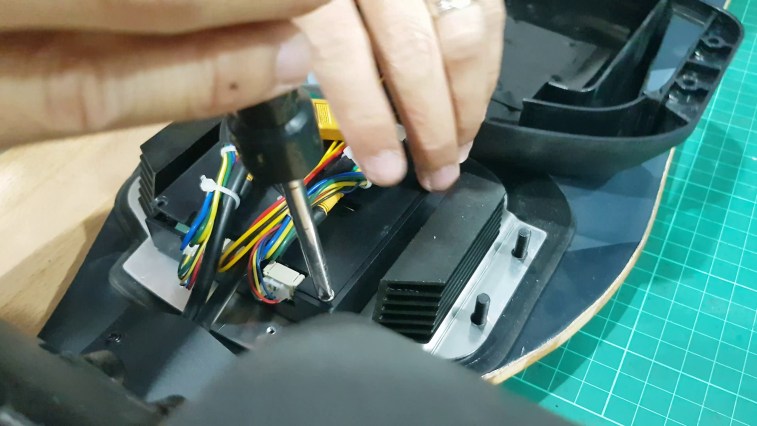
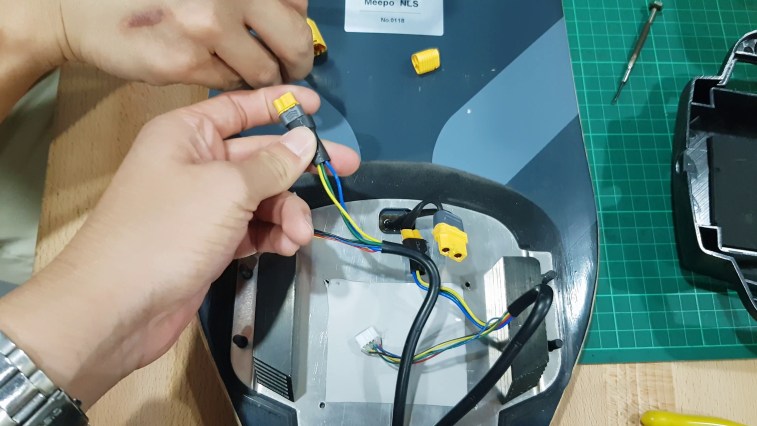
Remove whatever screws is in your way and remove the stock ESC.
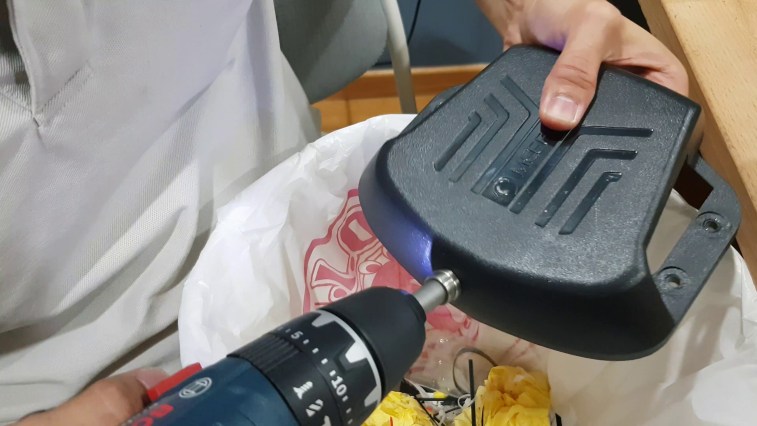
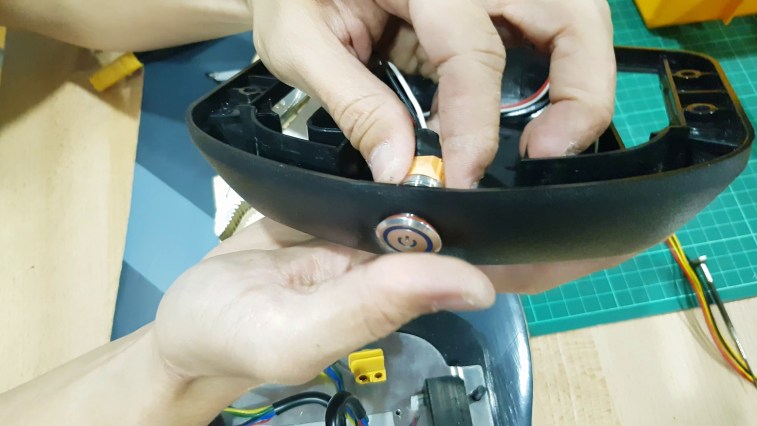
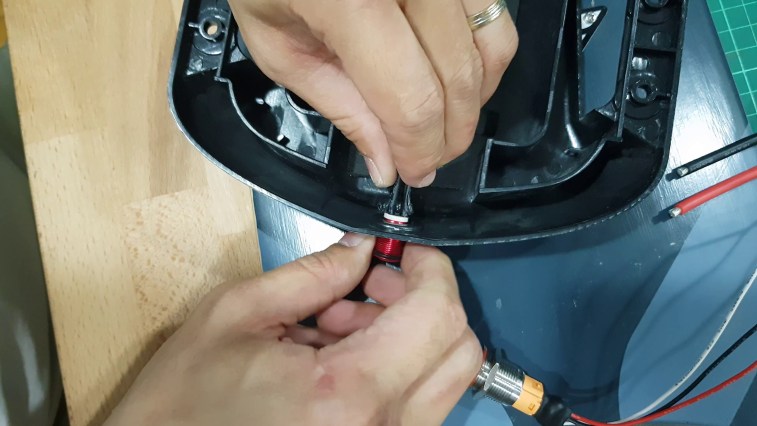
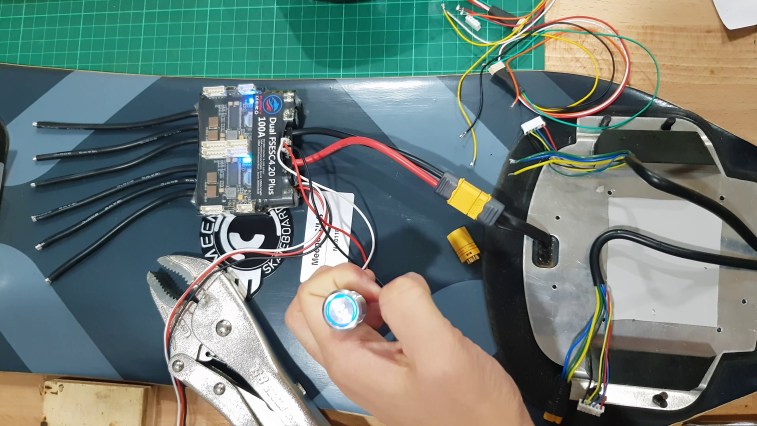
2. Installing the power button
Flipsky power switch is bigger than NLS’s, and the stock power button can’t be plugged into Flipsky ESC.
We drill a bigger hole for the Flipsky power switch.
3. Installing the hall sensor wires
NLS hall sensor doesn’t have a TMP wire
Flipsky FSESC receives a 6 pin connector for motor sensor while NLS hub motors use sensor connector with 5 pin head as it doesn’t have the temperature sensor.
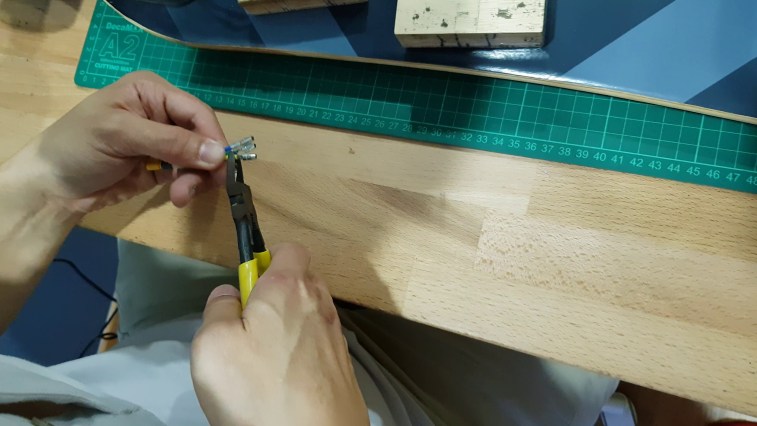
We will have to convert the NLS hub sensor wires to a 6 pin sensor connector. As we don’t have an unused 6 pin sensor head lying around, we harvested the one that comes with Flipsky.
We have to change the connector from left(5pin), to the right(6pin)
4. Installing the power cable
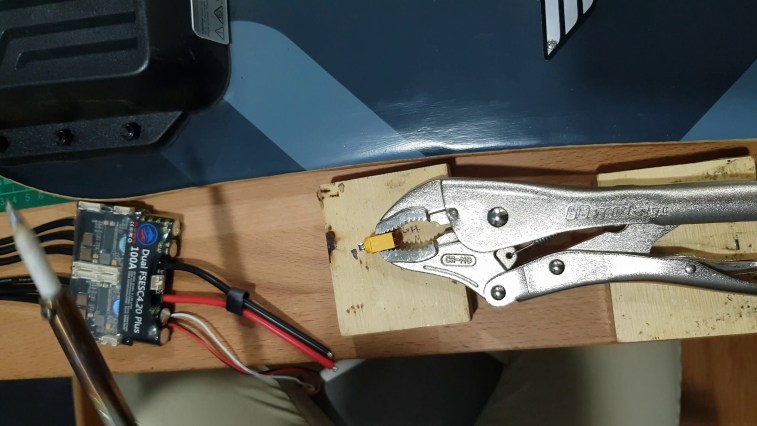
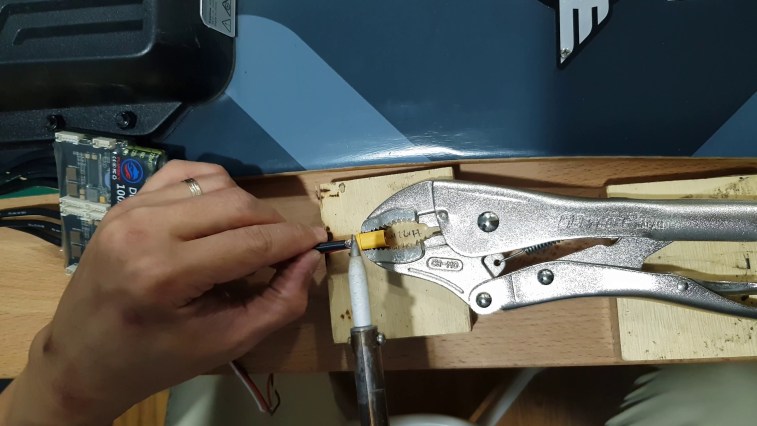
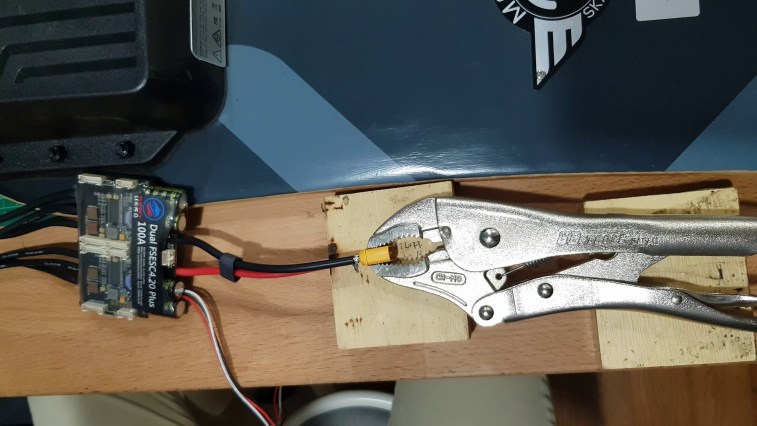
After ascertaining the poles of the power battery power cable, we solder the XT60 (Male) connector to the power cable from VESC.
5. Connecting the motor wires
NLS hubs use MR30 connectors. You will have a lot of option to connect it to Flipsky ESC, including cutting the MR30 connector and solders the wires directly.
NLS motor use MR30 connector
We choose to put MR30 connector on to the Flipsky ESC because it will allow us to swap back to the stock ESC easily (and make comparison test easier)
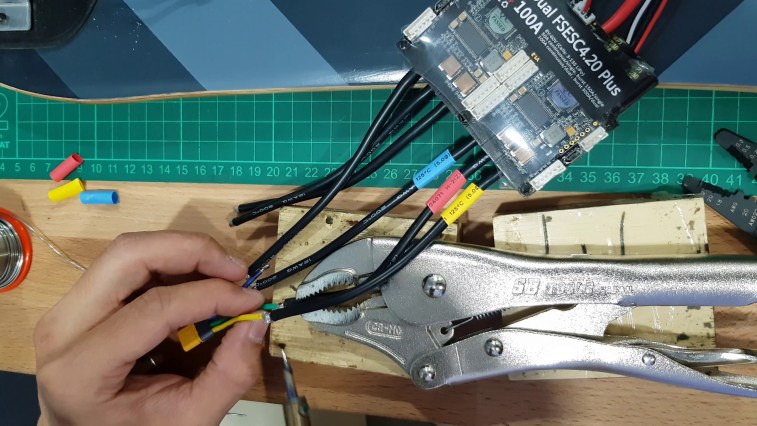
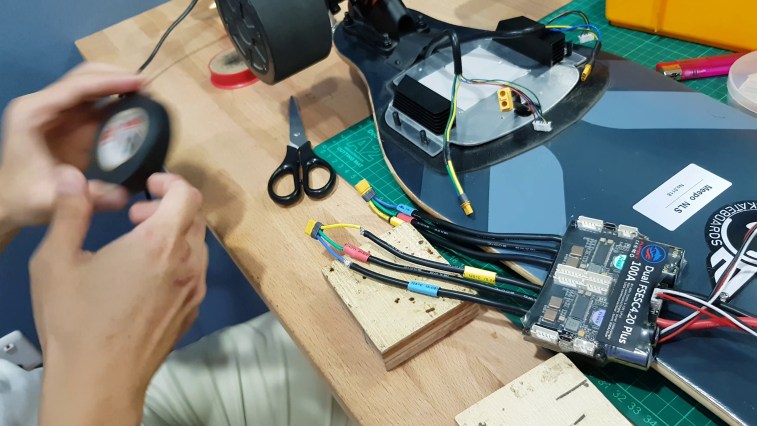
We solder the motor wires in this arrangement: From left to right, it should be Blue, Green, Yellow, then Yellow, Green, Blue. Of course, place a shrink tube in to seal the connection when the solder was done.
we cut the bullet connector
and solder wire to wire
This is the arrangement. Blue Green Yellow, Yellow Green Blue.
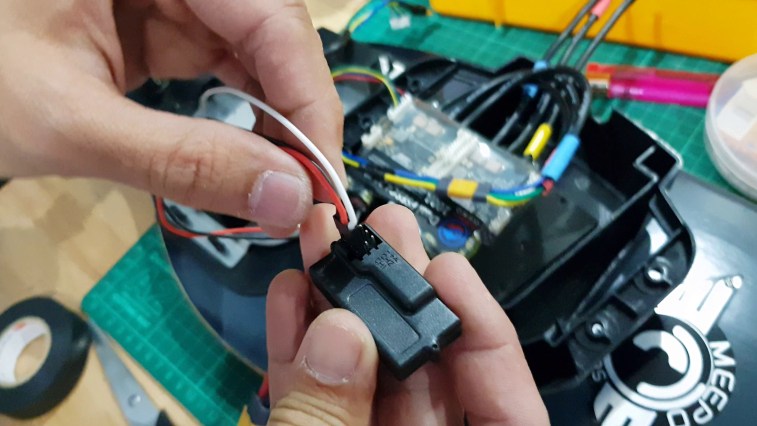
6a. Connecting the receiver (For Nano Remote)
This is pretty straight forward, connect the receiver to the VESC. You should plug into Channel 1.
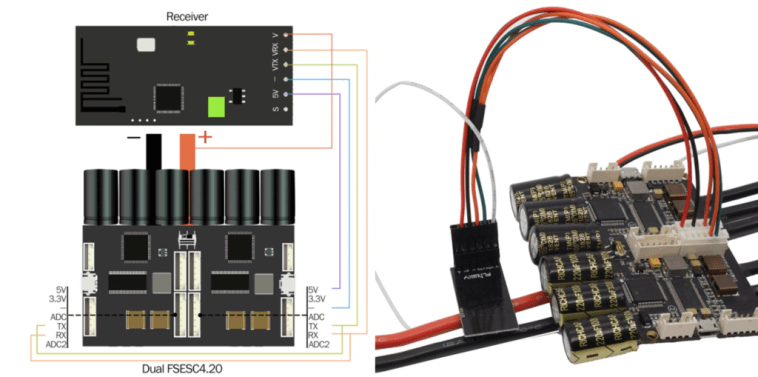
6b. Connecting the receiver (For VX1 remote)
Plug everything according to your ESC version. You can refer to a photo from Flipsky’s website.
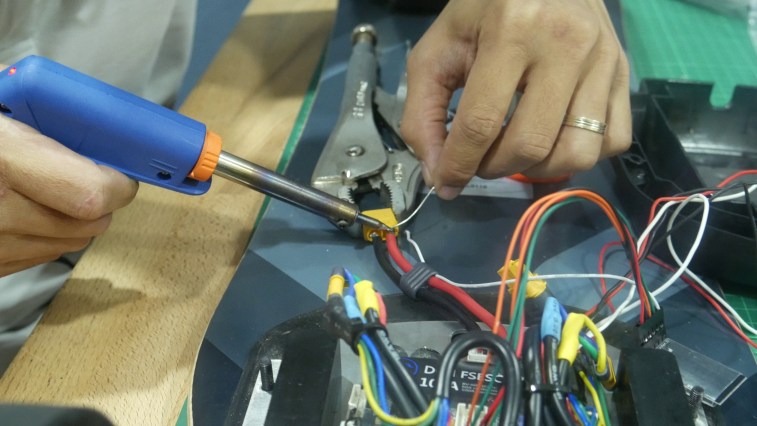
Solder the white wire to the red power cable.
7. VESC setting
Connect your Flipsky ESC to a Window PC via a USB cable. Run VESC-tools and update into the correct firmware version.
7a) Input setup Wizard.
Run the input setup Wizard to configure your remote. (VX1 remote doesn’t need you to do this)
7b) Input setup Wizard.
Run Motor Setting Wizard.
Motor Type: FOC Motor Current Max: 40A Motor Current Max Brake: -30A Battery Current Max: 30A Battery Current Max Regen: -10A
Battery Cutoff Calculator: Cells: 10 Hit Apply. Next.
It was over a year ago when I wrote about my findings after diving deep into the realm of Chinese Electric Skateboards. A lot has changed since then, and yet a lot also remains the same.
In 2019, anyone who is looking for a sub $500 entry level electric skateboard will find that segment of the market being dominated by new Chinese brands which provide the best value to money preposition.
Just to prove my point, try naming to me an electric skateboard under $500 that’s not made from a Chinese company.
… Acton Blink S?
Okay fine, maybe one. But Acton Blink S is just another Chinese manufactured product behind an American logo that has customer service that isn’t significantly better than that of established Chinese brands.
But where should you look? There are so many of them on the market. Anyone who is not already in the loop might find trouble separating the rubbish from the legit and the gem.
Lots of options for example, on Aliexpress.
Inclusion Criteria and Method
It’s a long process trying to get a grip on this market. I’ve reached out to all of the more reputable players in this market to request review units.
The criteria to be included is quite simple:
Is an electric longboard
Priced under $500
Can be trusted in Post-sales services
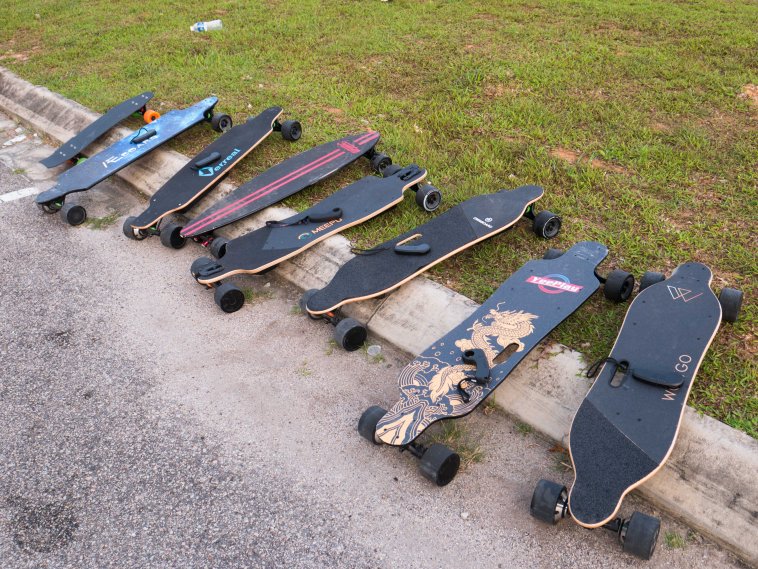
The brands that look to fulfil that criteria are:
Meepo Classic
Backfire G2 2019
Wowgo 2s
Ownboard W1s
Verreal F1
Teamgee H5, H6 and H9 (often under $500 after discount)
Yeeplay M2S, H2B
AEBoard AE1
Teemo boards
Jackzoom
Panther x3s
Harvoo
Notable exclusions of this criteria:
Backfire G2 (Because it has been discontinued, and the G2s and G2T are above the cut off price) (Andddd it’s back!)
Koowheels (Although I don’t have a high opinion of the Koowheels, but the reason of exclusion is the cut off price)
I-Wonder – More of a manufacturer, I am unsure of it’s 1 to 1 post-sales service quality.
Winboard’s- Big OEM manufacturer attempted to get into retail. Their retail line-ups are all priced above the cut-off $500 price tag.
Maxfinds – not a brand that’s known for quality. Performance is pretty lacking.
How did it go? Well, most of the included brands agreed to have their boards reviewed.
Teemo stopped replying to emails after a few to and fro, which is fair.
Jackzoom, Panther x3s and Harvoo never replied to my initial and the follow-up ‘hellos’. I think it’s pretty safe to say that if they don’t even bother to reply to a blogger, they won’t reply to regular customers – and hence failed criteria number 3.
So here is the summary of the selection:
Before we began
It is helpful to recognize that most of the Chinese vendors at this segment are aggregators who assembles parts available in the market to build their own product.
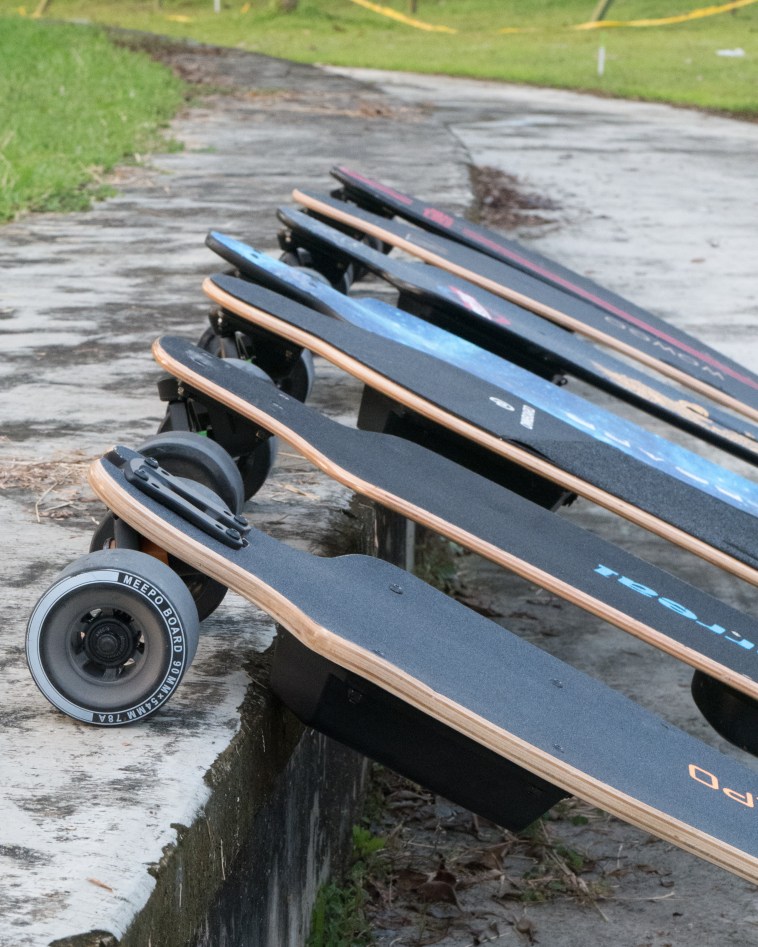
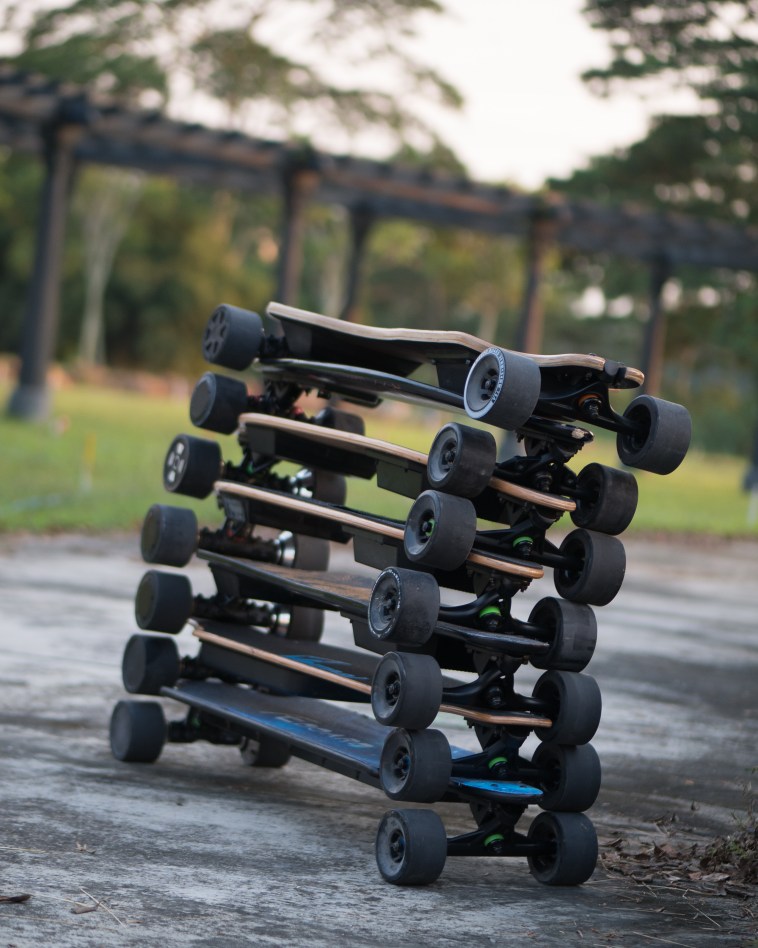
This results in many of these boards riding or even looking very similar.
This is not any more obvious and impactful than the choice of ESC. As this directly effects how the board controls.
At this point in time, all the boards in this list use one of these two: ESC -‘LingYi’ ESC or Hobbywing ESC.
LingYi ESC vs Hobbywing ESC
LiYing ESC
Hobbywing ESC
LingYi ESC has the biggest market share at this point in time.
A lot of big manufacturers will have LingYi in its ESC, tuned and tinkered to their liking of course.
Generally speaking, the profile of the LingYi ESC is a harsher acceleration and stronger braking. But it is very difficult to assume a boards behavior just by knowing it’s using the LingYi ESC, as brands do tinker it to suit their idea of good speed control. In doing so, this will change them quite a bit.
Eg, Winboards introduces an aggressive speed ramp in the control, making it less difficult for absolute beginners, but may frustrate those who like a precise control. Meepo use of LingYi is mainly to maximise on the acceleration and braking, in order to make a more aggressive and thrilling ride.
For the last year, many brands have moved away from LingYi ESC to the HobbyWing ESC.
The notable brands that use a variation of LingYi ESC currently are: Meepo NLS, Yeeplay M2s, Original Backfire G2, Winboard, Teamgee.
Some will tell you the rise of HobbyWing ESC is the best thing that has happened to budget electric skateboards.
HobbyWing ESC saw its first international debut when Wowgo 2s started using it. (Or did Ownboard do it first? Man… these things are hard to keep track of.)
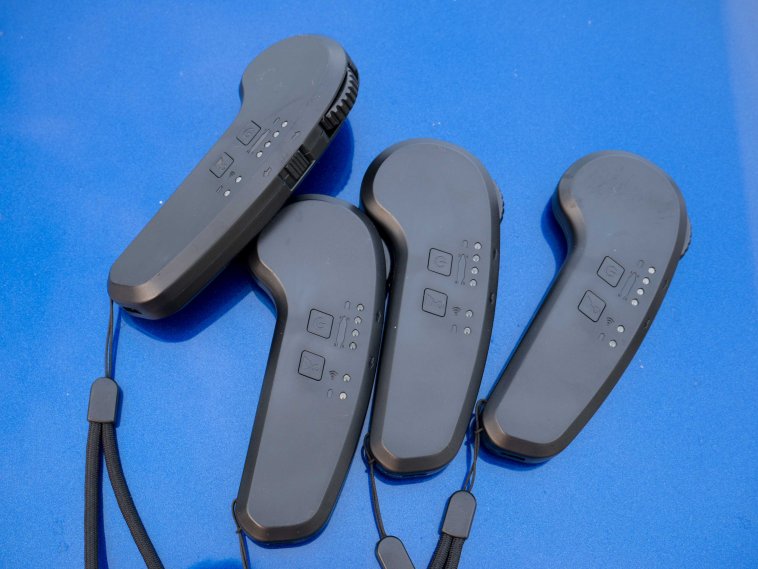
If a board uses this remote… then you know you have Hobbywing ESC.
Hobbywing ESC gains a quick popularity for its amazing performance. It’s smooth in both acceleration and braking, the control is precise, there are no latency issues and the control behavior is consistent throughout different speeds.
Some say it is even better than the Boosted board… that’s how good it is.
Some companies tune the Hobbywing ESC to get the most out of their board, but we generally can expect similar behavior on the Hobbywing ESC.
The notable brands that use a variation of Hobbywing ESC currently are – Meepo Classic, Backfire G2s, Wowgo, Ownboard, Verreal, AEBoards and higher end stuff like Exway X1 are using a custom version of it too.
But I digress, now the boards.
I’ve reviewed most of the boards. Now this will be the summarized thoughts about them and how well they fare against each other.
If you would like to learn more about them, there are always the in-depth full reviews that I’ve published.
Obviously the newer stuff is going to fare better than a dated product.
For those who don’t know, Meepo is the current leading budget brand that pioneered the Chinese budget board movement. Since its debut in 2017, MeepoBoard is now a mature brand that has refined its product. Their customer service, though not award winning, is reasonably good and serviceable.
Meepo Classic just came out in early 2019, it aims to replace the last gen Meepo V2, and it’s my favorite budget electric skateboard right now.
I think Meepo picked all the right parts when putting together the Meepo Classic.
This slideshow requires JavaScript.
I especially love the gorgeous double-drop deck which allows a very comfortable, stable low ride. Meepo’s shredder truck provides a good balance between maneuvrebility and stability and is another strong point for the board too.
With all of that said, the best move the Classic made undoubtedly is the switch to HobbyWing ESC. Though some people will miss the aggressive ride of the old LingYi ESC, most people will find a relaxing, smooth ride of HobbyWing ESC. This is a welcoming change – especially for beginners who are looking for their first board.
While I was working on this post, Backfire updated the Backfire G2.
While I never tried the newer version of the G2, I do have the G2T and the original G2. And I would say the updated Backfire G2 2019 is probably one of the best budget board money can buy.
Compare to most budget boards, the new Backfire G2 has the advantage of having bigger 5AH battery, and much better polish. The deck Backfire uses, in my opinion, are inferior to Meepo V2/ Meepo Classics but much better than the flat deck that Wowgo 2S and Ownboard W1S uses.
It also uses the Hobbywing which promises smooth acceleration and braking. Sadly, unlike its pricier siblings, G2 won’t come with the caliber trucks.
Smaller 83mm wheels might be a deal-breaker for those who have to dealt with poor and bumpy road. Although you can technically put on the bigger 96mm hub sleeve on G2’s hubs, the width of its truck wasn’t long enough and you will risk wheel bites. You can solve that by swapping in the longer Caliber II trucks, but at that point, you would be better off by paying extra 200$ and go for the G2T.
Verreal is one of the newer brands that tried to mimic the success of MeepoBoard, and it is doing quite well at that.
Verreal has a good track record in customer service and continue to offergood price to value.
Its latest product and current flagship, Verreal F1, is one of the better takes on a budget board.
Its use of a micro-drop deck and Hobbywing ESC results in a very responsive, agile, and zippy ride. It’s a lot of people’s favorite budget board and after putting it through the paces myself, it’s easy to understand why.
The low-light of the Verreal F1 is that the board’s polish and finishing is still leaving a lot to be desired. F1 also does cheap out a little bit on small parts, such as the bearings.
Though in exchange, the board usually is asking a bit less… especially after discounts as compared to other boards on the list!
As an OEM manufacturer that joined the retail game, Ownboard has a huge advantage right from the get go.
Almost from the get go, Ownboard built with higher quality parts and used good polish. Its customer service is generally considered good.
Ownboard W1S is one of the better iterations of the ‘typical’ budget board. It uses Hobbywing ESC which allows great control and it uses Paris-cloned trucks that offer great maneuverability. Ceramic bearings and its special foam-padded ‘EVA grip tape’ are the other highlights of the board.
This slideshow requires JavaScript.
The only weak point of this board would probably be the flat deck. The 6 ply maple +2 ply bamboo deck offer a fair amount of flex, but a little bit of concave would make it a lot better.
What makes Ownboard W1S a good deal is the option to go with 6AH Samsung 30Q battery – for just US$457.00. If by any chance a flat deck is what you are looking for (wut?), or you are going to deck swap any time down the line, Ownboard W1s is a very good choice.
Wowgo is the first competitor of Meepo and made Chinese budget brands a thing.
It has successfully shook the earlier image of a scrappy brand with weird taste in marketing and established itself as a major player in the budget board segment.
Product quality, polish and customer service of Wowgo are all good now.
The Wowgo 2S is especially significant, being the product that elevated the budget segment to another level. Being the first to make the Hobbywing ESC famous, Wowgo 2s was dubbed the Boosted killer for its comfortable control that rivals the top brands.
Today, it is still among the best budget boards on the market. But unfortunately, one-upped by its doppleganger Ownboard W1s that uses slightly better parts in the deck, bearings and trucks.
The differences are not all that significant and Wowgo 2S is still a good choice if you can get it at a better price.
Yeeplay M2S is another new brand coming out from the same mold of Meepo, Wowgo andOwnboard. Heck, even its products look like it came out of the same mold as the original Meepo, Wowgo and Ownboards.
The company is still very young, and there is still much speculation as to how it will handle post-sale service. The good thing is – there aren’t any complaints heard about this brand so far – and as usual, the earlier customers would usually be treated royally.
Yeeplay M2S itself is a valid option of a budget board. It uses one of the broader decks with good concave, making it a very comfortable ride. The use of Paris-cloned trucks allow the board to be maneuvreble and turny.
This slideshow requires JavaScript.
However it opted for ‘LiYing’ ESC, which has a more aggressive control. This caters better to specific crowds, but beginners are unlikely to favor it much. And hence making other boards on this list better alternatives.
Yeeplay recently released a belt drive ‘H2B’, which could be the only option for someone looking for a budget belt drive board.
I did not review the board, but performance could be postulated through the part used. LiYing ESC promised a more aggressive acceleration and braking. Using the same deck as Ownboard W1S means enough flex, but too bad no concave.
If you are planning to buy a Yeeplay, perhaps you are digging that exotic grip tape. Just be informed that the priced listed on the website at this point in time is not inclusive of a delivery fee.
AEBoard made a splash entry in to the market with boards that offer a lot of batteries for the price that it’s asking.
As it is the case for Yeeplay, AEBoard too is very new to the scene. No precedent can be known on how they handle customer complaints. Recently, however, I was able to help an unhappy customer get his purchase refunded, so I at least know my readers will be taken care of.
AEBoard AE1
The AE1 basically tries to offer as much value as possible while asking for as little as possible. The biggest ‘Wow’ factor here is the use of 10s3p battery while only asking for the entry level $430.
This slideshow requires JavaScript.
The use of broad micro-drop deck with good concave – plus the use of Hobbywing ESC – makes AE1 a very comfortable ride.
The base level 10s3p 20R Samsung battery is less impressive as initially assumed though. Basically, it’s performance is only equal to the $457 Ownboard W1S with a 10S2p Samsung 30Q battery – same performance with the extra weight of 10 batteries.
However, the biggest downside of all would definitely be the stiffness of the deck reinforced by the board length aluminium enclosure below the deck. It has zero gives. You know you are stepping on steel immediately as you step onto the board. This result in god-awful vibration when riding on a less than perfect road.
And, being a new company, the packaging and finishing of AEBoard is pretty raw.
All in all, AE1 has the most amount of battery to for the price it’s asking and is definitely a good base for future DIY tinkering. For someone who doesn’t mind extra-steel-like-stiff deck (it’s REALLY STIFF), and is looking for range, AE1 should be the board to check out. You can even upgrade the battery to a Panasonic 9.6AH battery for 25mile (40km) range (or Sanyo for even more range.)
While I was working on this piece, AEBoard launched a few new boards which is creatively named AE2 and AF. (Chinese market move so fast, I can barely catch up).
While AE2 seems to be a Wowgo 2S/ Ownboard W1S clone, AF is worth paying attention to as it has some very practical features
AE2, tell me if it doesn’t look like Wowgo 2s or Ownboard W1S
AEBoard AF
While I have not personally reviewed AF, I certain would suggest anyone looking for a budget board to consider it.
Reason? While most of the parts used in AF are old news, it is the only budget board in this list that allows hot swappable battery. On top of that, the battery that it’s carrying has the standard 4AH, 144wh capacity.
The advantage of hot swappable battery over bigger battery pack is, obviously, is the weight – You don’t need to carry the batteries that you don’t plan to use.
Hot swappable battery
Plus, this definitely solves the ultra-super-stiff deck complaints that I have on the AE1. Basically, I think of it as Wowgo 2s with concave deck plus hot-swappable battery. AF is definitely worth considering over AE2, Wowgo 2s, and the W1s.
Similar to Ownboard, Teamgee is another manufacturer turned retailer.
Just like the Ownboard, Teamgee maintains a certain standard in their products and customers care since day 1. That said, Teamgee is still young in the international scene and though there has been no bad news about the customer service so far, we are yet to see how well its’ post-sale service stands when some serious complaint comes in.
Unlike Ownboard however, Teamgee is not a follower of the generic Chinese budget board trend. It has a slim body design that hides all of the electronics inside the decks.
As a result, the board looks very much like a regular long board to non-prying eyes.
This slideshow requires JavaScript.
To cater to beginners, Teamgee also introduced heavy filtering to control input. This is done to soften the speed changes, however it also causes a noticeable delay between control input and the boards reactions.
This is done to cater to beginner crowd, who might find precise or zappy control intimidating. Many people will, however, be frustrated with the lag and the weaker acceleration.
Both the H5 and H6 are beautifully designed and give a reasonably good skating experience. H6 with the pintail deck has a very surfy feel and H5 with the broad dropdown deck has a stable ride.
Just be informed that stiff deck, relatively weak performance and voltage sags are what you have to be able to put up with when dropping $500 on these boards.
Even after trying the boards back to back to back, it is sometimes hard to tell the differences between two boards.
As a reviewer, my recommendations are based on the average taste of an average eskater but as any other personal purchase, personal preference often trumps everything else.
Hopefully with all of the information provided here, and the vetting done to screen out questionable brands, this can help you with your purchasing decision.
For those who are from a European country, you can choose to shop from a local dealer – Speedio. Speedio is an Electric Skateboard re-seller based in the Czech Republic. While you do pay a little premium, they offer a 2-year warranty, local support, and fast 2-5 days shipping.